
By Tommy Airey, an unabridged end-of-the-year review
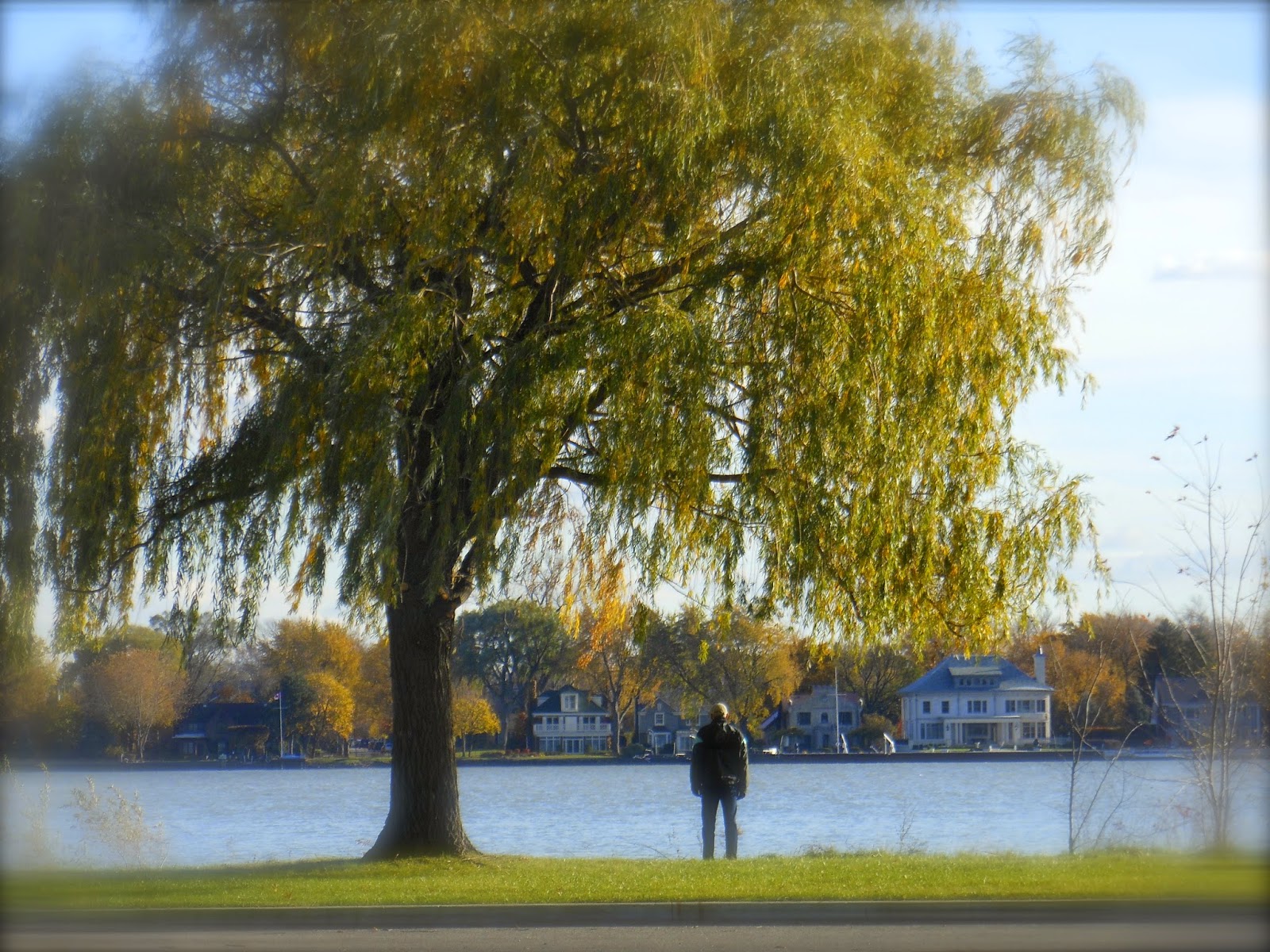
On Easter Sunday this year, I made my way out to the sacred place Native people call Wahnabeezee. It’s a 962-acre island in the middle of the Detroit River. I walked over to the willow tree. Right where I snapped a photo of my dad on his final Father’s Day in 2015. He was standing under the long yellow stems that the original stewards of this land used to weave baskets. Dad was looking across the water to Canada. Where enslaved Africans were once ferried to freedom. The last stop of the underground railroad.
On that clear blue Easter morning, I sprinkled some of my dad’s ashes. On the base of the trunk where the lichen was growing. Willow sounds like wallow. The basket tree held my sorrow. Crucifixion came six months later. Samhain summoned me back to my dad’s ashes. When I pulled up, I could not find the willow. It was gone. Not even the trunk. Totally uprooted. The only traces were a few long stems she left behind.
I thought to myself. We truly are living in The Age of the Uprooted. Palestine was heavy on my heart. An oppressed people enduring occupation, apartheid, genocide. For the past seventy-five years. Totally uprooted. I was also thinking about my neighbors. Over the past fifteen years, more than one-third of the entire population of Detroit has been forced to foreclose on their homes. Totally uprooted. Almost all of them Black. Rev. Roslyn Bouier runs a local food pantry. She recently told me that many of these residents now live out of their vehicles. A significant population of women and children sleeping in parked cars.
The uprooting does not just happen. The uprooted are not just collateral damage either. Certain communities are targeted. Detroit had the money to help its long-time, low-income residents. But instead, its corporate-sponsored leaders (all of them Democrats) have spent a half billion on “blight removal” and have given hundreds of millions in subsidies to wealthy white developers. What’s even worse, Detroit overcharged its poorest residents for their property taxes. They filled their austerity budget gaps on the backs of those Jesus called “the least of these.”
The people of Gaza are being carpet-bombed. The Democratic President and most reps in Congress have fully supported it – in the name of defending “the only democracy in the Middle East.” These leaders keep all the focus on Hamas and human shields and hostages and those who supposedly hate Jews in the halls of college campuses. It takes an enormous amount of discipline to stay on that script while tens of thousands of innocent Palestinian civilians are being murdered by AI technology called “the Gospel.” It is engineered to locate one Hamas fighter – and obliterate the entire neighborhood he lives in.
***
In the wake of the chainsaw massacre on Wahnabeezee, I was reminded that the people Indigenous to the land I live on were uprooted in a settler-colonial story too. The Potawatomie were forcibly removed from the region by local white militias commissioned by the U.S. government. A counterfeit of the Moses story. An exodus of 800 Native people held at gunpoint. Sixty days on foot, in the Fall chill, a trail of tears through the wilderness, all the way to a promised land where other Indigenous people already lived. For thousands of years.
My ancestors were uprooted too. But fate flipped the script for them. Targeted for land and protection, they came west from Wales, England, Ireland and Germany to places like Pennsylvania, Ohio, Michigan, Illinois, Wisconsin to “frontier” farmland in South Dakota and Central Washington to the suburban dream of Seattle, L.A. and Orange County. They got to move towards something materially better. Because now they were “white.”
Adding insult to injury, in the Age of the Uprooted, the moderate position is trending. It boasts of seeing “both sides” of every controversial issue – and it’s always complicated. So moderates stay civil, nice, neutral, realistic and reasonable. People who have a materially advantaged ancestry are magnetically attracted to this palatable perspective that makes polarization enemy number one. Its centripetal force is stronger than the riptide that pulled me and nephew Riley out into the Pacific on my 50th birthday in September. The moderate position is about safety, security and control. Moderates become the moderators of everything. They control a narrative that says extreme convictions are killing us. But when they say “us,” they just mean them. White folks and middle-class Americans.
The moderate position is almost always marked by a blend of despair, denial, indifference, cynicism and/or apathy. The moderate position is spiritual madness. Because it seeks to escape what Rev. Dr. Martin Luther King called “the inescapable network of mutuality.” The moderate position engages the world as if our souls were not caught in a web of connectivity with every living being. From his jail cell in Birmingham, King wrote a long letter to the white moderates – Christian and Jewish leaders – who called him an extremist. King proclaimed that a just world is not inevitable. It will only come if people commit to a kind of creative extremism curated by agape love.
The problem with the moderate position is that it does nothing to stop the uprooting. The moderate position is terrible news for the material lives of Black folks, Indigenous people like the Potawatomie and Palestinians, and refugees uprooted from countries colonized by Western powers. But it’s even worse. The moderate position is terrible news for the spiritual lives of its sponsors – those materially advantaged by the uprooting. Because it is designed to sustain a path of “success” soaked through with sensory overload and constant stress. School, college, career, mortgage, marriage, kids, activities, vacations and retirement – with all sorts of brand-building, virtue-signaling, family expectations and social obligations thrown in.
The things we are supposed to do crowd out the things that matter most:
Simple pleasures. Prayer and meditation. Unhindered time with the more-than-human world. Creative endeavors. Deep and meaningful conversations. Nourishing meals with people we love. Metabolizing grief and beauty with beloveds. Affirming one another. Awakening to harsh realities on the other side of the tracks. Advocating for policies that actually work for everyone.
The things we are supposed to do place an overwhelming burden on our souls. This burden is super symptomatic. Our culture is experiencing unprecedented levels of addiction, abuse, anxiety, depression and violence. Because our souls are being uprooted.
There is another option for people of faith and conscience resisting right-wing extremism. Our uprooting reality can radicalize us in a totally different direction. The word radical sounds scary to most of us who have been materially advantaged by the uprooting for the past few generations. Radical literally means “getting back to the roots.” I see the radical position as a commitment to addressing the roots of our personal and political crises. When we dig deeper, below the surface of our symptoms, we discover that our material and spiritual suffering are rooted in unmetabolized grief and trauma weaponized by destructive supremacy stories passed down through the generations.
I am talking about white supremacy, settler-colonialism, Western Christianity, capitalism, American exceptionalism, Zionism and hetero-patriarchy. While masses of moderates distance themselves from this “woke” diagnosis, these counterfeit ideologies go on scripting us to hide all our hurt behind the façade of being better than others. These counterfeit ideologies build a border wall between our soul and the inescapable network of mutuality. My partner Lindsay, a licensed marriage and family therapist, says that this epidemic of addiction, abuse, anxiety, depression and violence is just the counterfeit coming out sideways.
***
In a world that is uprooted by supremacy stories, there is Something Else working below the surface of everything, incognito, in the dark, (re)connecting us to the roots of our humanity. It is seeded by depth, meaning, intimacy, vulnerability and accountability. I believe that this greater power pivots on what Dr. King called a radical revolution of values. A love supreme. The long arc of justice. A compassionate groan. The inconvenient truth. A whole-hearted humility.
Here’s the catch. Radicals are the heroes of the past, but they are always unpopular in the present. When your whole life is scripted by Something Else, your social network gives you the side-eye. Harriet Tubman lived for Something Else. She took nineteen trips down south to free enslaved Africans – and a lot of folks thought she’d lost her mind. Dr. King lived for Something Else. He went to jail nineteen times to break the stranglehold of segregation – and he was demonized and dismissed and then shot to death. Dietrich Bonhoeffer lived for Something Else. He spent nineteen months secretly traveling to villages in Nazi East Germany, conducting an underground seminary for those resisting Christo-Fascism – and he arrested and then executed in a concentration camp.
It is very hard to cultivate a radical revolution of values when the liberal institutions that organize our lives – like mainstream media outlets, non-profits, church denominations and the Democratic party – incessantly promote the moderate position. My friend Wilson Dickinson calls these “zombie institutions.” They don’t really serve the living and they eat up all our time. Most white folks and middle-class people spend significant portions of our time working, living and breathing in these spaces. The radical’s presence can be redemptive. But I believe we need a more robust anthropology. Because zombie institutions are the ultimate protectors of the status quo.
The radical path is paved through wilderness spaces where we can experience Something Else. Grace Lee Boggs, a radical who lived most of her life on Detroit’s eastside, used to say this:
We can transform the world if we transform ourselves – and we can transform ourselves if we transform the world.
Grace Lee Boggs believed that this two-sided transformation is rooted in millions of diverse and scattered partnerships and groups, most of them small and barely visible. These radical incubators can cultivate in us the kind of moral courage we need in order to openly break rank with supremacy stories and create new ways of being and living. When two or three are gathered in the name of love, justice, compassion, truth and humility, Something Else is present and working towards transformation.
I do think that social media posts, protests on the street and bigger conferences have the power to shift some things in us and in the world. They certainly have for me. However, I believe that the real spiritual and emotional and political work happens when we intentionally re-root ourselves in relationships with confidants and comrades that are deep, meaningful, messy, intimate, inspirational, confessional and accountable.
I also believe that moving from the moderate position to a radical revolution of values does not happen overnight. We cannot just flip a switch and convert to radical ways right now all by ourselves. I only know what I’ve seen and heard – and experienced. This process of radical be(com)ing is long, intentional and never done alone. In 2023, I’ve been reminded over and over and over again of this inconvenient truth – and I’ve been blessed to be around many models of what radical be(com)ing looks like. They have amplified hope for me during this hard year.
***
I’ve been blessed to have confidants and comrades who dared to share vulnerably with me over meals and happy hours, on the trail and in the water, in zoom and phone calls, on retreats and post-evangelical recovery sessions, in text and email exchanges, in couples check-ins and lectio divina sharing circles.
I’ve been blessed to have a marriage partner who knows how to mourn and mobilize and marinate in beauty. She moves on a mixture of intuition, experience, expertise and ancestral knowledge. She harvests wisdom from harsh experience and warns me when Mars is in retrograde. She is the spiritual leader of our household. Because she knows the secret recipe for soul sauce. Just add presence, play, an agenda-free curiosity and full transparency.
I’ve been blessed by the radical practitioners who nursed Lindsay back to life. Her bout with long covid exposed the limits of Western medicine – and invited us into a more holistic way of thinking about everything.
I’ve been blessed by the 12-step meetings I’ve attended. So many shares resonate and empower me to take responsibility for my own healing and recovery. If I am not the problem, then there is no solution. My codependency cons me into believing that it’s up to me to change other people. That a perfect combination of listening and logic will work with people who are so unhinged by unhealed grief and trauma that they see almost everything as a power play. My program reminds me that it’s all about progress, not perfection.
I’ve been blessed by confidants like Rev. Dr. Nick Peterson, a seminary professor in Indy, and Jeremy Porter a post-evangelical spiritual director and school bus driver in Lexington, KY. Nick texted me one morning in October to remind me that all our little quests for perfection are counterfeit attempts to claim God’s place in the world. When I was in Lexington in May, Jeremy took me out to Kentucky Native Café to share a meal – and his presence, his tears and more of the deep roots of his life story.
I’ve been blessed to be in a group of white men who meet monthly. We commit to taking inventory of what holds each of us back from being fully human and to tapping into our vulnerability and tenderness so we can transform. After one session focused on shame, one of the guys texted me. “Seems my entire existence has been formed by a system that my soul is fighting against.” Maybe this is the radical epiphany that we all must experience – and come back to over and over and over again for the rest of our lives.
I’ve been blessed to be represented by Rashida Tlaib, a leader who has modeled moral courage more than anyone else this year. She is a Muslim and the only Palestinian-American in Congress. She spoke out against the aggression, apartheid, occupation and genocide committed by the state of Israel. US politicians, including many in her own party, called her everything but “a child of God.” Rashida just kept telling the truth – even after she was formally censured by her colleagues in the House. When Rashida came to Dearborn in December for a teach-in on water affordability, we stalked her on the way to her car. We thanked her for bearing witness. Lindsay told her that she prays and lights sage for her every day. Rashida told us that she cries all the time. She used to get two or three migraines every year. Now she gets them once a week. Meanwhile, the fascists continue to slander her – and the moderates just stay silent.
I’ve been blessed by so many sources that subvert counterfeit corporate media reports. On October 9, I was in Southern California, stuck in bumper-to-bumper traffic on I-5 just south of the Culver offramp. It was 5am. I had just embarked on an 850-mile drive to Bend, Oregon. A fatal accident shut-down the freeway. So I turned on Amy Goodman’s live broadcast on Democracy Now. That morning, she interviewed a journalist in Gaza, a member of Israel’s parliament who would later be suspended by his colleagues for criticizing the Israeli government and Rashid Khalidi, the professor of modern Arab studies at Columbia University and author of The Hundred Years War on Palestine.
On my dark detour through the side-streets of Orange County, I listened to Khalidi use extreme language to describe what had previously been done and what was about to be done to the people of Gaza and the West Bank. Khalidi said that, in the weeks ahead, we would see horrific war crimes, an awful, unparalleled massacre of innocent civilians. Those the Israeli defense minister, just the day before, referred to as “human animals.” Khalidi said that it was imperative that we put the events of October 7 in context. He summarized the history using terms like ethnic cleansing, occupation, settler colonialism and apartheid.
Khalidi lamented that, in this context, the kinds of atrocities committed on October 7 were inevitable. He was not justifying. He was explaining. Khalidi called it a “pressure-cooker.” He specifically named the Israeli government’s takeover of the Al-Aqsa Mosque, the heavy limits on food, water and electricity in Gaza, the annexation of more and more Palestinian land on the West Bank, two different laws for Israelis and Palestinians and the imprisonment of thousands of Palestinians (without charges).
Since October 9, I have listened to many moderates, online and in person, describe a situation much different than what Khalidi narrated. His description, however, has been supported and deepened by other voices in the wilderness. Palestinian martyrs like Refaat Alareer. Palestinian journalists like Motaz, Bisan, Bayan and Mosab Abu-Toha. Palestinian Christians like Naim Ateek, Munther Isaac and Jonathan Nahar. Jewish journalists and scholars like Norman Finkelstein, Miko Peled, Gabor Mate, Zachary Foster, Ilan Pappe and Amanda Gelender. Radical Christians like Claudia de la Cruz and Cornel West who are promoting alternative political platforms. Scholars like Noura Erakat, Sylvia Chan-Malik, Dylan Rodriguez, Maya Mikdashi, Omar Baddar, Ali Abunimah, Marc Lamont Hill, Chris Hedges, Biko Mandela Gray, Ta-Nehisi Coates, Steven Thrasher and Nick Estes. Long-form, independent journalism provided by Goodman and Brianha Joy Gray. If you want to get to the roots, follow a few of these.
I’ve been blessed by invitations to join Jewish Voice for Peace and Palestinian organizations in the streets of Detroit. These mostly younger leaders facilitated marches, rallies, protests, boycotts and vigils calling for a ceasefire and an end to the occupation in Gaza.
One November night, at a downtown vigil to honor those who have been murdered in Palestine, several folks shared about their family members back home in Gaza. A guy about my age said that he could not get a hold of his sisters and nieces for the past week. Another talked about his uncle, a dentist and a father of young children, who was found dead under the rubble. One young woman named her dad, her mom, her sisters, her cousins. All of them murdered by Israeli missiles. A big screen scrolled the names and ages of children. Now gone. The screen kept scrolling and scrolling and scrolling.
At another vigil, in front of the Holocaust Center in the suburbs, 86-year-old Holocaust survivor Rene Lichtman grabbed the mic to tell the world that Zionism is not the same thing as Judaism. This was right before he walked out into the street and laid down in the middle of a busy intersection. Stopping traffic to tell the truth.
I’ve been blessed by the deep connection between Detroit and Gaza, two spaces of suffering and beauty which are the same size geographically. In July, I attended the memorial service for JoAnn Watson, a Black women born and raised in the D. She was a community organizer, city councilmember and a pastor of the people. She was a teenager in 1967 when Black Detroiters rose up against police brutality, injustice and racism. Corporate media outlets called it a “riot.” Watson unabashedly called it a “rebellion” for the rest of her life. Because she knew the roots of the situation. Rebelling against white supremacist oppression is the only sane response to subjugation. The same goes for Gaza.
I’ve been blessed to be surrounded by spiritual ancestors. The unseen summons us in ways I know next to nothing about. On one humid summer day, I ran to the house Rosa Parks lived in for decades. She was a radical who went public with the inconvenient truth. She also lived simply – which made loving simple.
I’ve been blessed by the radical local organizing of Core City Strong, led by brilliant activist Vanessa Butterworth. We successfully resisted a wealthy white developer from the suburbs who wanted to build a huge concrete crusher facility in the middle of the Black-majority neighborhood right across Rosa Parks Blvd from where we live. We won!!!!
Also, I’ve been blessed by so much of the more-than-human world. Like the hummingbirds in my mom’s yard, sucking on the nectar of the trumpetbushes my mom planted at the edge of her front porch. I am convinced that they zipped by me to give me permission to pursue a radical, cross-pollinating pleasure that does not come at anyone else’s expense.
All of these, and so many others, are the salt of the earth. They flavor and preserve the whole planet. Not just their own profiles or their own families. I’ve been profoundly blessed by their presence in the Age of the Uprooted.
Tommy Airey is a post-Evangelical pastor and the author of Descending Like a Dove: Adventures in Decolonizing Evangelical Christianity (2018).
 Radical Discipleship