
By Rev. Graylan Scott Hagler
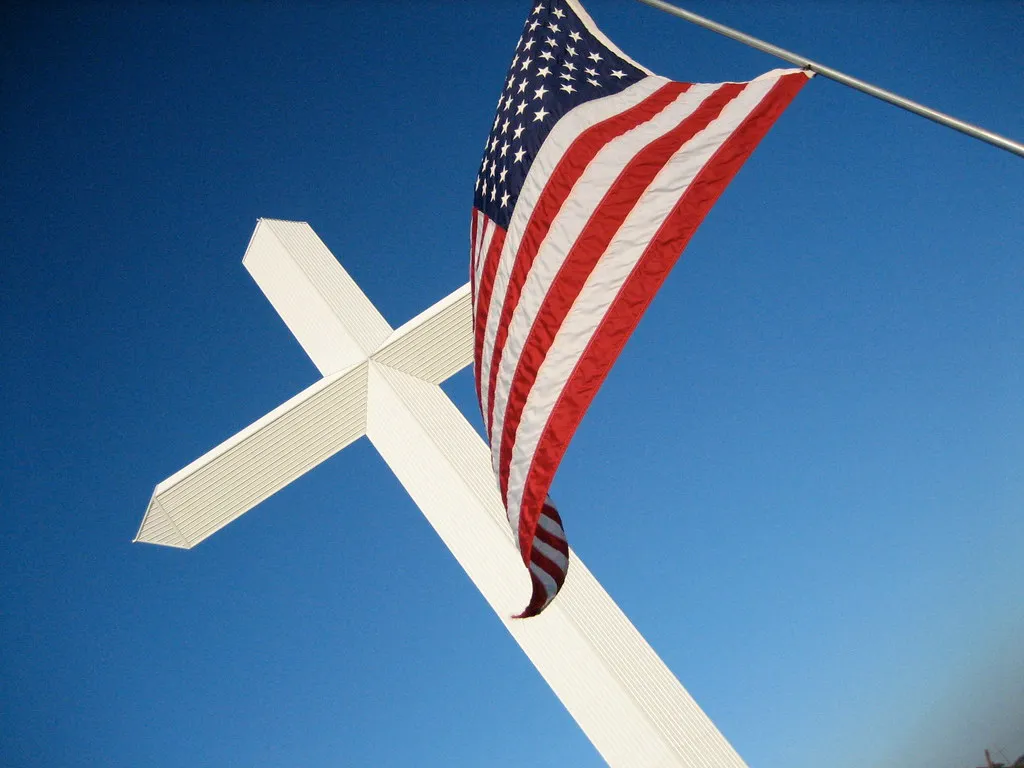
There are numerous organizations holding conferences and meeting, circulating petitions, making statements, and collecting prominent names to condemn Christian Nationalism. Coalitions and religious entities have been coalescing to resist what is being portrayed as an almost new and alarming phenomenon that is gripping the US’s cultural, political, and theological landscape with sharpened and ravenous claws. Though I fundamentally agree with those concerns I have some reservations about the timing and sense of urgency.
One of my questions is how closely are the concerns of these groups designed to coincide with the upcoming presidential elections? Is the timing of the objections, and the sense of urgency surrounding Christian Nationalism more allied with the Democratic Party instead of with the theological and ideological ethics and implications of Christian Nationalist in and of itself.
The crisis of Christian Nationalism has existed long before now. It was apparent with President Jimmy Carter and his IRS skirmish over Bob Jones University. Rev. Jerry Falwell, among others, felt that Carter had betrayed evangelical Christians and therefore sought another candidate to support for President and deliver a message to any who were considered to have betrayed Christian Nationalist values. The candidate they chose was Ronald Reagan. It should be noted that Bob Jones University and many of the other Christian Schools were established or became havens to resist racial integration. Christian Nationalism expresses itself predominantly through the white evangelical movement and is credited with George W. Bush’s rise to power and was an achilles heel for George H. W. Bush who did not actively seek their support. Christian Nationalism is not a new threat, though the threat may seem immediate, but only to those who are unaware of its historical manifestations.
As groups and coalitions of liberal religious interest offer statements to counter Christian Nationalism, though correct in their denunciations, run the risk of being pawns in the current political duopoly. My advocacy here is to push these organizations with their statements and pronouncements to reach beyond this moment or the politics on the right or left and consider some larger questions that is inherent in the issue.
Are all forms of religious nationalism wrong and destructive? Or are we just focused on Christian Nationalism which brings us back to the initial question of whether we are pawns in the political duopoly. What about Black religious nationalism? What of white religious nationalism? Why not add Muslim and Jewish religious nationalism to our list of condemnation? As these many liberal leaning groups and coalitions condemn Christian Nationalism as a racist, hateful, and xenophobic they are remiss if they don’t apply a principle in this moment and condemn all forms of religious nationalism.
The response to that question probably would be, ‘if those movements and religions were as dominant on the US landscape as Christian Nationalism there would be equal alarm.’ Though to some degree that can be argued it still avoids the larger discussion of whether religious nationalism is something to be condemned in general, and not just from a sectarian perspective?
Religious nationalism, in general, seeks to establish a sanctioned religious framework over the culture, society, and in the laws. It seeks to establish defined norms and ethos in its interpretation of a religious movement. It therefore argues that the flow of the culture and society needs to conform to a particular understanding of what is religiously sanctioned and what is not. The ramifications of the exercise of religious nationalism creates a sense of cultural superiority over other cultures, is ethnocentric in nature, and geographically elevates territory and people to a level where the differences represented by everyone else is diminished and scorned. It does not contribute to a world of justice and humanity, but instead continues to massage the fear of scarce resources and of being overrun by those who are different in race, culture, and religion.
Paul D. Miller writes in Christianity Today,
“Christian nationalism is the belief that the American nation is defined by Christianity, and that the government should take active steps to keep it that way. Popularly, Christian nationalists assert that America is and must remain a “Christian nation”—not merely as an observation about American history, but as a prescriptive program for what America must continue to be in the future.”
The problem with Christian Nationalists, even among Christians, is who defines the orthodoxy of the Christian movement. To say something is Christian is to ignore the fact that there are many and various interpretations of Christianity. Therefore, Christian Nationalism seek to define an established, protected, and exclusive form of what is Christian and what is not. Likewise, all forms of religious nationalism seek to do the same. Each is exclusive, intolerant, and threatens those who are not of the dominant strain. It is important therefore, that in a diverse society where pluralism is celebrated that all forms of religious nationalism and nationalism in general be rejected.
If the groups and entities railing against religious nationalism would be more objective and encompassing in their condemnation of religious nationalism it would seem less partisan. Instead of being suspect as theological ideology from the right or left, it might be taken and understood as an assessment of values that reach beyond the political moment or a particular party. If the groups and entities concerned by the dangers of Christian Nationalism would undertake the condemnation of all religious nationalism then they would further themselves as legitimate arbiters of diversity, healing, and wholeness.
Rev. Graylan Scott Hagler is ordained in the Christian Church (Disciples of Christ) and the United Church of Christ. Rev. Hagler is the Pastor Emeritus of Plymouth Congregational United Church of Christ, Washington, DC having served the church for 30 years. He is currently a Senior Advisor to Fellowship of Reconciliation, USA (the oldest interfaith and peace and justice organization in the country. Rev. Hagler was instrumental in ridding Washington, DC of Payday Lenders, was a co-founder of the Neighborhood Assistance Corporation of America (NACA), and is Director and Chief Visionary of Faith Strategies, LLC, a collective of clergy manifesting progressive perspectives on human and civil rights in the public arena.
 Radical Discipleship
John K Stoner jstoner961@gmail.com
/
Thank you for clarifying the toxicity of all nationalism. You could say, and we probably should say, Christian nationalism is not possible, because if it is Christian it cannot be nationalist, and if it is nationalist it is not Christian.
This feels tone deaf right now. Feels like a veiled condemnation of Hamas. Why can a Christian not support people’s nationalist struggles? Islam and Buddhism have had a very different relationship with imperialism than Christianity, though that isn’t to say they haven’t been weaponized for oppression or even imperialist interests. But…. a world of a difference.