
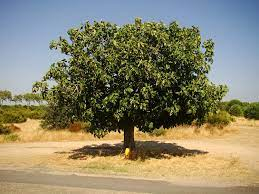
A sermon from Jim Perkinson on Luke 13:1-9 (March 23, 2025 at St. Peter’s Episcopal Church in Detroit, MI)
13 There were some present at that very time who told him of the Galileans whose blood Pilate had mingled with their sacrifices. 2 And he answered them, “Do you think that these Galileans were worse sinners than all the other Galileans, because they suffered thus? 3 I tell you, No; but unless you repent you will all likewise perish. 4 Or those eighteen upon whom the tower in Silo′am fell and killed them, do you think that they were worse offenders than all the others who dwelt in Jerusalem? 5 I tell you, No; but unless you repent you will all likewise perish.”
6 And he told this parable: “A man had a fig tree planted in his vineyard; and he came seeking fruit on it and found none. 7 And he said to the vinedresser, ‘Lo, these three years I have come seeking fruit on this fig tree, and I find none. Cut it down; why should it use up the ground?’ 8 And he answered him, ‘Let it alone, sir, this year also, till I dig about it and put on manure. 9 And if it bears fruit next year, well and good; but if not, you can cut it down.’” (Lk 13:1-9)
You know me, always trying to get down under the meaning, looking for an unforeseen seed going on journey in the soil, suddenly bursting unanticipated from below ground. Well, it happened here. In today’s text We read our bibles in English. Which translates the ancient Latin (Vulgate). Which translates the Greek. Which translates the Aramaic. Which translates the Hebrew. We are more than four times removed, more than four cultures out of sync with the text. We can’t really get back there in any pristine form but can at least muse. Let some things happen with images that provoke consternation or amusement! So come with me for a minute.
Our indigenous teacher, Martín Prechtel is always telling us, “Pay attention to the etymology, to the sequence of meanings that a given word harbors over time.” Underneath this word right here, that seems mundane and boring to you, there is an older meaning, and under it an even older meaning, and then another and another and another. Follow the root of the word back and down and ultimately you come out in place that is likely ancestral and indigenous and very different than here in the seemingly “ordinary” sense the word now conveys. There are ancestors and grand mysteries up inside many of our words, but deep under their present appearance and sound—like the hair on the side of a root of a mushroom under the soil, leading into a network as wide as an entire forest.
Like when Prechtel was a young man, half white, half Native, growing up among the Pueblo Indian reservations in New Mexico, early on walking away from the white habits and schooling he was exposed to and gravitating to Native practices and wanting to get acceptance there. Specifically, wanting to hunt like Native young men did and bring in food to the tribe he liked to regularly visit. So, one day as a pre-teen, out in a nearby canyon, he happened upon a wagging little tail, extruding from a hole in the ground, grabbed the tail and pulled to see what would happen. And out came a snake with its jaws around a small marmot, that he could take back to the reservation. Not much of a meat offering, but at least something. He kept the snake and began to go around with it to various places in the mesa terrain of central New Mexico, looking for holes to release the snake in front of while holding onto its tail and letting it slither in and latch onto whatever animal lived there, pulling out the snake by its tail, and taking the animal flesh to the pueblo to some of the mothers there as “game” to be cooked for food.
A young kid, “hunting” in the only way available to him at that age, discovering something a bit amazing. (And you may react to such hunting, but that was how many Native groups knew to survive, and attended such with respect and prayers and offerings, very differently than how we pursue our contemporary industrial horror-show.)
And so Prechtel would encourage us in his school that my wife and I have attended for more than a decade, to pay attention to little, seemingly insignificant “tails” barely flickering at the edges of tiny holes in our daily experience—to allow as how there might be something magnificent at the other end that has been long forgotten or hidden. And to do so especially with some of the words we encounter, daring to go back upstream on their meanings and history. We have forgotten so much that was honorable back in our ancestry. But some of it is still there, tucked away behind more recent understandings.
That is preface. Now to the text today. So, Jesus is headed to Jerusalem. He set his face on that focus in chapter 9 in Luke, and indeed at the end of the present chapter we will hear him respond to some Pharisees who warn him about Herod’s plot to take his life while he is still up in Galilee. And Jesus says, “Tell that fox” I will continue to do my work today, and tomorrow, and finish my course on the third day. “Nevertheless, I must go on my way today and tomorrow and the day following; for it cannot be that a prophet should perish away from Jerusalem. O Jerusalem, Jerusalem, killing the prophets and stoning those who are sent to you! How often would I have gathered your children together as a hen gathers her brood under her wings, and you would not! Behold, your house is forsaken” (Luke 13: 31-35).
The people who address Jesus with grave concern about fellow Galileans who went up to Jerusalem and were murdered by Pilate, provoke the Nazareth prophet to bring out the presumed subtext that remains unspoken. These Galileans were worshipping God with their sacrifices as the law required and God allowed this to happen??? But northern-dwelling, “Galilee of the Gentiles” hill-folk were suspect in Jerusalem in the 1st century as rebellious renegades resisting both Roman rule and Temple-State tithing extractions. So, the presumption was, they must have been sinfully scheming in some way and have done something to offend divinity in the Temple.
But Jesus says, “No, they are not different than the rest of you, my fellow Galileans!”
And then he cites another instance of violent demise—involving 18 “debtors” (literally in the Greek) presumably working for Pilate on a building project to reconstruct a tower at the Pool of Siloam, who perished when it fell. Poor working conditions! No Worker’s Compensation for their families! In fact, this entire project was deemed offensive to God since foreign occupier Pilate had raided the sacred “Corban” money in the Temple Treasury—a kind of priestly security stash—to fund part of the aqueduct works bringing water into Jerusalem and particularly perhaps for construction of a surveillance tower to monitor people during the various feasts in Jerusalem when the possibilities for revolt were rife. So, the street assessment of that event is that those workers were betraying their Jewish identity and their Jewish Deity in allowing themselves to be coerced by their economic poverty and unpaid debt to work for the oppressor.
But Jesus says, “No, they were not any more complicit than anyone else in Jerusalem.”
And in each of the two recited cases, he concludes emphatically: “Listen up! Beware! Unless you ‘repent’ [our English bibles say], you are just as much at risk! Just as vulnerable!”
Ok, “repent.” But of what? In which direction? We, who are 2000 years removed from this scenario and, as I have indicated, more than 4 cultures and languages distant, take up the term—like so many other words in the bible—and use it the way our political culture and religious ideology counsels us: as a term referencing individuals making decisions about the ultimate destiny of their souls. Which is exactly what empire loves about Christianity. Afterall—Constantine and everyone after him, up through Columbus and the Puritans and the evangelicals and the Moral Majority and the Heritage Foundation and Peter Thiel in our day, have remade the Galilean Jesus movement into the perfect tool of domination, atomizing communities into individuals and individuals into mere “souls,” shaped in fear, only concerned to get this invisible, ethereal “spiritual substance” into the Heavenly suburb.
What the term originally meant was “turn,” as in something you do with your body not just heart, your hands and feet and eyes not just your spirit. Indeed, your lifestyle! Turn!
And then Jesus launches into a little parable story about a fig tree, a riddle about a root and a trunk and leaves not yet delivering fruit. What? What does that have to do with murder in the city? And labor put at risk and crushed, building a tower?
Everything. It is a radically different vision of human being and human valuing, grounded literally in the land, centered on figs in the midst of grapes. A fruit tree in a vineyard. And we are deep into it. And deep into what “flashed” at me as a little wriggling tail sticking out of a particular word that I just barely caught sight of. At first glance the story seems boring, almost silly as in “so what, cut the tree down or let it do its thing another year: either way.” But, as usual, details are everything in the text.
This is a tree planted by an owner of a vineyard. Historically for Israel fig trees and vineyards were thought together as an image of mutual flourishing, as in “everyone beneath their vine and fig tree,” invoked as the imagination of an oppression-free future by the likes of the prophet Micah (Mic 4:4). What does good living look like? Sitting for an afternoon out in one’s “own” vineyard under a fig tree for shade and sweet-eating, not having to worry about working for someone else or trespassing on privatized land claimed by a fat cat landlord.
But in Roman-occupied first century Palestine, wine had become an export crop. More and more barley fields providing bread for the poor had been taken over by landlords using predatory loan schemes to pry fields away from peasant farmers and into their own hands and then to convert them into vineyards producing grapes for export to Roman markets. More and more small farmers had been kicked off their lands and re-hired (sometimes) as tenant farmers on what used to be their own lands. And thus, we plop right down into the center of the text today.
The owner has a typical human supremacist relationship with the tree and with “his” vineyard. He wants “produce.” And here is the astonishing hint. He charges the tree with “wasting” the soil, taking up space, occupying ground “uselessly.” But underneath the Greek word katargei meaning “completely idle” is quite possibly the Hebrew word shavas or said in English, shabbat, “sabbath.” If so, the owner is charging the fig tree with practicing “sabbath” with the soil—in his estimation, giving the ground too much time of wild, undomesticated “rest.” And his hired hand (likely an oppressed peasant tenant farmer) pushes back, asking him literally to “forgive” the tree for another year.
Yes, the phrase “let it go” used by the vinedresser is actually the word that elsewhere in the New Testament is translated “forgiveness”—another of Empire’s distorting little “spins” on the biblical tradition.
The Greek term aphiémi is more accurately translated “release”[1] and references the entire tradition of Sabbath-Jubilee “unshackling” of domesticated/coerced plants, animals, soils, humans, and time. It is a tradition anchored in the “origins” memory of slaves escaped from Egypt, re-learning how to live on the land, gathering up “manna” which was likely aphid poop, coming out the rear ends of these little scale insects, up on tamarisk branches, eating leaves and defecating 130 % their body weight every hour, that Arab Bedouin in the Sinai today scoop up to bake into honey loaves and call, in Arabic, man, the likely cognate of Hebrew manna. Counter the enslaved focus on “building storage cities for grain” for Pharoah’s “Food as Weapon” policy (Exod 1:11), the desert practice was a return to a “hunting and gathering” modality of only taking up enough food for one day at a time in trust that the land that provided today would provide tomorrow as well. And yes, then every sixth day, gathering two days’ worth. But not an iota more! Not extraction for surplus!
And as elaborated ritually, sabbath was then not a quaint practice of having a day off to take a nap, watch baseball on the tube, and then take a walk in the park. No. It was rather a proscription of extractive work, a liberatory “return” of every creature including humans back into their originally “wild” condition of not serving any form of domestication or surplus production. It was an entire “Schoolhouse of the Sevens”—a “program” requiring practical observation every seven days; ritual remembrance for the seven weeks between Passover and Pentecost; and then once again practical adherence for seven days in the field during the seventh month, for the whole seventh year, and for the whole seven-times-seventh-plus-one 50th year of theevery generation “Jubilee.” Israel, in its new agricultural venture in Palestine, no longer eating manna, but now cultivating grain, was to spend nearly one-third of its time[2] and energy going back and remembering how to live on the land such as they learned for 40 years in the wilderness after their walk-out from imperial Egypt. Which is to say, this Sabbath-Jubilee continuum, concocted by Moses, was intended to be a comprehensive discipline, to try to keep Israel from getting sucked up into citified mechanisms of accumulation and domination and forget what they had learned as a counter-imperial way of living, “taught” by the land—even though it was never fully kept.
And here it is worth noting the subtle reiteration of the concerns voiced by Jesus back in Luke 11 as the centerpiece of his teaching—his Rabbi’s prayer (the so-called “Lord’s Prayer”) distilling what was of prime import in all that he was saying (Myers, 24). In Greek that centerpiece is markedly an invocation for forgiveness of sin (hamartia) by God that is leveraged by release of economic indebtedness (opheileema) exercised by oneself towards those who owe. Tellingly, while the words for “forgiveness” and for “release” are the same in both Greek (apheimi) and the precursor Aramaic, the words for “sin” and “indebtedness” (though also the same in Aramaic), are different in Greek. The prayer is a very pointed underscoring that personal integrity with God is determined by economic relationship with other people. Sin release depends upon debt release. And strikingly, this word-difference is then slyly re-invoked in the story of the Galilean “sinners” murdered by Pilate and the Jerusalemite “debtors” crushed by the toppling tower.
But the real corker is the emphasis on release—twice articulated in the earlier prayer—that in this vignette about two instances of Jerusalem violence only shows up in the seemingly unrelated parable that follows in connection with a non-human actor. It appears as a peasant appeal on behalf of a supposedly “offending” fig tree that itself has already enacted three years of “release” for its companion soil! And we might then summarize out of the Luke 11 prayer capped off by the Luke 13 news report and parable commentary: release of sin in relationship to God is realized by release of debts economically in relationship to a human debtor that is itself learned from non-human “elders” in the natural economy of trees and soils.
And so yes, in today’s text, turning away from mesmerization by Jerusalem machinations—we are invited instead to remember a fig tree itself practicing sabbath-release of the soil, and a hard-laboring peasant asking for another year of shabbat-release for the tree, at the end of which that “gardener-peasant” would dig and give manure (animal poop) and thus re-kindle something mutual! And if that did not suffice, then the owner would have to come and cut it down himself (“but not me” implies the peasant laborer).
The fig tree is a deep, old teacher, a keystone species and mutualistic model in an amazingly complex interdependence with pollinator wasps (don’t get me started), and way back—a coerced (?) collaborator with the need of Adam and Eve in the Garden of Eden to “hide” once having violated the limits on tree-harvesting that they were given. A fig tree in a vineyard is an instance of species multiplicity and mutuality. But this owner only cares about productivity. If cut down, he will presumably convert the ground-usage to viticulture and export cropping. Whereas the presence of the tree among the vines is a profound instance of nature’s astounding mutualism and co-generation.
It is the ancient Palestinian equivalent of the Three Sisters tradition of Anishinaabe peoples, the squash, beans, and corn dynamism they so deeply cherish and nurture and learn from.
And it actually gets even deeper. Because in rabbinic lore, the fig tree is that very tree in the Garden of Eden that was the forbidden “Tree of Knowledge” (Goor, 124). All the other trees were given freely to Adam and Eve, to take fruit from, to take shelter under, to use the branches thereof. They had the run of olives and dates and acorns and pomegranates. But the fig tree was apparently originally set up as verboten, reserved for itself, indicative of that part of the Garden that was not for humans to use and use up. It represented a sacral limit—the boundary line that is necessary to have a sustainable ecology in the first place—the very thing that “civilization” claims is non-existent for human beings. The very thing that indigenous cultures insist is central to their relationship to their given ancestral land. But once violating the limit, Adam and Eve grab up those very leaves to cover the “overshoot” they have initiated. They hide behind the fig. And amazingly the fig is not adamant; it cooperates, in spite of the violation. And feeds the offspring ever after.
And then Jesus lifts it up in a little story as daring to give sabbath rest to a piece of ground, or if we want, as embodying a little bit of Garden of Eden co-limit and self-reservation for a tiny patch of nature—separate from human intention—right in the middle of a commodified vineyard. Whoa. Do we dare to see it?
So, let’s back out a bit further now. The entire second half of Luke’s gospel is preoccupied with Jesus’ decision to take his movement out of the outback of Galilee which has been his wilderness center of organizing and teaching, up to the Temple in Jerusalem for the high noon showdown with the Powers that be. Like Martin Luther King headed back to Memphis in April of 1968, Jesus is not naïve about what is likely to happen. He is going to name the Temple-State “thug central,” “den of robbers,” the institutional lynchpin of all the mugging and extraction and disenfranchisement going on all over Palestine of that day. The Temple—as both shrine and “bank” (where records of indebtedness were kept)—has been the center of disinformation, of using the name of God to pick the pockets of the poor. And the city, Jerusalem—just like every other big city over our species’ history—has not been a regime of “Peace,” “Salem,” “Shalom,” as its name tries to suggest, but a source of elite wealth-concentration and power-mongering.
And he is on mission to name it to its face, unmask its operation, and pay the price. The urbanized Temple-State is what he is against. Nowhere in the gospels does Jesus embrace a city or a town as his primary abode or place of ministry. And Pilate’s murder of Galileans in the Temple environs and the collapse of the Siloam Tower killing indebted workers are just more of the same. “Turn,” he says, “turn!”
Turn where? Towards what? Towards the entire history of interdependent reciprocity with trees and land and wasps and rain and wind and water that had birthed Israel in the first place. As friend and collaborator biblical teacher Ched Myers has argued: the entire conflict between Jesus and the authorities of his time was over the meaning and practice of Sabbath (Myers, 23, 24-29). Not in its minutia of weekly adherence, but as a thorough-going ritual and indeed everyday practice, codifying a way of living very different from urban-centered extraction and accumulation. An entire continuum of interdependence rooted in land-reciprocity and tree-symbiosis and herder-savvy.
Jesus was not primarily the Great Lone Ranger “individual” as Empire wants us to think. He was the leader of a movement. And that movement was centered in peasants and fisherfolk, being schooled to return to a lifestyle of reciprocity with the wild. The Galilean Jesus movement was a back-to-the-land movement. And going up to Jerusalem was not to preach but to confront. It was temporary and dangerous. Over-against such, the real deal was a recalcitrant fig tree, refusing merely to cooperate with landlord-rapacity wanting marketable “productivity” to inflate a bank account, but appearing instead as an ancestral Elder, going back to primordial times, offering wisdom, offering limitation, offering sabbath-witness to the interdependence of species without which no one has a future.
I could go on, but enough. What to do today? Indeed. You tell me. I have no idea how to get there from here. I only know, if we keep going as we are now, we are going off the cliff edge, in very short order. Trump and company are not an aberration. They are an indication. A sign of this human super-inflation in numbers and extraction and consumption and arrogance that is now planet-wide and billionaire-backed and soaked in self-certainty that only “we” (humans) matter and everything else literally is merely there for us to take up and remake as technology—as armatures and prostheses of our own absurd grandiosity and self-absorption. What do I do? I grieve. And sound warning. And protest. And feed the redbirds. What do you do?
Bibliography
Goor, Asaph. 1965. “The History of the Fig in the Holy Land from Ancient Times to the Present Day,” Economic Botany 19: 2 pp. 124- 135, https://www.jstor.org/stable/4252586.
Myer, Ched. 2001. The Biblical Vision of Sabbath Economics. Washington, DC: The Church of the Savior.
[1] Forgiveness (of sin) implies getting off the hook for something wrong done by you. Release (of debt) implies getting free from something done to you.
[2] Adding up all of the days spent observing these requirements (7th day, 7 days out in the field in the 7th month, 7th year, and 50th year), if kept, would translate into 8145 days out of 25550 days in a lifetime of 70 years (70 x 52 plus 70 x 7 plus 70 x 365 plus 365).
 Radical Discipleship
Hi Jim I had trouble sending this comment via WordPress. So I’m trying this. Luckily I made copy for myself. Here it is. Jim:
This is absolutely, profoundly prophetically world-changing biblical work. I am just at the end of reading Paul Hawken’s new book “Carbon: The Book of Life” which is basically saying the same thing but here you have so intricately connected his insights about the teachings of the land with so many biblical themes. Last Sunday I avoided the gospel reading because I sensed it would require too much work–and here you have done all the work I sensed needed to be done. Wow!! Bravo. As I read I found myself wondering if you had read Ched Myer’s and then BAM–there you were making connections with Sabbath Economics. Also the connection with “the wild” is utterly mind blowing. I’ve been naming Jesus as “Our Wilderness driven Lord” for years now–but you have helped me understand why. Thank you, thank you, thank you fellow fundementalist–evangelical refugee!
Meg Jordan (she,her) There is no way to peace; peace is the way. Mahatma Gandhi
>
Pingback: Fallow Trees and Falling Cities – Dr. James W. Perkinson