The Ties that Bind: The Integrity of Penitence, on the 50th Anniversary of the Massacre at My Lai

my-lai-1024x683By Ken Sehested

Concealment makes the soul a swamp. Confession is how you drain it.

—Charles M. Blow

Except in a few traditional religious settings, penitence is a relatively unknown word. While its more common synonyms—confession, apology, contrition, and repentance—are standard parts of many church liturgies, the images they convey have generally fallen out of favor. There are good reasons why this is so. The primary definition of penance is “voluntary self-punishment inflicted as an outward expression of repentance for having done wrong.” A web search for penance reveals more than a few pictures of people whipping themselves. Continue reading “The Ties that Bind: The Integrity of Penitence, on the 50th Anniversary of the Massacre at My Lai”
Dos ancianos locos una para otra

OLYMPUS DIGITAL CAMERAAuthor asked to remain Anonymous.The author and her novio have been in relationship for over six years. When people ask why they don’t get married so he can get a green card, her answer is, “It only works that way in the movies.

So we’re walking through slush on a February Sunday

Going up to the drugstore so you can get some medicine for your friend Continue reading “Dos ancianos locos una para otra”

Fallen Upon Me To Do So

WellsRe-posted from the brilliant New York Times series of fifteen obituaries written for women that were overlooked over the decades.  This piece on Ida B. Wells was written by Caitlin Dickerson, a national immigration reporter who still uses the reporting techniques that were pioneered by Wells.

It was not all that unusual when, in 1892, a mob dragged Thomas Moss out of a Memphis jail in his pajamas and shot him to death over a feud that began with a game of marbles. But his lynching changed history because of its effect on one of the nation’s most influential journalists, who was also the godmother of his first child: Ida B. Wells.

“It is with no pleasure that I have dipped my hands in the corruption here exposed,” Wells wrote in 1892 in the introduction to “Southern Horrors,” one of her seminal works about lynching, “Somebody must show that the Afro-American race is more sinned against than sinning, and it seems to have fallen upon me to do so.” Continue reading “Fallen Upon Me To Do So”

The Joke Is All We Have Left

Free the WaterBy Jim Perkinson (right), an excerpt from “Jesters, tricksters, taggers and haints: Hipping the church to the Afro-hop, pop-‘n-lock mock-up currently rocking apocalyptic Detroit,” a November 2017 article in Teologiese Studies/Theological Studies (HTS):

In many places today, the joke is all we have left to pry open the prison gate – a jest and a belly laugh rooted in the deep past and the abandoned margins. But its truth remains absolute, despite corporate pretention otherwise. We all finally will come apart at the seams and decay into streams of composting liquid and molecules – even US drones and bankers’ computer screens, blinking with algorithms. The only question is when and for what.

In recognition of such an eventuality of equality, may we choose well where to expend our breath and exercise our push back and dreaming otherwise. May we become soldiers of the unrepentant joke, militant laughers learning our hope from the least. May we keep our jest visceral and its spear-point like a razor, ready for whatever crack of freedom the Mystery of Wild Hilarity that created this planet may open. May we do so, even if that possibility is ephemeral and uphill as a spray-painted st and a stenciled demand on a tower and the political struggle to ‘free the ow’ that follows! Indeed, may we finally be strong like water and as insurgent as a tower growing from concrete!

40 Birds of Lent: Water

Barrows Goldeneye
Barrow’s Goldeneye

By Laurel Dykstra

I woke up this morning humming:

Water heals our bodies
Water heals our souls
When we go down, down to the water
In the water we are whole.

Wood Duck
Wood Duck

The song I learned in water ceremonies at Standing Rock, is the chorus of Coco Love Alcorn’s song The River. It’s not so surprising that these were the words in my head as I spent the better part of yesterday morning singing them outside the gates of Kinder Morgan’s Westridge Marine Terminal—the intended shoreline destination for transferring Tar Sands bitumen from the proposed Trans-mountain expansion pipeline project to ocean-going tankers. Beside the water of the Burrard Inlet on unceded Coast Salish Territory we sang as trees were limbed and cut in anticipation of a tunnel through the mountain. Continue reading “40 Birds of Lent: Water”

Wild Lectionary: This Text Bites Back

17626669_10154197866197434_8979553795951658612_n copy(2)
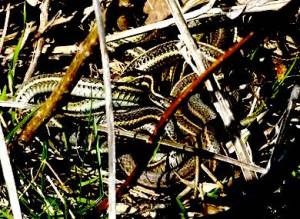
Mating ball of garter snakes, Lent 2017, Richmond BC

Lent 4B

Numbers 21:4-9
John 3:14-21

By Laurel Dykstra

Today’s gospel reading contains perhaps the best-known verse in the bible, certainly the New Testament passage that is known best in modern North America.

It begins like this, “For God so Loved the World… Continue reading “Wild Lectionary: This Text Bites Back”

The Subject of a Carceral State

SoniaFrom the conclusion of Justice Sonia Sotomayor’s dissent in Utah, Petitioner v. Edward Joseph Strieff, Jr. (June 20, 2016):

This case involves a suspicionless stop, one in which the officer initiated this chain of events without justification.  As the Justice Department notes, supra, at 8, many innocent people are subjected to the humiliations of these unconstitutional searches.  The white defendant in this case shows that anyone’s dignity can be violated in this manner.  But it is no secret that people of color are disproportionate victims of this type of scrutiny.  For generations, black and brown parents have given their children “the talk”–instructing them never to run down the street; always keep your hands where they can be seen; do not even think of talking back to a stranger–all out of fear of how an officer with a gun will react to them. Continue reading “The Subject of a Carceral State”

Predators, Profit, and Precarity

el-refugio.pngBy Joyce Hollyday

To get to Lumpkin, Georgia, you have to really want to be there—or be taken against your will. The highways wind southwest of Atlanta, roughly paralleling the Chattahoochee River, for 143 miles. The town is parked on red clay amid tangles of kudzu, its square a cluster of shuttered storefronts next to an abandoned gas station, where the only visible signs of life on a mid-morning in early January were at the courthouse and a store labeled Christian Gun Sales (motto: “Guns Cheaper Than Dirt”). Continue reading “Predators, Profit, and Precarity”

All Those People

Cornelius EadyFrom Cornelius Eady’s “The Cab Driver Who Ripped Me Off” in The Autobiography of a Jukebox (1997):

That’s right, said the cab driver,
Turning the corner to the
Round-a-bout way,
Those stupid, fuckin’ beggars,
You know the guys who
Walk up to my cab
With their hands extended
And their little cups?
You know their problem?
You know what’s wrong with them? Continue reading “All Those People”