During Fridays in Easter we will be sharing reflections on where folks are seeing resurrection today. Please consider contributing and email it to lydiaiwk@gmail.com
By Kyle Mitchell, Cleveland, OH
During Fridays in Easter we will be sharing reflections on where folks are seeing resurrection today. Please consider contributing and email it to lydiaiwk@gmail.com
By Kyle Mitchell, Cleveland, OH

By Wes Howard-Brook and Sue Ferguson Johnson, Commentary for April 3 (John 20.19-31)
Today, as we continue through the season of Uprising, we encounter a character often known as “doubting Thomas.” Looking closely at the scene, though, we hear no doubt in Thomas at all. Having missed the other disciples’ encounter with the Risen One, he proclaims: “Unless I see the mark of the nails in his hands, and put my finger in the mark of the nails and my hand in his side, I will not [Gk, ou me] believe” (John 20.25). Put a bit more colloquially, one could render his words, “No way I’m going to believe!” Continue reading “My Lord and My God!”
From Francisco Garcia of Clergy and Laity Uniting for Economic Justice:
Today, in front of the Metropolitan Detention Center in Los Angeles, outside the very courtroom where Central American children defend their cases for asylum, 21 faith leaders and allies — Continue reading “21 CLUE Leaders Arrested”
The gift of discernment is basic to the genius of the biblical life style.
Discerning signs has to do with comprehending the remarkable in common happenings, with perceiving the saga of salvation within the era of the Fall. It has to do with the ability to interpret ordinary events in both apocalyptic and eschatological connotations, to see portents of death where others find progress or success but, simultaneously, to behold tokens of the reality of the Resurrection or hope where others are consigned to confusion or despair. Discerning signs does not seek spectacular proofs or await the miraculous, but, rather, it means sensitivity to the Word of God indwelling in all Creation and transfiguring common history, while remaining radically realistic about death’s vitality in all that happens. – William Stringfellow
Where do you see glimpses of the Resurrection? Where do you see life where tehre was death? Where are the places that death does not have the final word? Throughout the Easter season, we will post short reflections from folks who name the places they see Resurrection happening. We would love to include your voice in that. Send a sentence, a paragraph, a short reflection to lydiaiwk@gmail.com.
A mural from artist James Janknegt, painted for Christ the Reconciler retreat center in Elgin, TX:

From James Cone in A Black Theology of Liberation (1970):
Christian freedom is the recognition that Christ has conquered death…The free are the oppressed who say no to an oppressor, in spite of the threat of death, because God has said yes to them, thereby placing them in a state of freedom.
Luke 24:1-12On the first day of the week, at early dawn, the women who had come with Jesus from Galilee came to the tomb, taking the spices that they had prepared. They found the stone rolled away from the tomb, but when they went in, they did not find the body. While they were perplexed about this, suddenly two men in dazzling clothes stood beside them. The women were terrified and bowed their faces to the ground, but the men said to them, “Why do you look for the living among the dead? He is not here, but has risen. Remember how he told you, while he was still in Galilee, that the Son of Man must be handed over to sinners, and be crucified, and on the third day rise again.” Then they remembered his words, and returning from the tomb, they told all this to the eleven and to all the rest. Now it was Mary Magdalene, Joanna, Mary the mother of James, and the other women with them who told this to the apostles. But these words seemed to them an idle tale, and they did not believe them. But Peter got up and ran to the tomb; stooping and looking in, he saw the linen cloths by themselves; then he went home, amazed at what had happened.

By Tom Cornell, Co-founder of Catholic Peace Fellowship
After the Last Supper, Jesus and his companions walked across the Kedron Valley to Gethsemane, the Mount of Olives. If you visit Israel today, you will surely want to see the Mount of Olives where Jesus suffered his Agony in the Garden. You come to a little stream at the bottom of the valley on the way. The guide tells you, “This is the Kedron River.” You are surprised. It’s not much of a river now, just a little stream, not much more than a trickle. You can hop over it. It was broader then, the guide tells you. Jesus and the apostles took their sandals off to wade across. Imagine it. Continue reading “A Good Friday Homily”
By Ched Myers
Note: This is part of a series of Ched’s occasional comments on the Lukan gospel readings from the Revised Common Lectionary during year C, 2016. Because the Easter Sunday reading from Luke is long, so too is this reflection. It is abbreviated from a chapter entitled “Easter Faith and Empire: Recovering the Prophetic Tradition on the Emmaus Road,” in Getting On Message, edited by Peter Laarman, Beacon Press, 2006.
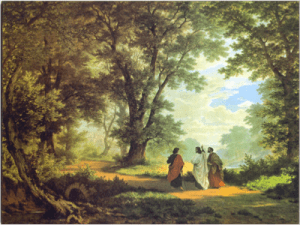
In the first century Pax Romana, Christians had the difficult and demanding task of discerning how to cling to a radical ethos of life—symbolized preeminently by their stubborn belief in the Resurrection of Jesus—while living under the chilling shadow of an imperial culture of domination and death. Today, in the twenty-first century Pax Americana, U.S. Christians are faced with the same challenge. Continue reading “The First Bible Study in the History of the Church”
By Tommy Airey
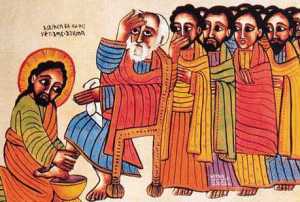
[Jesus] got up from the table, took off his outer robe, and tied a towel around himself.
John 13:4
To invite people to look at, to wash, to care for our feet is to invite them to accept us as we are.
Wes Howard-Brook, John’s Gospel & The Renewal Of The Church (1997)
In each of the four canonical Gospels, Jesus is portrayed in terms of kenosis, or self-emptying. In none of the canonical Gospels is the scandal of the cross removed in favor of the divine glory.
Luke Timothy Johnson, The Real Jesus (1996)
For those just now tuning in, Western Christianity is in the midst of a massive intramural contest over what it means to follow Jesus. Fortunately & strategically, Holy Week re-calibrates us towards a creative & constructive imitation of Jesus’ life of service. If the various brands of Christianity (from evangelical to ecumenical, from Catholic to Charismatic, from fundamentalist to free thinking) can come together tomorrow and focus our respective energies & resources on acting out the Gospel script (washing one another’s wretched feet), we can realistically hope for a more compelling witness to our audacious claim that a redemptive Something pervades our existence.
Continue reading “The Towel Before The Tomb”