By Tommy Airey, an unabridged end-of-the-year review
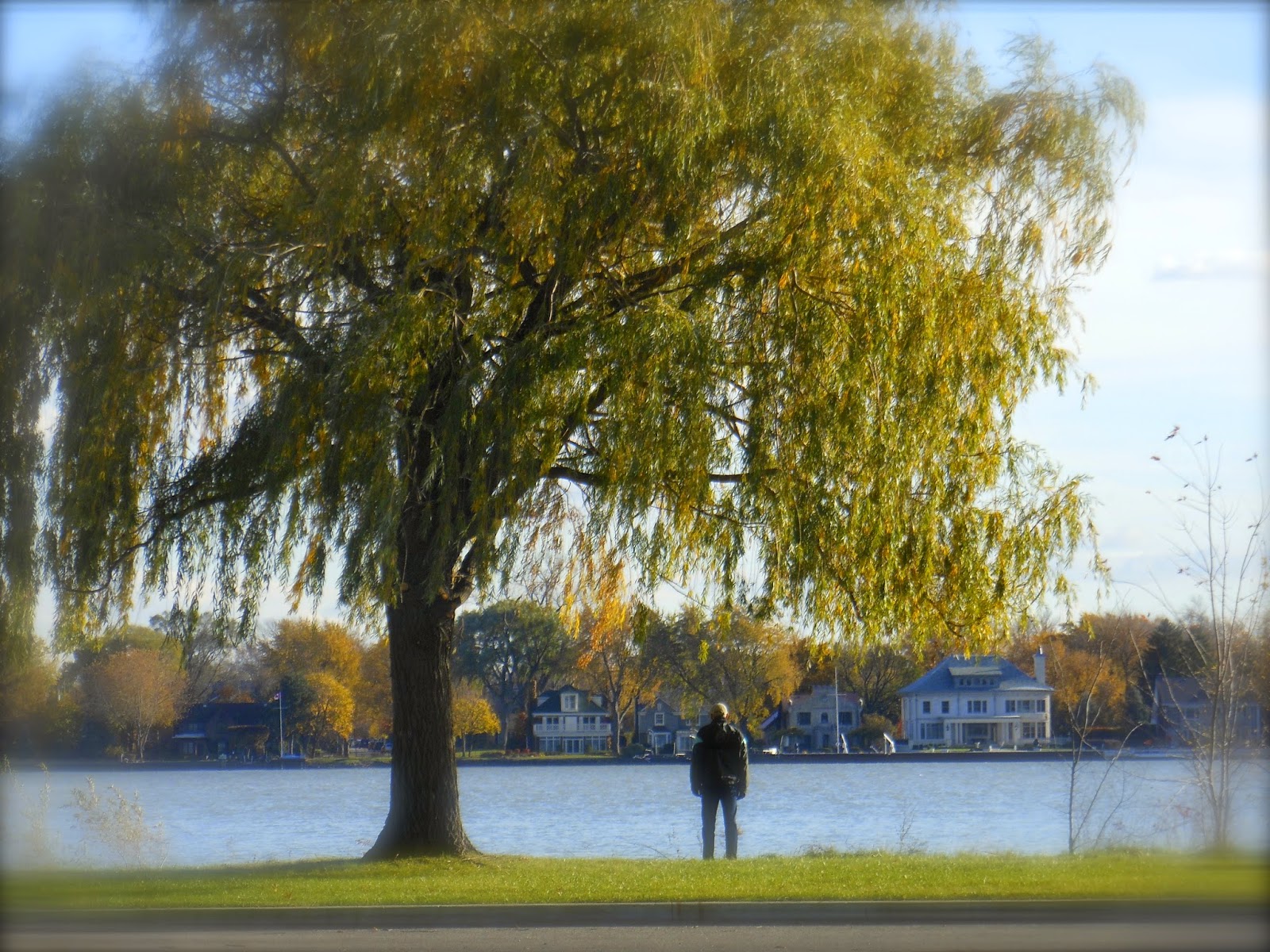
On Easter Sunday this year, I made my way out to the sacred place Native people call Wahnabeezee. It’s a 962-acre island in the middle of the Detroit River. I walked over to the willow tree. Right where I snapped a photo of my dad on his final Father’s Day in 2015. He was standing under the long yellow stems that the original stewards of this land used to weave baskets. Dad was looking across the water to Canada. Where enslaved Africans were once ferried to freedom. The last stop of the underground railroad.
On that clear blue Easter morning, I sprinkled some of my dad’s ashes. On the base of the trunk where the lichen was growing. Willow sounds like wallow. The basket tree held my sorrow. Crucifixion came six months later. Samhain summoned me back to my dad’s ashes. When I pulled up, I could not find the willow. It was gone. Not even the trunk. Totally uprooted. The only traces were a few long stems she left behind.
I thought to myself. We truly are living in The Age of the Uprooted. Palestine was heavy on my heart. An oppressed people enduring occupation, apartheid, genocide. For the past seventy-five years. Totally uprooted. I was also thinking about my neighbors. Over the past fifteen years, more than one-third of the entire population of Detroit has been forced to foreclose on their homes. Totally uprooted. Almost all of them Black. Rev. Roslyn Bouier runs a local food pantry. She recently told me that many of these residents now live out of their vehicles. A significant population of women and children sleeping in parked cars.
Introducing a new online course from The Alternative Seminary.
DECOLONIZING PALESTINE: Settler Colonial Theory in Conversation with Palestinian Liberation Theology
January 8 – 29, 2024 7:00 – 9:00 pm EST
Led by Rev. Amy Yoder McGloughlin
“Decolonizing Palestine is a wake-up call for people interested in Israel/Palestine to recognize the reality on the ground, to reflect critically and prophetically on the scripture, and to engage in a new paradigm.” — Mitri Raheb
By Rev. Dr. Munther Isaac, a liturgy of lament, Evangelical Lutheran Christmas Church Bethlehem, Saturday December 23rd, 2023. Originally posted to the church’s social media page.
We are angry…
We are broken…
This should have been a time of joy; instead, we are mourning. We are fearful.
20,000 killed. Thousands under the rubble still. Close to 9,000 children killed in the most brutal ways. Day after day after day. 1.9 million displaced! Hundreds of thousands of homes destroyed. Gaza as we know it no longer exists. This is an annihilation. A genocide.
The world is watching; Churches are watching. Gazans are sending live images of their own execution. Maybe the world cares? But it goes on…
We are asking, could this be our fate in Bethlehem? In Ramallah? In Jenin? Is this our destiny too?
The bible says that Jesus was born in a small Palestinian town called Bethlehem. His Jewish parents were surviving imperial occupation. They were forced to travel back to their ancestral region to register for Caesar’s census. There was no room in the inn. So Mary gave birth to baby Jesus in a stable. This year, it’s even worse. The inn and the stable have been bombed by Caesar – along with the refugee camps, the schools, the mosques, the churches and the hospitals. Baby Jesus is lying in a manger – in the rubble. This year, we will be attending a live-streamed church service from Bethlehem, along with a multitude of others who are anchored in the agape love of Christ – or who are, at the very least, Jesus adjacent. Will you consider joining us in this time of worship, solidarity, mourning and mobilization?
Check the RadicalDiscipleship.Net Facebook page or NewVision Media Center’s YouTube channel for the livestream on Sat, December 23 at 11amEST.
An excerpt from a message from Mark Braverman, executive director of Kairos USA. Download the Kairos Palestine Christmas Alert pdf here. If you are looking for a compelling alternative to Christian Zionism, this is definitely one of them.
WE TEACH LIFE TO THE REST OF THE WORLD
This is what meets your eyes as you enter the Christmas Lutheran Church in Bethlehem, in place of the traditional Christmas tree. No explanation is needed, beyond what is articulated by the church’s pastor Rev. Munther Isaac in this year’s Kairos Palestine Christmas Alert:
“Christmas celebrations are cancelled this year in Bethlehem.There will be no tree lighting, no street parades, and no festivals.
“We watch in horror and agony as one child after another is pulled out of the rubble in the genocide in Gaza, reminding us of the ruthless massacre of the children of Bethlehem at the hand of the Empire—yet another reminder of the relevancy of the Christmas narrative. We will not celebrate. It is hard to rejoice. We are afraid. We are broken. We are shaken.
This is the Introduction of a position paper in solidarity with Palestinian liberation written by NDN Collective and the LANDBACK Team. The full paper is posted here.
When questioning the problems around our communities, Indigenous youth are often told, “it’s a complicated issue”. We see our grandparents’ houses with no electricity or running water while transmission lines run overhead and water lines supply nearby resource extraction projects. Coincidentally, when asking about what is happening in Palestine (named in Arabic, Falasteen), the dominant response is the same. However, neither the questions nor the answers are truly complicated. The current conditions we face as People stem from the root causes of settler colonialism, genocide, and apartheid. Under settler colonialism, settlers do not care about the People or the land. Their relationships are based on extraction and exploitation. Indigenous Peoples protect and defend our land and our communities. The land convenes us and helps to define who we are and what our purpose is. This is our shared relationship and understanding to Indigenous Peoples globally. That is why, we look to our Palestinian Relatives who, like us, continue to demonstrate the power of resistance against colonialism and occupation. This position paper, provides information on the historical relationship between Palestinians and Native Peoples, an overview of the devastating impacts of zionism, and reasons why NDN Collective and the LANDBACK Team stand in full solidarity and commitment to the Right of Return of our Palestinian siblings and full liberation of their homeland. Just as we fight and organize to reclaim land here on Turtle Island, our Palestinian relatives fight and organize to return to the land and for the land to return to the people. It is through our relationships and shared history of resistance against colonialism that we present the position paper: The Right of Return is LANDBACK.
From Dana Mills, Resource Development Manager, +972 Magazine, sent to subscribers of The Landline, their weekly newsletter on Friday, December 8, 2023
It has been 63 days since the atrocities carried out by Hamas in southern Israel, and since Israel began its nightmarish assault on the Gaza Strip. October 7, the first day of the war, was also the Jewish holiday of Simchat Torah, which occurs on the last day of the holiday of Sukkot. Now, two months later, we find ourselves beginning the next Jewish holiday: Hanukkah. But this Hanukkah feels more complicated than any I can remember.
A week before the start of Hanukkah, Israeli soldiers brought a huge hanukkiah — a nine-branched candelabrum lit by Jews around the world during the eight-day festival — into Gaza. The soldier holding the camera proudly smiles and announces that it is “the first hanukkiah in Gaza,” while the other soldiers around him cheer, the rubble of Palestinian homes and buildings visible in the background. A headline about the hanukkiah in the right-wing Israeli newspaper Israel Hayom proudly stated: “We will drive out the darkness with light.” But looking at soldiers assembling a hanukkiah on top of the ruins of Gaza, where the army has killed more than 17,000 Palestinians in the past two months, was a moment of deep darkness for me.
This image brought to mind a Hanukkah photo from a very different place and time: one in which a hanukkiah sits on a windowsill while, in the background, a swastika flag hangs from a building. The photo, taken in 1931 in Kiel, Germany, strikingly captures the eve of Nazism’s ascension. That hanukkiah was lit by Rabbi Dr. Akiva Posner and his wife, Rachel — my great-uncle and great-aunt.
The fact that this photo is part of my own family archive has always made me proud. Like any photo, it can be read in different ways. For me, it represents a legacy of defiance, the importance of celebrating one’s Jewishness as a subversive act, and the significance of holding on to ritual even in the face of grave danger. It symbolizes the power of resistance and moral courage, which are core to the kind of Jewishness I seek to embody.
The hanukkiah lit in Kiel against the backdrop of a swastika feels like the polar opposite of the hanukkiah standing on the ruins of Gaza. While the Kiel hanukkiah celebrates defiance in the face of oppression and the sanctity of ritual, the Gaza hanukkiah glorifies death and destruction.
This death and destruction is not an accident or an unintended consequence of Israel’s military operation in Gaza: Israeli officials have called for a permanent forcible transfer of Palestinians in Gaza, and, as our recent investigation demonstrated, the army is fully aware of civilian casualties when choosing its targets. Among the Israeli public, too, there is increasing legitimacy for calls to “flatten Gaza” and decreasing concern for the collective punishment being carried out against civilians.
In less than a century, we have moved from lighting candles against a backdrop of the genocide of Jews to a world in which there are Jews lighting candles to affirm, legitimize, and celebrate a genocide that they themselves are involved in committing.
Reflecting on the brave acts of Jewish resistance and defiance throughout history, including my own family lighting that hanukkiah against the backdrop of the swastika, ought to push us in the Jewish community to consider more seriously how we can use our faith, tradition, and culture to bring about a more just world. Jewish history is rich with examples of how we have opposed fascism and resisted racism throughout history. Turning to those examples at this difficult time can help us in fighting the widespread hatred, fear, and vengeance that are currently so prevalent in Israeli society.
Looking to our history for inspiration does not mean romanticizing those moments in which Jews were under horrific attacks and dealt with grave danger, bolstering an image of the Jew as constantly suffering and a pariah by disposition and destiny. But the violence and racism inflicted upon us as Jews should be a constant reminder to cherish humanity above all and resist racism enacted in our name.
As I prepare to light my own hanukkiah, it feels unbelievable that the war is still raging, that the Israeli army is continuing its unchecked attacks on Gaza, and that Israeli hostages are still being held captive. This Hanukkah, may the Kiel hanukkiah serve as a call to celebrate and treasure life.
Inspired by the defiance embodied in my family’s hannukiah, we must call to prioritize bringing home all of the hostages, to stop the immense death and suffering being inflicted on Palestinians, and to achieve a political resolution that ensures all human lives between the river and the sea are protected. We must demand that genocides are a thing of the past and work to bring light into our midst through resistance to racism and fascism — including when it comes from those who claim to speak in our name.
There is always another way to read history and to brush against its grain in support of the crucial value of humanism. In this horrific moment in Israel-Palestine, my great-aunt and great-uncle’s hanukkiah teaches us to not be afraid to dissent, and to fight to drive out the darkness and bring in the light.
Happy Hanukkah, Dana Mills Resource Development Manager, +972 Magazine








 Radical Discipleship