When you open my ear, touch it gently. My mother’s voice lingers somewhere inside. Her voice is the echo that helps recover my equilibrium when I feel dizzy during my attentiveness.
You may encounter songs in Arabic, poems in English I recite to myself, or a song I chant to the chirping birds in our backyard.
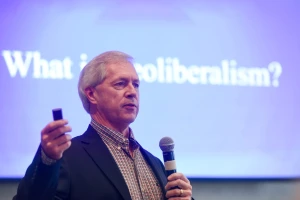
Three years ago, we interviewed Dr. Bruce Rogers-Vaughn (above), an ordained Baptist minister, pastoral psychotherapist and Associate Professor of the Practice of Pastoral Theology and Counseling at Vanderbilt Divinity School, and the author of Caring for Souls in a Neoliberal Age (Palgrave, 2016). “Neoliberalism,” he writes, “has become so encompassing and powerful that it is now the most significant factor in shaping how, why, and to what degree human beings suffer.”
This is why Bruce presses for a “post-capitalist pastoral theology” that empowers people to resist the system (instead of adapt to it), to embrace communion and wholeness in relation to others and the earth (instead of functioning in accord with the values of production and consumption) and to pursue interdependent reliance within the web of human relationships (instead of accepting shame-based personal responsibility narratives).
Above all, Bruce prods pastors, therapists and social workers to identify the source of personal distress in the social and political environment instead of within the individual (he rejects what he calls “sophisticated exercises in blaming the victim”). Oh—one more thing about Bruce. All of his work is informed by his deep roots in southern Appalachia.
This is an excerpt from the beginning of our five-part conversation. See this for Part I, this for Part II, this for Part III and this for Part IV.
—————————————————————————————-
Neoliberalism is simply an awful word. It is almost inevitably misleading. When I first encountered this expression, I imagined it was designating some new (“neo-”) form of political or theological “liberal.” But, actually, the term originates from economic philosophy. Its first proponents—the so-called “German Ordoliberals”—coined the name during the 1930s. Today the word is used, almost exclusively by its critics, to refer to the current phase of capitalism. This phase gained political traction in the USA and the UK in the 1980s, during the Reagan and Thatcher administrations, and by the mid-1990s was the dominant way of thinking and believing that guided global economics, politics, and culture.
My friend Cindy Weber, pastor of Jeff Street Baptist at Liberty in Louisville, Ky., retired last month. Tomorrow, 1 October 2023, her congregation is celebrating her ministry.
She was initially called to serve as associate pastor (1984-1991) and then as pastor (1991-present). The congregation was expelled by the (Southern Baptist) Long Run Baptist Association when Cindy was called as pastor (because she was female).
The congregation’s history traces its roots back to a ministry to the city’s “derelicts, alcoholics, prostitutes, and homeless in 1881.” In the early ‘40s, Clarence Jordan, who would later co-found Koinonia Farm in Georgia, played a role in supporting the mission.
By Jim Perkinson, a sermon for St. Peter’s Episcopal Church (October 1, 2023), a
So, land. A big topic. My wife was recently asked to open a Michigan Climate Summit Conference hosted at Oakland University where she teaches with a formal land acknowledgement and after giving greetings in her native tongue of Kapampangan from the Philippines, the traditional homeland of the Ayta, she offered the following:
I’ve been asked to do the Land Acknowledgment to set the tone for our gathering today and it is fitting that I do so because I, too, am a settler here on Turtle Island. As one Mohawk scholar once said to me once, “It doesn’t matter if your people were brought here through historic colonization, as far as Native peoples are concerned, you are still settlers.” Something I’ve had to sit with for a long time and ponder.
And as protocol goes, it is settlers like myself—not Native peoples—who must acknowledge whose land we’re on—that we are here on Native peoples’ stolen land. And we name this truth not just as pro forma, but as part of the discipline of facing into—and beginning to unlearn—our settler privilege—recognizing that our presence here on this land as non-indigenous peoples means we are beneficiaries not only of native genocide and dispossession, but of other kinds of historic oppressions such as African slavery, U.S. imperialism abroad, and the ecocidal clearing of forests and decimation of wildlife habitat in order to build our cities that’s part of what is driving climate change.
Humanity is naturally separated by language, geography, culture, race, existential narratives, and many other cultural accents that make us uniquely different. We are divided ideologically, politically, racially, by class, belief, faith, and theology. Each group and sub-group has its own ways of expressions and customs, but unfortunately, in one way or another, each group and sub-group claims that its ways and thoughts are uniquely more significant than everything and everyone else in creation. This is human nature where the familiar becomes the norm, and our norms becomes the vehicle by which we evaluate everything and everyone else. For example, in Christianity, Jesus is the way and there is no other way. In Islam, there is no god but God, and Muhammad (Peace be upon him) is the Messenger of God. Historically, Judaism believes that there is only one God who has established a covenant, or special agreement with those of the faith (or traditions). Buddhism believes that life is one of suffering, and that meditation, spiritual and physical labor, and good behavior are the ways to achieve enlightenment, or nirvana and to overcome. In general, Hinduism believes that there are four goals in human life – kama, the pursuit of pleasure; artha, the pursuit of material success; dharma, leading a just and good life; and moksha, enlightenment, which frees a person from suffering and unites the individual soul with Brahman. There are many other cultural- religious understandings in the course of human thinking and they all grapple with the meaning of life, how to effectively live life, and how to live righteously in the human community. Each cultural-religious perspective emerges out of geography and context that frames language, perspective, and understandings.
One day you finally knew what you had to do, and began, though the voices around you kept shouting their bad advice — though the whole house began to tremble and you felt the old tug at your ankles. “Mend my life!” each voice cried. But you didn’t stop. You knew what you had to do, though the wind pried with its stiff fingers at the very foundations, though their melancholy was terrible. It was already late enough, and a wild night, and the road full of fallen branches and stones. But little by little, as you left their voices behind, the stars began to burn through the sheets of clouds, and there was a new voice which you slowly recognized as your own, that kept you company as you strode deeper and deeper into the world, determined to do the only thing you could do — determined to save the only life you could save.
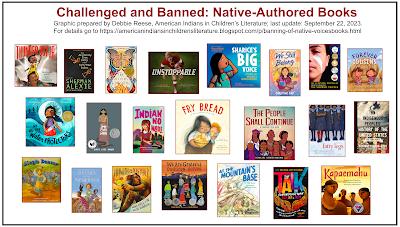
This is reposted from American Indians in Children’s Literature (AICL) which provides critical analysis of Indigenous peoples in children’s and young adult books. AICL was established in 2006 by Dr. Debbie Reese of Nambé Pueblo. Dr. Jean Mendoza joined AICL as a co-editor in 2016.
The year is 2023.
People continue to take from Native peoples and Native Nations. It started with our lands and our children. It included efforts to destroy our nationhood and cultures by making it illegal for us to speak our languages and tell our stories and practice our religions.
We persevered.
In recent years more and more of us are being published. Through books, we are using our voices, telling our stories to our children and yours, too, in pre-school and kindergarten story times and in high school classrooms.
But now, our books–our voices–are being removed from libraries and classrooms.
The concurrence of two calendars brings together two significant historical episodes.
The Sunday morning terrorist bombing of 16th Street Baptist Church in Birmingham, Alabama, killed four children and injured or maimed many others, on 15 September 1963. Bombs targeting the Black community in that city were common, which gave rise to the nicknaming of the city as “Bombingham.” This one, however, was especially hideous.
Though the FBI concluded that known members of Ku Klux Klan were responsible, no one was brought to trial until 1977, when the ringleader, Robert Chambliss, was convicted in the murder of one of those children. Not until 2001 were the other culprits convicted.
Can you imagine the whipsaw emotions of Dr. Martin Luther King, Jr.? Eighteen days before he had been the singular figure in the largest demonstration (to that date) in US history, the 28 August March on Washington for Jobs and Freedom. His “I Have A Dream” speech is considered by many to be the most important speech of the 20th century.
And then he had to pivot to planning funeral services for these murdered children.
Sunset on Friday, 15 September, also happens to be the beginning of Rosh Hashanah, the opening act of the 10-day High Holy Days of Judaism, ending with Yom Kippur, the holiest day in the Jewish liturgical cycle.





 Radical Discipleship