We went to prove we are not something, which is to say We were not all there to do the same thing, which is to say We had our reasons.
Where were you? Fussing with your collar. Quaking with a new knowledge— We are nothing like God, we’ve never met Her. That apple was just a dizzying tumble Into our own dark hollow. We’ll only diminish That which we form in our image and likeness. Our slightness.
What, to the American slave, is your Fourth of July?
I answer: a day that reveals to him, more than all other days in the year, the gross injustice and cruelty to which he is the constant victim. To him, your celebration is a sham; your boasted liberty, an unholy license; your national greatness, swelling vanity; your sounds of rejoicing are empty and heartless; your denunciation of tyrants, brass-fronted impudence; your shouts of liberty and equality, hollow mockery; your prayers and hymns, your sermons and thanksgivings, with all your religious parade and solemnity, mere bombast, fraud, deception, impiety, and hypocrisy-a thin veil to cover up crimes which would disgrace a nation of savages.
The theologian James H. Cone captures this in his masterpiece “The Cross and the Lynching Tree.” Cone says that for oppressed blacks the cross was a “paradoxical religious symbol because it inverts the world’s value system with the news that hope comes by way of defeat, that suffering and death do not have the last word, that the last shall be first and the first last.” Cone continues:
That God could “make a way out of no way” in Jesus’ cross was truly absurd to the intellect, yet profoundly real in the souls of black folk. Enslaved blacks who first heard the gospel message seized on the power of the cross. Christ crucified manifested God’s loving and liberating presence in the contradictions of black life — that transcendent presence in the lives of black Christians that empowered them to believe that ultimately, in God’s eschatological future, they would not be defeated by the “troubles of this world,” no matter how great and painful their suffering. Believing this paradox, this absurd claim of faith, was only possible in humility and repentance. There was no place for the proud and the mighty, for people who think that God called them to rule over others. The cross was God’s critique of power — white power — with powerless love, snatching victory out of defeat.
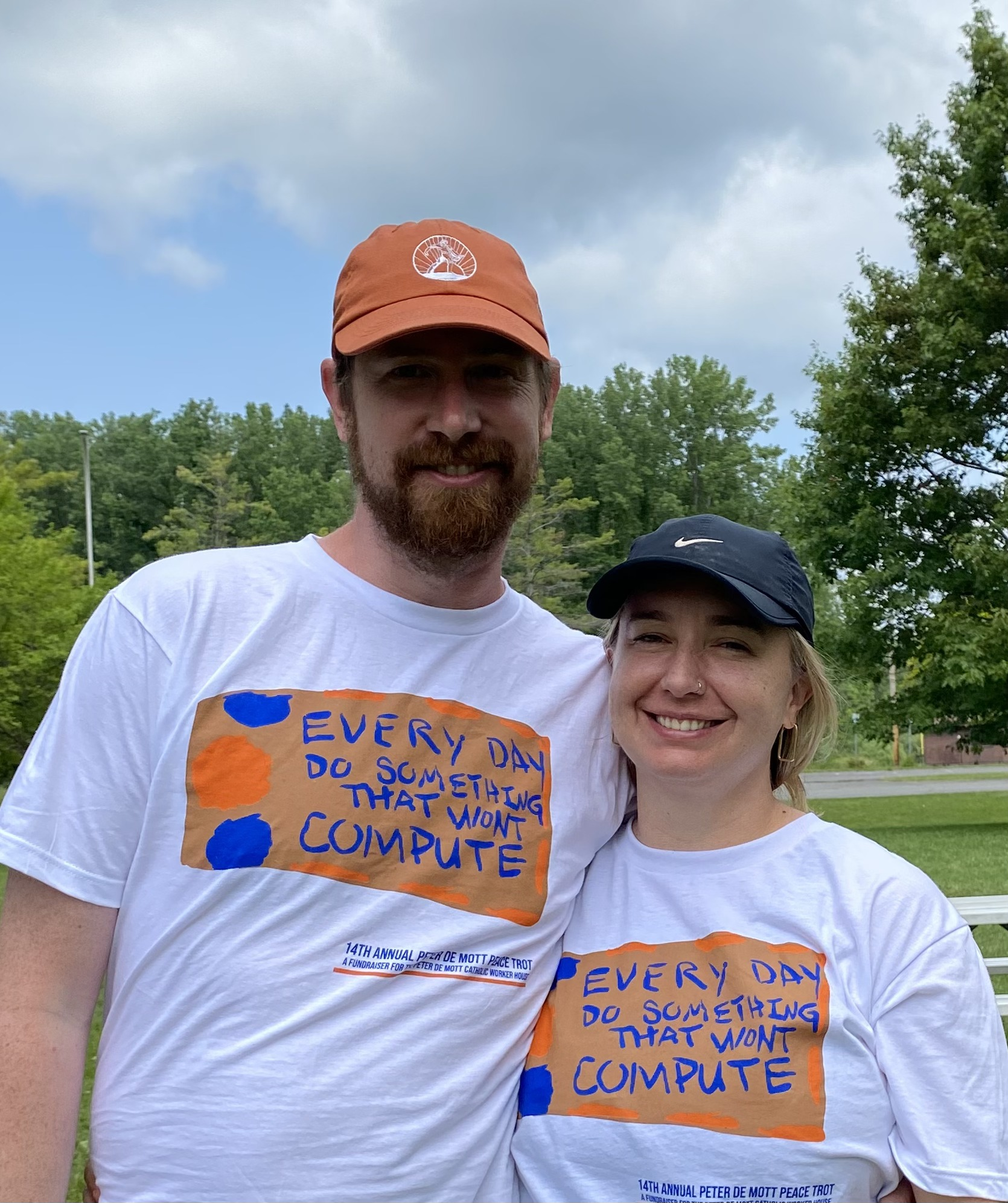
Plenty of radical runners participated in the 14th Annual Pete De Mott Peace Trot last weekend, on Father’s Day, in Ithaca, New York. The race is named after the veteran Catholic peace activist who spent time in federal prison for numerous anti-war protests. This is the pre-race pump up speech from Pete’s daughter Cait De Mott Grady (above, with Mike Williams of Three Lyons Creative).
My mom asked me to say a few words about this year’s Peace Trot t-shirt. The shirt is based on a ceramic tile I made this spring with words from a Wendell Berry poem called Manifesto: The Mad Farmer Liberation Front. The full poem is on the back of this year’s t-shirt, and I encourage you to give it a read.
For those who knew my dad, you likely heard him recite the Mad Farmer poem. This poem was a mantra for my dad, a poem he knew by heart, a poem he looked to as a guide, and a poem whose wisdom became a part of everyday life.
The first stanza of this poem calls out the dominant culture of the United States – a culture that Dr. King powerfully named for us as a culture of rampant materialism, militarism, and racism.
An excerpt from a recent Democracy Now interview with Jonathan Eig, the author of the new bookKing: A Life.
I think it’s really important for us to acknowledge that our heroes have flaws, and if we expect our heroes to be perfect, nobody will ever rise to the occasion. Nobody will even try.
And King was deeply flawed. As you mentioned, he attempted suicide twice as a teenager, jumping from a second-story window of his home when he was upset about, first, an injury suffered by his grandmother and then, later, by her death. And when he won the Nobel Peace Prize, he was hospitalized at the time for what he called anxiety, but for what Coretta described as depression. He was hospitalized numerous times throughout his life because the pressure had just gotten to him so badly.
On Juneteenth, we open up Toni Morrison’s Beloved. This passage comes right after Indigenous people, who refused to move to the reservation, cut off the shackles of Paul D, a man who escapes slavery and stays with them in the Southern woods.
“Paul D finally woke up and, admitting his ignorance, asked how he might get North. Free North. Magical North. Welcoming, benevolent North. The Cherokee smiled and looked around. The flood rains of a month ago had turned everything to steam and blossoms.
‘That way,’ he said, pointing. ‘Follow the tree flowers,’ he said, ‘Only the tree flowers. As they go, you go. You will be where you want to be when they are gone.’
So he raced from dogwood to blossoming peach. When they thinned out he headed for the cherry blossoms, then magnolia, chinaberry, pecan, walnut and prickly pear. At last he reached a field of apple trees whose flowers were just becoming tiny knots of fruit. Spring sauntered north, but he had to run like hell to keep it as his traveling companion.”
An excerpt from a 1993 interview with Walter Brueggemann entitled “Why Prophets Won’t Leave Well Enough Alone.” Thank you Rev. John Maine (Kitchener, Ontario) for passing it along!
I believe the large truth surrounding us today is that the white, male, Western, colonial hegemony has collapsed by the mercy of God. The collapse of that hegemony means that we have a chance to reorganize and reconfigure all social relationships. True prophets are prophets who act in the direction of that collapse and are working at reorganizing social relationships, and false prophets are people who want to keep pretending that they can jack up the white, male hegemony and keep it going. The pastoral task, then, is to help people face the reality of the collapse and relinquish those old assumptions of privilege, priority, and power
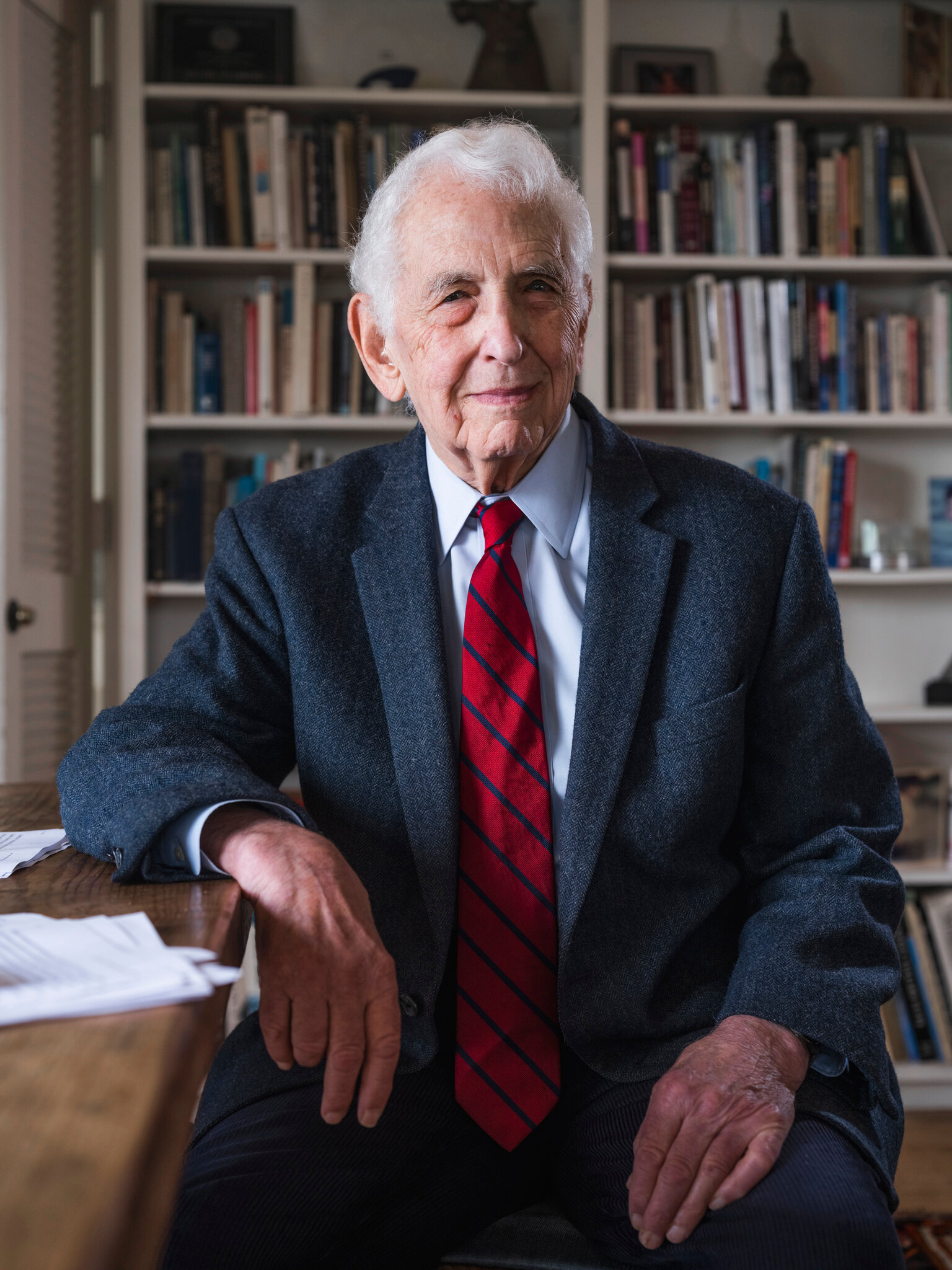
Today, we celebrate the life of Pentagon Papers whistleblower Daniel Ellsberg (1931-2023), who transitioned to the great cloud of witnesses on Friday. This is a letter he wrote to friends and supporters three months ago, reposted from Common Dreams (March 2, 2023).
Dear friends and supporters,
I have difficult news to impart. On February 17, without much warning, I was diagnosed with inoperable pancreatic cancer on the basis of a CT scan and an MRI. (As is usual with pancreatic cancer–which has no early symptoms–it was found while looking for something else, relatively minor). I’m sorry to report to you that my doctors have given me three to six months to live. Of course, they emphasize that everyone’s case is individual; it might be more, or less.
I have chosen not to do chemotherapy (which offers no promise) and I have assurance of great hospice care when needed. Please know: right now, I am not in any physical pain, and in fact, after my hip replacement surgery in late 2021, I feel better physically than I have in years! Moreover, my cardiologist has given me license to abandon my salt-free diet of the last six years. This has improved my quality of life dramatically: the pleasure of eating my former favorite foods! And my energy level is high. Since my diagnosis, I’ve done several interviews and webinars on Ukraine, nuclear weapons, and first amendment issues, and I have two more scheduled this week.
An opening paragraph from Orisanmi Burton’s “Targeting Revolutionaries: The Birth of the Carceral Warfare Project, 1970-1978” in Radical History Review. The entire article is available for free here.
By Kateri Boucher, a homily for a Pride Celebration at St. Peter’s Episcopal Church (Detroit, MI) on June 4, 2023. Click here to watch the video version (homily starts around minute twenty-six).
It is a powerful thing to be celebrating this holiday in this space, with this community. I don’t take it for granted that we can gather here today in this way. It was only in 1976, 46 years ago, that the Episcopal church officially became open and affirming. As we know, there are many other streams of the Christian tradition that have done so even more recently, or still haven’t yet.
There are many people who believe that the phrase “queer Christian” is an outrage or an oxymoron. And I can feel it coming from both sides… I’ve joked with my friends that coming out as queer was not a very big deal for me, which I’m very grateful for, but coming out as Christian to my queer friends has caused a bit of a stir. People are like, “Oh my gosh… Are you okay? Can we support you?” Just yesterday I was at a brunch with a bunch of young queer folks and I told someone I work for a church. It was kind of uncomfortable. They were kind of like, “Why?”

 A timely