By Mahmoud Darwish, translated by Naseer Aruri and Edmund Ghareeb


By Mahmoud Darwish, translated by Naseer Aruri and Edmund Ghareeb

By Mosab Abu Toha (above), a Palestinian poet from Gaza. Follow him on Twitter here.
I’m sick of journalists who keep asking us if we have “hope after the ceasefire.”
Stop calling it a ceasefire.
It is not a ceasefire when thousands of Palestinian bodies, many of them children, remain buried beneath the rubble for months, while Israel continues to block the entry of the heavy equipment needed to retrieve them.
It is not a ceasefire when the Rafah border crossing remains sealed.
It’s not a ceasefire when reconstruction materials are blocked, when even basic necessities like tents, mattresses, blankets, and clothing are not allowed in for displaced families.
It is not a ceasefire when thousands of critically ill and wounded people are trapped in Gaza, unable to be evacuated for treatment because of Israel’s ongoing, brutal siege.
Continue reading “It’s Not a Ceasefire”From Palestinian poet Mosab Abu Toha.
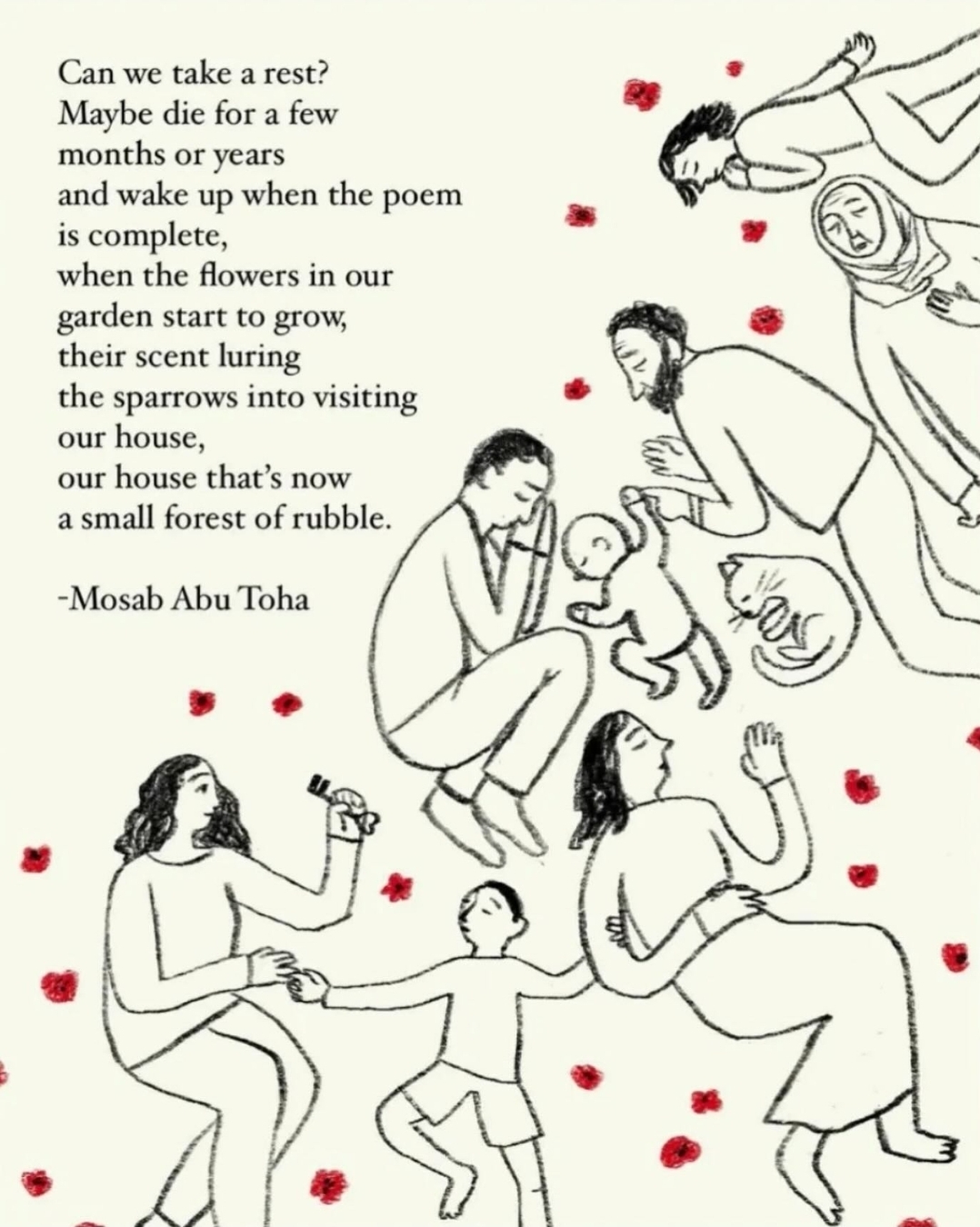
A poem by Darius Simpson in memory of Assata Shakur, who died on Friday. Reposted from X.


From the Free Leqaa Kordia IG Page
On March 13th, on the 523rd day since the start of the genocide in Gaza, Leqaa was kidnapped and sent to Texas.
Today is day 678 of the genocide that has taken almost 200 of Leqaa’s family members lives and day 155 since Leqaa has been confined at Prairieland Detention Center for speaking out against the genocide.
This page was created by Leqaa’s loved ones to ensure that her story and the reason why she was confined — for protesting the ongoing genocide of her family and people in Gaza — does not fall through the cracks. We must stand up for Gaza and for Leqaa.
Leqaa is currently represented by Texas Civil Rights Project (@txcivilrights), CUNY CLEAR(@cuny_clear), Muslim Advocates (@muslimadvocates), Waters Kraus Paul & Siegel, and Boston University School of Law Immigrants’ Rights Clinic. Leqaa’s Official page: @freeleqaakordia
Artwork by: @shirien.creates
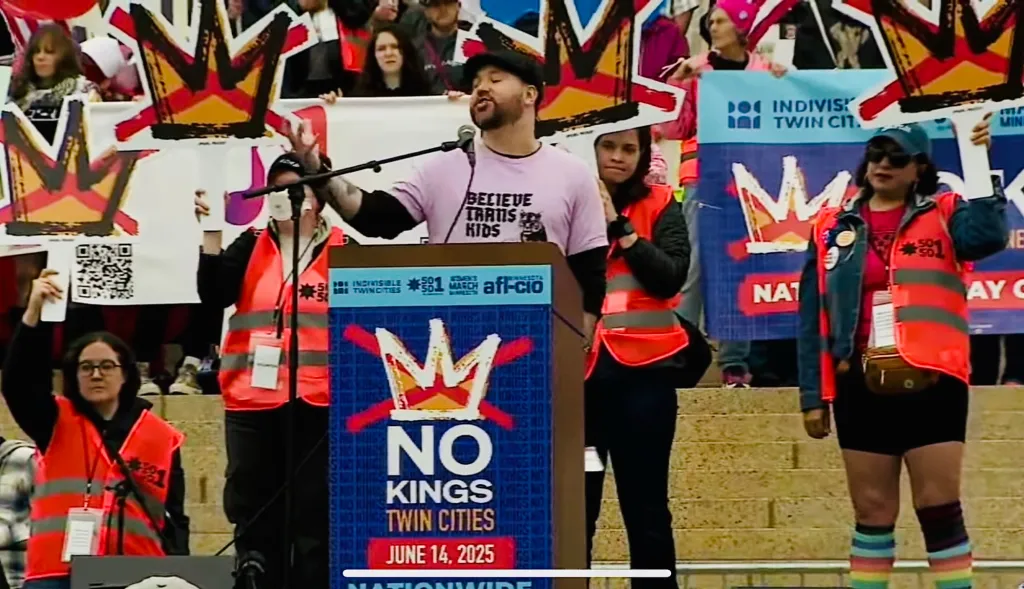
By Kyle “Guante” Tran Myhre, a poet and activist cultivating a deeper engagement with social justice issues, one based in both empathy and agency. Re-posted from his website here
I don’t have time/energy right now to share very much commentary; hopefully people are aware of the news here in Minnesota. Our No Kings rally went forward, and even with authorities telling people not to gather, thousands of people showed up. I shared a poem.
Actually wrote and memorized it last week, but because it ended up being about grief, how we carry it, and what we might do with it, it felt appropriate to share today too. Full text below, for the folks who have been asking for it.
ALSO: please check out the latest post in my FREE email newsletter: What’s next? Things to do after a big march
———————-
The ancestor on my shoulder doesn’t tell me to put the brick down, or that the weight isn’t worth it. I’m sure many of you are familiar with that… heaviness, whether guilt, or grief, or just the daily shipwreck of the news, all this information we already know:
How things are bad. How they’ve always been bad for some of us, and how shining a light on the bad thing doesn’t change it… but can be a first step. How a big march like this can be a first step, but is never a destination. How going “back to normal” is going backwards. And how desperately the cowards in power want you going backwards, want you to put that brick down, want you to focus on your job, make money—focus on your family.
Continue reading “no kings, all bricks”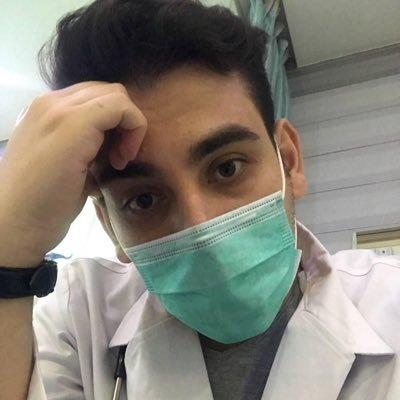
From Dr. Ezzideen Shehab (above), re-posted from social media on April 25, 2025. Support the publication of his first book here. Support his medical clinic in Northern Gaza here.
This morning, the heralds of decay, UNRWA and the World Food Programme, proclaimed what was already written in the bones of the living: the flour is gone, the food is spent, and the age of starvation has officially begun.
No more bread for the condemned.
No more hollow ceremonies of distribution.
Now, the mask has been torn away: the people are sentenced to death by hunger, and the world has chosen not to hear the verdict.
Behold! There is no economy, no labor, no dignity of exchange. The body, stripped of its last illusions, becomes an animal clawing at the dust. The soul, once capable of hope, sinks into a silent, grey despair.
Continue reading “Something Far Worse”
From Olly Costello, re-posted from social media (04.22.2025). Mohsen Mahdawi’s pre-trial hearing is this morning.
Friends, I know there is so much grief. So many people needing our attention and support. I am amplifying Mohsen’s story because he is a dear friend of some dear people in my life.
Mohsen is another Palestinian Columbia student, fighting for human rights who has been abducted by ICE. He has not been charged with any crime and the DoJ has not given a reason for his detention. His pretrial hearing is TOMORROW morning.
There are a few asks from his community for support that you can find on slide 3. If you can’t spare financial support, consider writing him a letter. Contact your congressional leaders and demand they take action on behalf of Mohsen and all our community members facing persecution for their status and advocacy. Please share his story and watch this incredible interview he did with CBS the day before his abduction.
I hope you will join me and so many others continuing to fight against the violence of detention, incarceration, state violence and growing fascism here and around the world.
Continue reading “Continuing to Fight”
Another excerpt from Chris Hedges’ interview with Omar El-Akkad, the author of the newly released One Day Everyone Will Always Have Been Against This (2025). Really, you must listen to the entire interview here.
I describe myself as a pacifist, as a fairly committed proponent of nonviolence. But I have the privilege of saying those words in a relative vacuum, a vacuum created by the fact that I live on the launching end of the bombs. I live within the heart of the empire. And so two things come into clarity that I wish hadn’t, but being as though they have, I need to address them.
The first is my right to tell anybody under a state of occupation how to resist that occupation, which is no right at all. I have zero right to tell anybody anywhere who lives under occupation and injustice how to resist that occupation and that injustice. Particularly when there is no acceptable form of resistance in the view of the institutions doing the oppressing. You engage in boycotts, that’s economic terrorism. You try to march peacefully, you are shot with the intent to kill and or maimed. You boycott cultural institutions, you are being illiberal. You take up arms, you are a terrorist, and you will be wiped out. All you can do is die. That is your only acceptable form of resistance. So first of all, I have absolutely no right to tell anybody how to resist their occupation or a state of injustice.
But second, I can sit here and I can tell you how committed I am to nonviolence. And I can believe that fully. But by virtue of the society I live in, by virtue of what my tax dollars are being used to do, I am one of the most violent human beings on earth. And I can’t simply brush that away and say, hey, I haven’t thrown a punch since I was 15 years old, I’m fully committed to non-violence. I am part of a society that exercises great industrial violence. And at the very least, I should acknowledge that. And that makes it much, much more difficult to then go around parading my views about how violence as a whole. Sure, it does, but I am actively engaged in it right now. That has been a very difficult thing to contend with and I wish I had a sort of easy wraparound answer for it, but I don’t.

This is an excerpt from Chris Hedges’ interview with Omar El-Akkad, the author of the newly released One Day, Everyone Will Always Have Been Against This (2025).
A long time ago I was at a literary festival up in Canada and literary festivals in Canada started with land acknowledgements well before US festivals started doing the same. And we were sitting there, we were about to start our event and one of the organizers gets up and says, just before we begin, you know, I just want to take this time to acknowledge the really important acknowledgement that we are on unceded indigenous territory and to also thank the hedge fund that is sponsoring this event. And I was like, this is the most honest land acknowledgement I’ve ever heard.
I think of it, particularly this idea of after the fact acknowledgement as, and maybe this is particularly cynical of me, but I think of it as a continuation of theft. You steal land, you steal lives, and what’s left to steal at the end but a narrative? The narrative that absolves all that came before. You know, when I wrote the title of this book when I was first thinking about it, I wasn’t thinking in terms of weeks or even years. I was thinking if I’m fortunate enough to live the average lifespan in this part of the world, maybe by the end of my life, I’ll be watching a poetry reading in Tel Aviv that begins with a land acknowledgement. I think it’s a fundamental part of any system of endless taking, which, you know, colonialism and whatever stage of capitalism we’re in are fundamentally part of. There are very few systems as well-versed in after-the-fact shame and after-the-fact guilt as the ones that are predicated on endless taking.
And you see it all over the place. I mean, there’s an incredible poetry collection by a Layli Long Soldier called “Whereas,” which is all about sort of repurposing and undermining a U.S. government declaration that basically said, sorry about all that genocide, indigenous people, sorry about the theft. And it was passed in the most sort of bland manner hundreds of years after the fact. And that is such an important part of the entire project. We can all be sorry afterwards. The taking happens now and the apology comes later. It’s a hallmark of every colonial society.
The thing that makes it so dangerous to acknowledge right now is that we’re not after the fact. We’re in the middle of the fact. And so the people who disagree with the content of this book or with the assertion of that title are going to disagree vehemently until one day they don’t have to. And then they’re going to acknowledge it and there will be no repercussions and we can sit around and listen to a very flowery land acknowledgement when it’s too late to do anything about it.
 Radical Discipleship