A final message from Alice Wong, the author of Disability Intimacy: Essays on Love, Care and Desire. This was posted on Twitter on November 15, 2025.
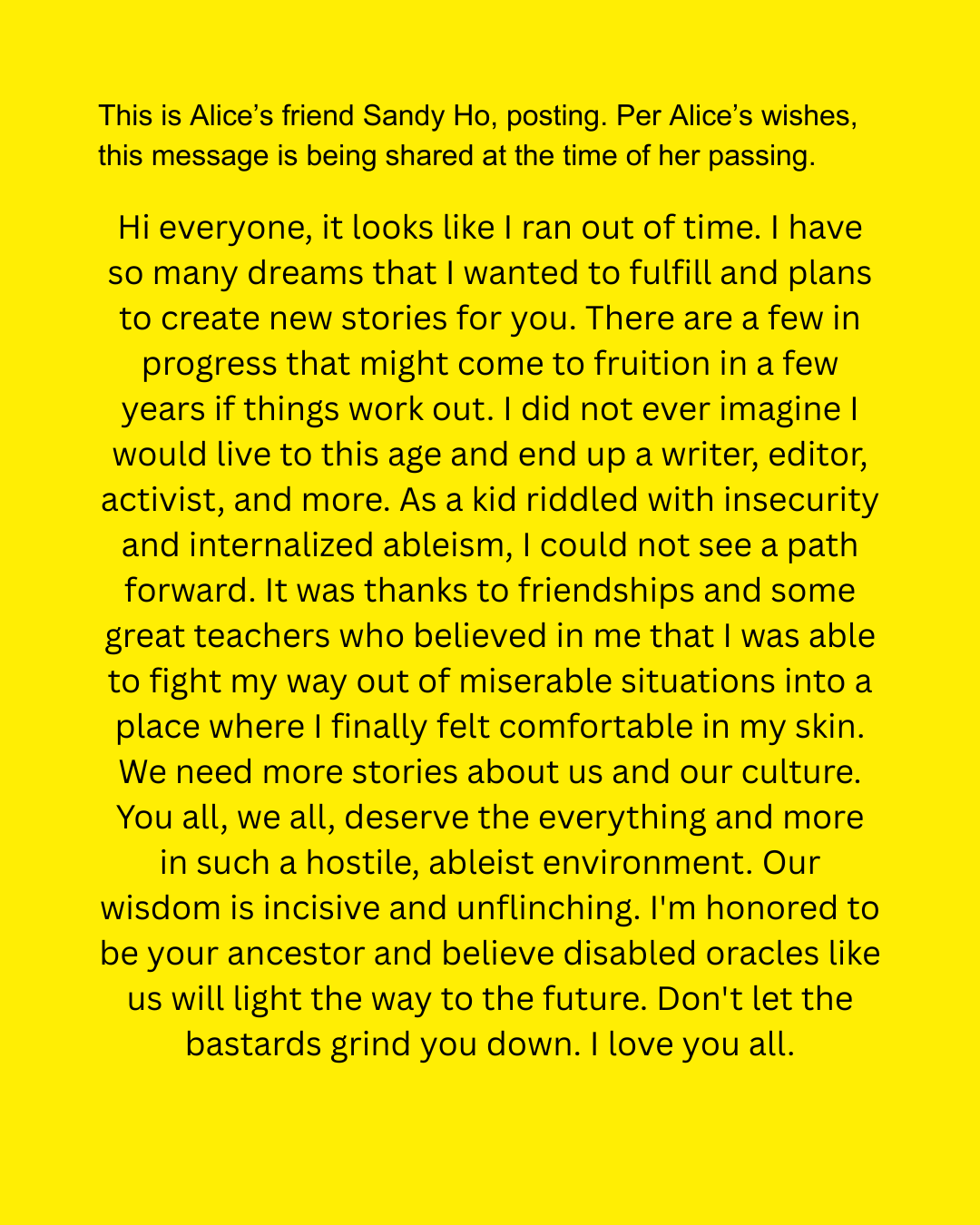

A final message from Alice Wong, the author of Disability Intimacy: Essays on Love, Care and Desire. This was posted on Twitter on November 15, 2025.
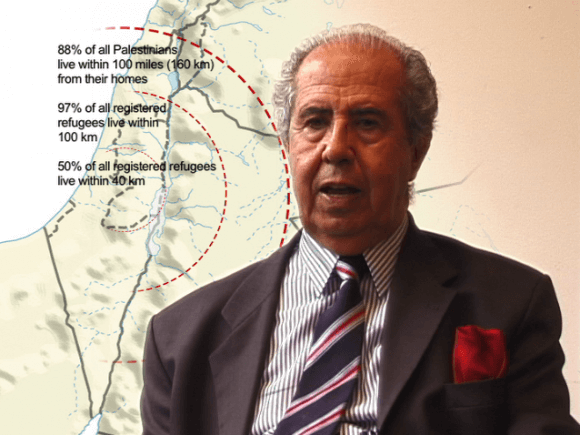
By Salman Abu Sitta, a Nakba survivor and the founder and president of Palestine Land Society, re-posted from Facebook on 9/3/25.
A MESSAGE TO AN AMERICAN JEWISH PROFESSOR
Dear Prof xxx
For many years you wrote scholarly “moderate” articles on Zionism and Israel.
Yesterday you wrote that “Israel has a right to exist” is not in question.
As a Palestinian who was born in Al Ma’in Abu Sitta, I ask a simple personal non academic question: will this state exist on my land?
If yes, I do not agree, never did, never will.
My family was attacked by Zionist militia on 14 May 1948 and our landscape was destroyed. We became refugees ever since. Four kibbutzim were built on my land.
Continue reading “We Shall Return”
From Kendra Savusa, a Palestinian-American artist (above) in the US South. This is a re-post from social media (12.18.2024). Follow and support her work here.
I used to think part being a good Christian woman meant holding my tongue all the time, something I’ve never been good at—and in some cases, that is still the wisest thing to do. But this past year, every time I’ve wanted to remain silent, I’ve felt an overwhelming push from God to speak.
So here I am, day 437, still speaking.
To my fellow Christians who have chosen silence, who have clung to what they’ve always been taught, who have stood with the powerful instead of the oppressed—I’m asking you to reconsider.
This week at my church, we reflected on Jesus washing His disciples’ feet—the ultimate act of humility and service. What would it look like for us, as His followers, to lower ourselves in the same way, to serve those we’ve been taught to fear or dismiss?
I pray that 2025 is the year you “find a Palestinian” (in the words of my friend, Amy) and allow yourself to be humbled enough to learn from them.
Continue reading “Find a Palestinian”
This is Dean Hammer’s review of a new book edited by Arthur Laffin and Carole Sargent called Arise and Witness: Poems by Anne Montgomery, RSCJ.
Note: Sr. Anne Montgomery was a nonviolent witness in war zones in the Holy Land and Iraq, and endured years of imprisonment due to her involvement in Plowshares actions. Her poems are rooted in her love for accompanying the marginalized, borne out of her experience of religious life and community. Most of these poems, now published posthumously, provide unique and rich biblical insights into what it means to be human and a faithful follower of Jesus. This volume serves as both a powerful spiritual anchor and a source of inspiration for all who seek to be a radical witness of truth and hope. Drawing on her experience as a religious, teacher and peacemaker, Anne’s poetry offers powerful scriptural insights that can sustain people’s hope.
Thanks to the skillful and loving work by the editors of Arise and Witness, we are gifted witha posthumous memoir of Sr. Anne Montgomery: poet, mystic, and witness par excellence. While composing this review, I heard Anne’s voice from the heavenly realm protesting the lauding of her extraordinary life: “the story is not about me,” she insisted. Indeed, her story and poetry portray her hopefulness, undaunted by the chaos and violence of our world. Her theopoetic reflections invite us to share her connection with “the God who proclaims peace: the merciful, the advocate, the restorer” (71). Her narrative reveals a lived profession: “The light shone in the darkness and the darkness could not extinguish the light” (22).
In the prologue, Facing the Darkness, Anne cites Denise Levertov, a sage protest poet and mentor of peacemaking: “A voice from the dark called out, the poet must give us imagination of peace…peace, a presence, an energy field more intense than war.” Anne traveled to places of great suffering (Palestine, Iraq, Bosnia, Guantanamo, and various jails as prisoner of conscience) bearing witness to the Light, the mystical force peace and compassion. She “practiced resurrection” (Wendell Berry).
Continue reading “Arise and Witness”
Rev. James Lawson died yesterday. He was 95. Here are some compelling things about his life that we can meditate on and emulate today (curated from a few biographies and obituaries).
Lawson became a “conscientious objector” during the Korean War. In April 1951, he was found guilty of violating the draft laws of the United States, and sentenced to three years in a federal prison. Upon his release from prison, Lawson returned to Baldwin-Wallace and earned his bachelor’s degree.
In 1956, Lawson entered Oberlin College’s Graduate School of Theology. In 1957, one of Lawson’s professors introduced him to the Reverend Dr. Martin Luther King, Jr., who urged him to move south and aid in the Civil Rights Movement.
“Don’t wait! Come now! We don’t have anyone like you down there,” MLK pleaded, according to author David Halberstam’s history of the civil rights movement, The Children. Rev. Lawson was outwardly “mild and gentle,” wrote Halberstam, “but he was a true radical Christian who feared neither prison nor death.”
Continue reading “A True Radical Christian”
A message of solidarity with Gaza encampments on college campuses, from the National Council of Elders, a coalition of veteran Civil Rights and Peace Activists.
The National Council of Elders calls upon all people to embrace the courageous students demanding a ceasefire in Gaza, an end to the occupation of Palestine by the Israeli government, and the divestment of university funds that support weapons and War.
As veterans of the great liberation movements of the twentieth century, we understand that young people demanding justice and peace are critical to creating more compassionate, responsible societies. Their visions and values of the future are being practiced in encampments on campuses as they construct
communities to care for each other, to learn together, and to develop concrete processes for change.
The consciousness and sensibilities of today’s students has been shaped by actions stretching over the last decade. With Occupy Wall Street, climate justice actions, Me Too, and the Movement for Black lives, students have been demonstrating courage and tenacity in the face of ever escalating repression. Many are stepping forward for the first time and recognizing their power to create change.
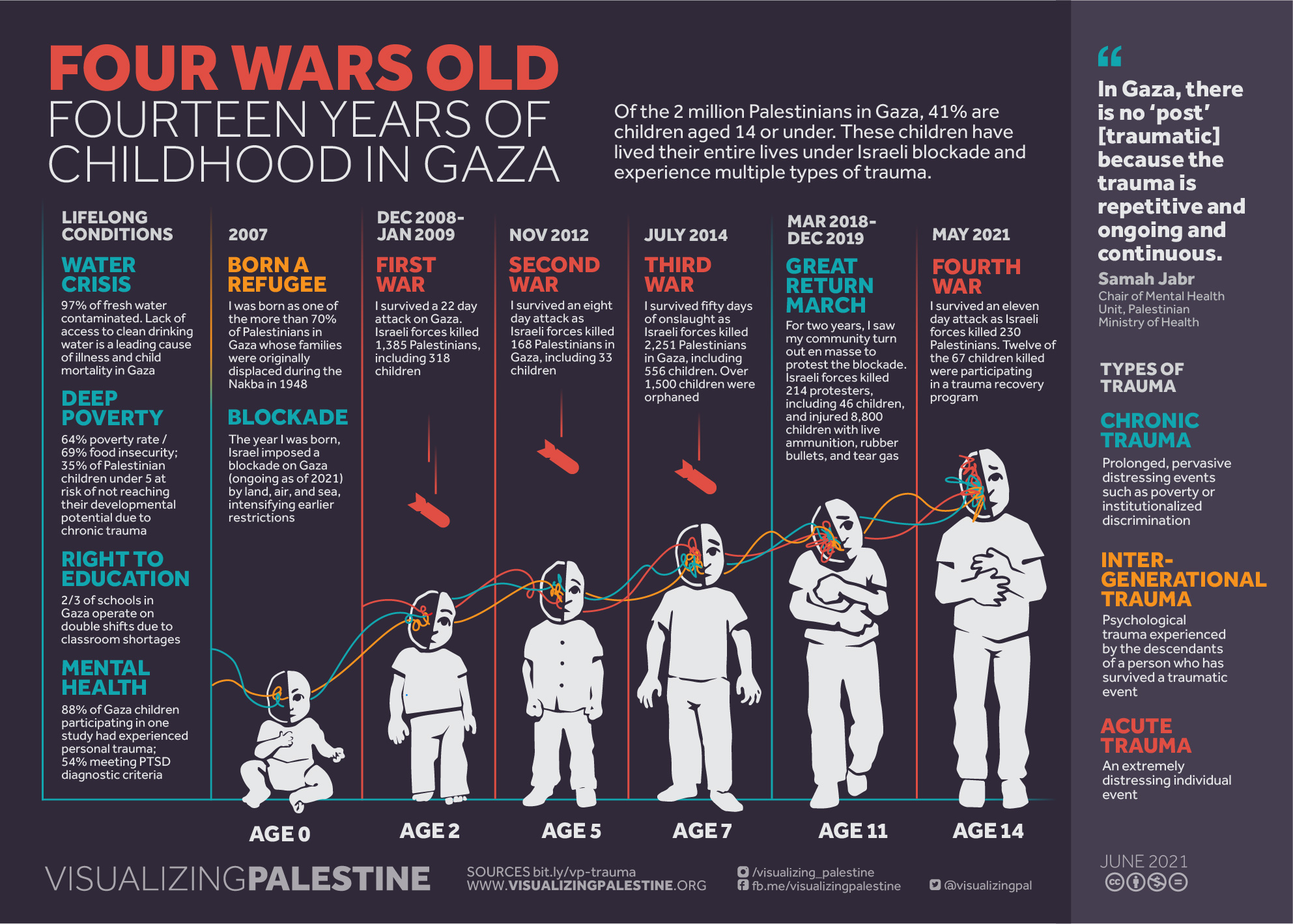
Continue reading “The Courageous Students”One piece of propaganda claims that Hamas broke a ceasefire on October 7. This image, created in June 2021, uncovers the historical truth.

A Twitter thread from Iyad el-Baghdadi (above), the founder of Kawaakibi Foundation and the author of The Middle East Crisis Factory
I’m a Palestinian and I do not enter conversations or debates that are premised upon my own dehumanization. Such as:
– Palestine doesn’t/didn’t exist
– Your people aren’t a people
– Go back to Jordan (or Hejaz, or Arabia)
– You are the colonialists
– You don’t belong here (this is our ancestral homeland, not yours)
– Palestinian refugees aren’t refugees
– You left your homes in 1948 and 1967 out of your own accord
– You were squatters in historic Jewish land
– Yes we kicked you out from your land but get over it, it’s ours now, get over it

In early November 2023, author Ta-Nehisi Coates came on Democracy Now to talk about the mass murder of Palestinian civilians in Gaza – and to share his own experiences in the Occupied Territories earlier that year. He was asked to comment on remarks made by White House Press Secretary Karine Jean-Pierre who compared pro-Palestinian protesters to the white supremacists who took part in the deadly Unite the Right rally in Charlottesville, VA in 2017. This is how Coates responded.
I’m sure she’s a very, you know, nice person and a very, very kind person. But, you see, all of us stand on the shoulders of Martin Luther King. All of us stand on the shoulders of the nonviolent struggle. And on King’s birthday, the White House, like it’s done for years, stands up, and, you know, it praises Dr. King, and it talks about Dr. King as our modern-day prophet. I don’t know how these people do that and sleep at night. I don’t know how you compare people who are trying to stop a war, who are very much in the tradition of nonviolence, who are trying to stop bombs being dropped, literally, on refugee camps, to neo-Nazi protesters. It’s disgraceful, to use her own words. It’s disgraceful. It’s reprehensible. It is offensive, as far as I am concerned, to the shoulders on those whom we stand right now. I just — I don’t understand it.
I would extend this further. I mean, I think hearing President Biden himself — and here I will personalize it — downplay the number of Palestinian deaths, to say that he doesn’t believe the Palestinians, I just — when his own State Department was citing those figures only months ago, you know? At some point, you know, there’s that saying: When people show you who they are, you have to believe them. And so, I’ve spent a lot of time trying to do the political calculus on this. And I think at a certain point we have to just stop and say, “They believe it.” They believe it. They believe bombs should be dropped on children. They just think it’s OK. They think it’s OK, or at the very least they think it’s the price of doing business.
Continue reading “The Test is What You do in the Moment Right Now”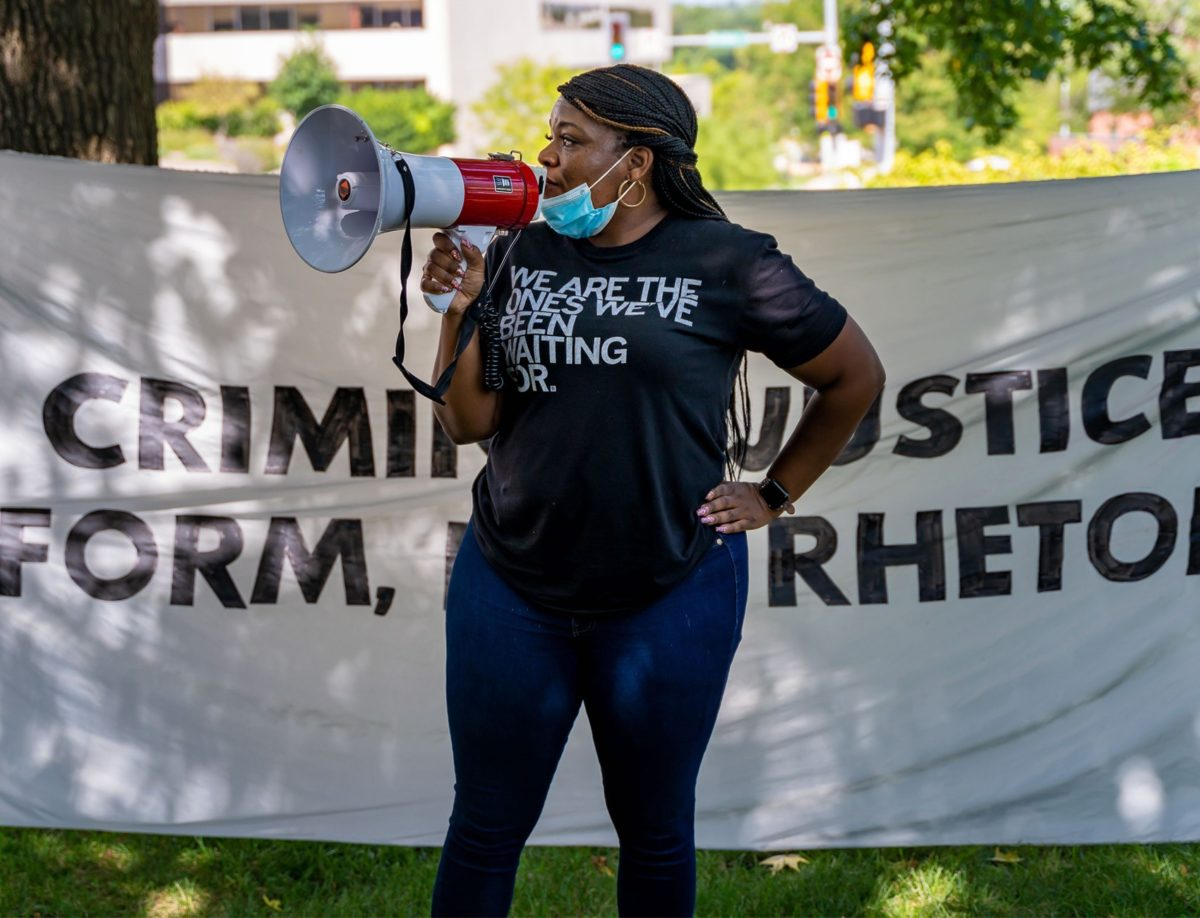
 Radical Discipleship