The Woman Who Built a Soulmaking Room


Jester_Risher
John August Swanson’s image “The Jester” seems to capture the story of the Shunammite woman who builds a room for the holy. Support more of John’s incredible art and revolutionary vision (in affordable cards, prints) at http://johnaugustswanson.com/.

By Dee Dee Risher. Part of the continuing series on biblical women.

The Bible comes to us out of a patriarchal culture. At the same time, I believe firmly that the hand of the Spirit of God shaped what was recorded, however troubling or puzzling; however these recordings may reflect the dynamics of oppression in this world rather than the creative liberation I feel is core to the reign of God. I hold these two realities in tension.

Because of this conviction, I pay constant attention to the stories of women who do break into Scripture. Most of them are, predictably, relegated to the margins. They can appear sidekicks to the “real” stories of the (male) prophets, kings, patriarchs, warriors, and holy men. Yet hidden precisely within these “narratives of the margins” are the rankling questions that upset the power structures and interrogate our assumptions about God. Continue reading “The Woman Who Built a Soulmaking Room”
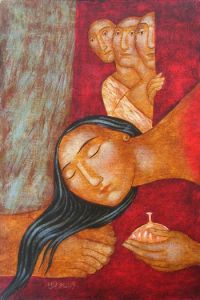
Collecting Healing

This WomanBy Grace Aheron

I address the crowds within me:
Rustling robes of people I know only from dreams,
Childhood friends with small hands,
My parents–
One who left his body behind.

When I take steps in this world,
They slosh within me.
Sometimes, a bit of my mother
Spills out
When I take a turn
Too quickly.
The heart of a beloved
Sails forth through a cage of ribs
When I raise my arms in praise. Continue reading “Collecting Healing”

Infinite Circles: Celebrating Female Friendship in the Bible and Beyond

By Cara Curtis, a lifelong Quaker, a student at Harvard Divinity School, and a fan of noodles of all kinds. This piece is part of the ongoing series on badass biblical women.IMG_3146

When I think about the idea of “badass women of the Bible,” my mind immediately jumps to the several courageous and fierce ladies of scripture who pull off daring and deeply powerful acts. The Magnificat is a downright badass poem. Esther was clearly not one to be messed with. Ruth has a whole book commemorating her faith and story. I celebrate these women in all of their strength and power, as well as the many others like them whose acts of faith and bravery were not preserved for us in the canon. But you know that saying, “behind every successful man is a strong and wise woman”? In my experience, this is just as true of successful women–in fact, I’ve often found that it takes a whole community of women encouraging and supporting each other for acts of deep caring, bravery, justice, and truth telling to become possible. Simply put, badass women help each other be more badass! Continue reading “Infinite Circles: Celebrating Female Friendship in the Bible and Beyond”

Learning from Laughter AND THE TREES

taize2
The first tree we climbed in Taize France in 2008.

By Lydia Wylie-Kellermann.

It has been eight wonderful years being with Erinn and as I look back I am struck by the trees. Leaves and branches and carpets of needles weave together our love story. At twenty-one, we climbed up an old tree laughing as we listened to the bells ring from the Taize monastery at the top of the hill. That tree led us to the hillsides in Palestine where we fell in love with the Olive trees as we watched them go up in flames from the Israeli-shot tear gas canisters. Soon, we lay together in a hammock beside my mother’s grave held in a circle of cedars imagining a life together. Then we committed our lives to one another under a red maple on the banks of the Tahquamenon River as we broke bread and shared wine. Soon, on a cold April day, we stood in a foreclosed yard covered by budding fruit trees staring up at a house where we would build a life. In that yard, the peas now climb the handcrafted cedar and grapevine arbor that canopied our vows. It was an apricot tree I was pruning when contractions began with Isaac. Continue reading “Learning from Laughter AND THE TREES”

An Upside Down World

upside down worldBy Joyce Hollyday

A frigid wind sent snow dancing and swirling through the streets of Washington, DC, that Christmas Eve. Shopping carts and paper bags loaded with years’ worth of collected string, cans, broken umbrellas, and other street items had been dragged in out of the cold and were parked in the foyer of the church that served as an overnight shelter. The women who owned them were finishing a dinner of soup and bread, made special by dozens of sugar cookies that had been baked and decorated by the church’s children. Continue reading “An Upside Down World”

Mary and Elizabeth

mary and elizabeth.jpgBy Lydia Wylie-Kellermann

Reflection written up from a homily given at St. Peter’s Episcopal Detroit on December 20, 2015.

Luke 1: 39-56

I wonder about the beginning of this reading. “Mary went with haste….” It seems like there are three possibilities for this. First is that she was so excited and filled with anticipation that she fled to a friend she loved. I think this is our most common interpretation. But I think it more likely the second or third possibility. Either she was sent away out of shame and embarrassment for three months. Or as I did more reading, it seems likely that being pregnant and not married with her status was actually cause for being stoned to death. She may have been fleeing for her life. Continue reading “Mary and Elizabeth”

The Most Interesting Woman in the World

samaritan womanBy Rose Marie Berger. Continuing series on badass biblical women.
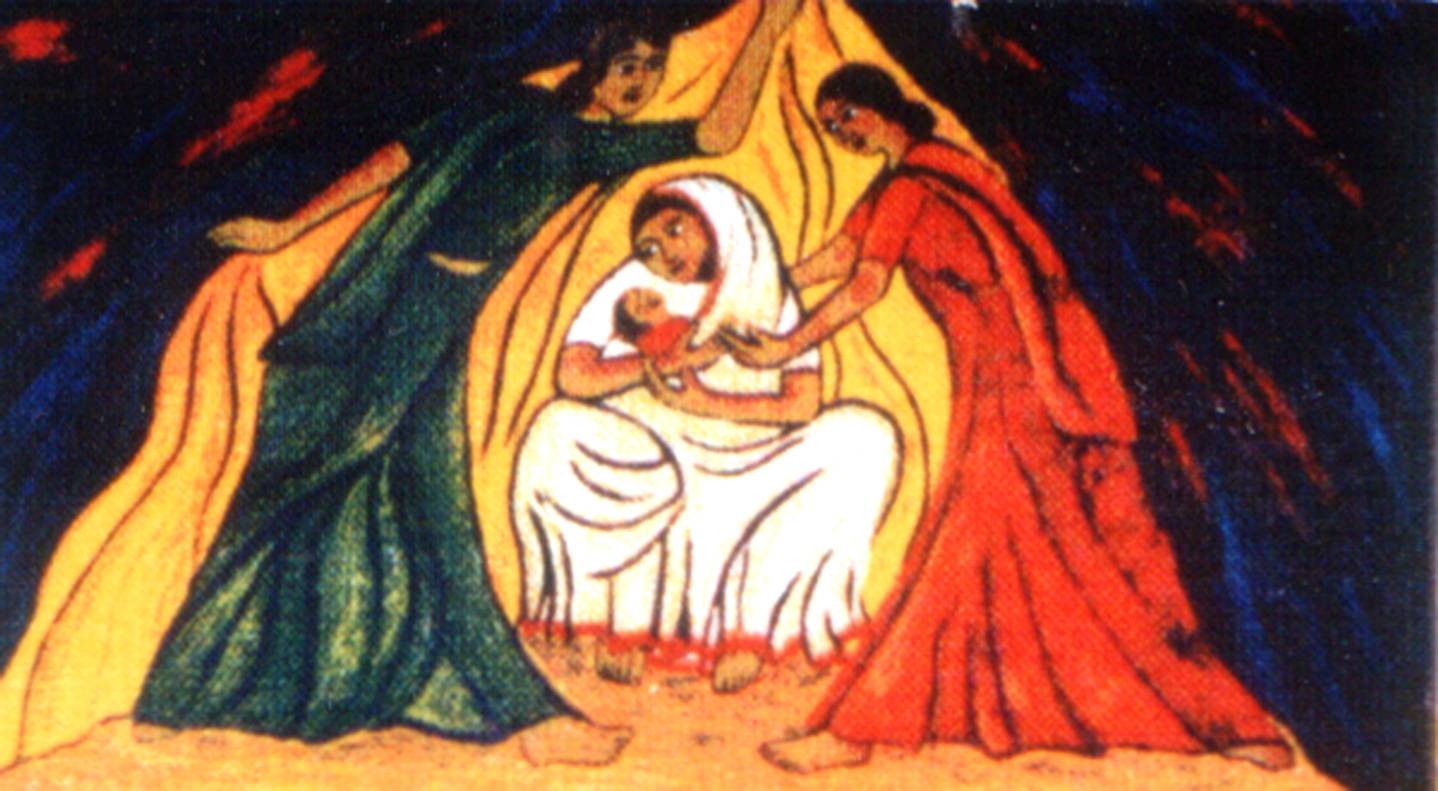
Have you seen the Dos Equis commercials starring actor Jonathan Goldsmith as “the most interesting man in the world”? “People hang on his every word,” the narrator intones, “even the prepositions.” Though the ad is clever and funny, the “Stay thirsty, my friends” tagline makes clear that what’s being sold is unquenchable thirst.

Contrast this with the Samaritan woman Jesus meets at the well. What’s on offer in John 4 is “living water.” But obtaining it requires a more daring leap than the short-term gains of “Interesting Man’s” carpe diem philosophy.

Who is the Samaritan woman with whom Jesus holds his longest discussion in the gospels? First, let’s clarify what she is not. She is not a whore, nor promiscuous. She’s not spiritually dead or “hopelessly carnal,” as some male interpreters have claimed. Continue reading “The Most Interesting Woman in the World”

Reflections on the Hebrew Midwives

midwivesThird post in the series on radical biblical women. Written by Amanda Dalosio who lives in NYC with her family and is part of the New York Catholic Worker community.

Exodus 1:15 The king of Egypt said to the Hebrew midwives, one of whom was named Shiphrah and the other Puah, 16 “When you act as midwives to the Hebrew women, and see them on the birthstool, if it is a boy, kill him; but if it is a girl, she shall live.” 17 But the midwives feared God; they did not do as the king of Egypt commanded them, but they let the boys live. 18 So the king of Egypt summoned the midwives and said to them, “Why have you done this, and allowed the boys to live?” 19 The midwives said to Pharaoh, “Because the Hebrew women are not like the Egyptian women; for they are vigorous and give birth before the midwife comes to them.” 20 So God dealt well with the midwives; and the people multiplied and became very strong.

The account of the two midwives, Shiphrah and Puah, is set in a scene of overwhelming cruelty and oppression. The King of Egypt has enslaved the people of Israel having set taskmasters over them to oppress them with forced labor Ex1:11 who are ruthless in all the tasks that they imposed on them Ex 1:14. Yet out of this misery comes a moment of great courage. The women disregard the edict of death imposed by the empire and instead choose to remain faithful to life. And so is recounted the first biblical example of individual moral resistance to an empire.        Continue reading “Reflections on the Hebrew Midwives”

Lift the Ban on Women Priests: An Open Letter to Pope Francis

royby Roy Bourgeois

Dear Pope Francis:

In 2012, after serving as a Catholic priest for 40 years, I was expelled from the priesthood because of my public support for the ordination of women. My expulsion from the priesthood by Pope Benedict came just five months before you became our Pope.

As Catholics, we are taught that men and women are created equal: “There is neither male nor female. In Christ you are one.” (Galatians 3:28). Pope Francis, why can’t women be priests? Continue reading “Lift the Ban on Women Priests: An Open Letter to Pope Francis”

Learning from Laughter: Wedding Veils and Wrestling

familyBy Lydia Wylie-Kellermann.

Isaac pulls a green sheet off the floor puts it over his head and says “You getting married.” (He still refers to himself as “you”). He brings Patrick, the life-size stuffed dog out of his room and stands him up to pretend they are getting married. I don’t know where he got the idea, but all I can do is smile and say “You look beautiful.”
Continue reading “Learning from Laughter: Wedding Veils and Wrestling”