Conflicting Memorials: The Lord’s Table of Remembrance vs. The Nation’s Vow of Preeminence

Ken SehestedBy Ken Sehested

My earliest memory of Memorial Day is of my Dad, puttering in his garage shop (he was a mechanic and jack-of-all-trades fixer-upper) on a rare day off from work, listing to the Indianapolis 500 car race on a portable radio. On one of those occasions I remember using a hammer, and the concrete garage floor, helping him straighten nails for reuse.

Both my parents were children of the Depression. Thrift was a primal virtue even when it was no longer a necessity.

I have no doubt Dad would silently recall some of his war-time experience while enduring the monotony of listening to race cars doing 200 laps around an oval track at speeds in excess of 200 mph. He managed to survive being in the first wave of troops landing at Omaha Beach in the 1944 D-Day invasion of Europe, though I can remember only once in my life when he talked about those days. I was an adult before I knew he carried a bit of 88mm German artillery shrapnel, bone-embedded, behind his right ear.
Continue reading “Conflicting Memorials: The Lord’s Table of Remembrance vs. The Nation’s Vow of Preeminence”

Para Todos

Cop CameraA charge before “An Interfaith Day of Prophetic Action,” a protest in downtown Los Angeles (04.13.2017) over recent actions by U.S. Immigration and Customs Enforcement agents:
We will be sanctuary for all.
No exceptions.
Not one more.
No more separating families.
Para Todos.
This is just the beginning.
There will be a next one until justice prevails.
An organized community is a secure community.
We will abide by the principles of nonviolent resistance.
We will stay focused.
We will stay in prayer.
We will stay in the radical love of God.

Chelsea Manning: Free At Last

ManningBy Tommy Airey

Today, as a result of one of Barack Obama’s last actions in the White House, Chelsea Manning, real American hero, walks free after 2,545 days in military captivity.  We celebrate Manning, particularly the powerful contributions she made towards subversively exposing the ever-violent truth in an imperial context and for enduring 2,545 real-life episodes of The Handmaid’s Tale.  Manning’s actions were truly apocalyptic (from the Greek apokalypsis meaning “unveiling” or “revealing”).

In July 2013, we drove 40 miles from Washington D.C. to Fort Meade, Maryland for the closing arguments of Manning’s trial.   We joined 32 other spectators in the courtroom and three dozen others in an overflow portable with closed-circuit TV coverage of the trial. Most of these folks were curious activists who wore black shirts with TRUTH scrawled on the front. On the day we attended the festivities, the lead attorney for the prosecution took up six hours for his closing remarks (in contrast, the next day, the defense took three hours). He called Manning an “informational anarchist” and repeatedly claimed that Manning was only motivated by his quest for notoriety while methodically doing whatever it took to cover up his misdeeds.
Continue reading “Chelsea Manning: Free At Last”

The Wild Edge of Sorrow

wellerA Review By Tommy Airey

I’m someone who strictly reads books with a pen in hand. I do, after all, have standards. Francis Weller, though, is someone who writes books that force me to rearrange my standards for what gets underlined. His recent release The Wild Edge of Sorrow: Rituals of Renewal and the Sacred Work of Grief (2015) follows that trend. One-fourth of my copy is penned up. If I applied normal standards, though, it would easily be two-thirds. Paragraphs swim through waves of sentences pounding the reader with profundity. For the most part, I’m a typically unexpressive, work-it-out-in-my-head white heterosexual male. Weller, though, sparks something deeper in me. I found myself nodding, slapping inanimate objects, muttering out loud “Yep, holy shit.” An example from early in the book:

What I have come to see is that much of the grief we carry is not personal; it doesn’t arise from our histories or experiences. Rather, it circulates around us, coming to us from a wider expanse, arriving on unseen currents that touch our souls.

Weller is drawing on thirty years of experience in the therapy room, concisely summarizing Jung and Freud, relaying many stories that arise from clients. But he also peppers us with quotes from poets like Rilke and Rumi, Mary Oliver and David Whyte. The icing on the cake is the way he draws on indigenous wisdom and soul-tenders like Pema Chodron and John O’Donohue. Continue reading “The Wild Edge of Sorrow”

A Society Gone Mad on War

billDay 4 of our Lenten Journey with Dr. King’s “Beyond Vietnam” Speech

Since I am a preacher by calling, I suppose it is not surprising that I have seven major reasons for bringing Vietnam into the field of my moral vision. There is at the outset a very obvious and almost facile connection between the war in Vietnam and the struggle I and others have been waging in America. A few years ago there was a shining moment in that struggle. It seemed as if there was a real promise of hope for the poor, both black and white, through the poverty program. There were experiments, hopes, new beginnings. Then came the buildup in Vietnam, and I watched this program broken and eviscerated as if it were some idle political plaything on a society gone mad on war. And I knew that America would never invest the necessary funds or energies in rehabilitation of its poor so long as adventures like Vietnam continued to draw men and skills and money like some demonic, destructive suction tube. So I was increasingly compelled to see the war as an enemy of the poor and to attack it as such.
—————–
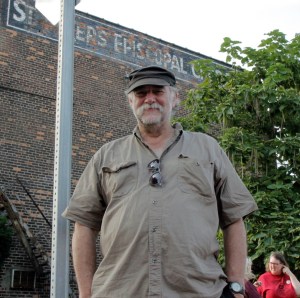
“A Lent Beyond Despair” By Rev. Bill Wylie-Kellermann (photo above) of St. Peter’s Episcopal Church in Detroit

As we begin the contemplative foray into Dr. King’s seven words on the war, it is well worth considering the overall structure of those reasons for resistance. The first three view the war through the lens of the reigning principalities of the U.S. domination system: materialism, white racism, and militarism: 1) that the war is an attack on the poor, dismantling programs of support in order to fund it, 2) that it is a racist war, sending young men in brutal solidarity to burn huts in Vietnamese villages, who wouldn’t be able to live next door in Detroit, and 3) that he couldn’t preach nonviolence to young people on the street without also opposing the “greatest purveyor of violence in the world today – my own government.” He will subsequently name these the “giant triplets,” the ruling powers of domination. Continue reading “A Society Gone Mad on War”

Sanctuary: To Stand and Suffer With

alexiaAn excerpt from the recent Christian Century interview with Alexia Salvatierra:

We sense that there are a lot of churches that can’t participate in the sanctuary movement because it is more radical than they are willing to be, including immigrant churches. We are creating something called the Matthew 25 Movement. It consists of individuals and congregations that pledge to protect and defend the vulnerable in the name of Jesus. This can mean a variety of things. There are churches that will pray and educate and give money. Others will participate in the creation of safe zones… Continue reading “Sanctuary: To Stand and Suffer With”

Not Always Black & White

lynn-hurBy Lynn Hur, originally published in The Mennonite and on the ReconciliAsian blog

The classroom is silent, apart from the ticking of the clock and the shifting of a chair. My English teacher looks at us pensively as my classmates awkwardly look around, waiting for someone to speak up. We had been beginning to read To Kill a Mockingbird, and the inevitable subject of race had been brought up again. My friend tells the teacher that she cried watching the assigned documentary following the Scottsboro Trials, and how she couldn’t believe the injustice of it all. Heads nod in agreement. I respond, commenting that this isn’t just something that happened, but is happening today as well. My teacher nods once again, agreeing. I try to continue, but get cut off. “Moving on,” he says. “You guys can talk more about that in a history class. We don’t have time to get too deep into the details.” Continue reading “Not Always Black & White”

Save the Date: Beyond Vietnam as a Lenten Devotional on RadicalDiscipleship

mlk3.jpgBeloved Community,

RadicalDiscipleship invites you to journey with us through the 40 days of Lent by reading and reflecting daily on Martin Luther’s King’s “Beyond Vietnam.”

March 1-April 16 Continue reading “Save the Date: Beyond Vietnam as a Lenten Devotional on RadicalDiscipleship”

#FaithJustice: Sacred Right to Rest

laborBy Grecia Lopez-Reyes, Organizer with Clergy and Laity United for Economic Justice, originally posted on the Law At The Margins blog

For the past year and half I have worked as a Faith-Rooted Organize for Clergy and Laity United for Economic Justice (CLUE). I educate, organize, and mobilize the community of faith to walk in intimate solidarity with workers and their families fighting for a living wage, respect, and better working conditions in industries such as the Ports of Los Angeles and Long Beach. The ports are an industry that thrives from the sweat and labor of misclassified Port Truck Drivers. Due to misclassification, drivers are considered independent contractors and not employees, which requires for workers to be responsible for paying the lease of their trucks, maintenance, insurance, and fuel to name a few of the costs. Misclassification makes these drivers vulnerable to wage theft, while also denying them of benefits such as overtime pay, worker compensation, and health care. Read more here: “The BIG RIG Poverty, Pollution, and the Misclassification of Truck Drivers at America’s Ports a survey and research report.Continue reading “#FaithJustice: Sacred Right to Rest”