Drowning in Whiteness

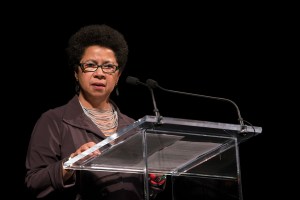
SeattleA [re]post from Ijeoma Oluo’s speech at “Interrupting Whiteness,” an event held on June 1, 2017 at the Central Library in Seattle, co-hosted by KUOW Public Radio.

Hi, I am Ijeoma Oluo, and I am a mixed race black woman who was raised by a white mother in this very white city.

I have a Ph.D. in whiteness, and I was raised in “Seattle nice.” I was steeped in the good intentions of this city and I hate it. I love this city. I love you guys. Also, I hate it. I really do.

And I’m going to talk a little bit about why. I write about race, and I’m regularly reached out to by really well-meaning white people who want to explain to me what my work is like to them as a white person and the white perspective that I’m missing.

And the only part of the white perspective I’m missing is the ability to be unaware of the white perspective. Continue reading “Drowning in Whiteness”

I Will Have My Voice

Gloria AnzalduaFrom Gloria Anzaldua in “How To Tame A Wild Tongue:”

So, if you want to really hurt me, talk badly about my language. Ethnic identity is twin skin to linguistic identity – I am my language. Until I can take pride in my language, I cannot take pride in myself. Until I can accept as legitimate Chicano Texas Spanish, Tex-Mex, and all the other languages I speak, I cannot accept the legitimacy of myself. Until I am free to write bilingually and to switch codes without having always to translate, while I still have to speak English or Spanish when I would rather speak spanglish, and as long as I have to accommodate the English speakers rather than having them accommodate me, my tongue will be illegitimate.

I will no longer be made to feel ashamed of existing. I will have my voice: Indian, Spanish, white. I will have my serpent’s tongue — my woman’s voice, my sexual voice, my poet’s voice. I will overcome the tradition of silence.

Ella Baker’s Group-Centered Leadership

Ransby
Dr. Barbara Ransby at the Lannan Foundation’s In Pursuit of Cultural Freedom series in 2016 (PC: Dan Usner).

An excerpt from Dr. Barbara Ransby’s “Ella Taught Me: Shattering the Myth of the Leaderless Movement,” originally published at Colorlines.com: 

Those who romanticize the concept of leaderless movements often misleadingly deploy [Ella] Baker’s words, “Strong people don’t need [a] strong leader.” Baker delivered this message in various iterations over her fifty-year career working in the trenches of racial-justice struggles, but what she meant was specific and contextual. She was calling for people to disinvest from the notion of the messianic, charismatic leader who promises political salvation in exchange for deference. Baker also did not mean that movements would naturally emerge without collective analysis, serious strategizing, organizing, mobilizing, and consensus-building. Continue reading “Ella Baker’s Group-Centered Leadership”

When Networking Goes Wrong: The Trouble With “Come Meet a Black Person”

jyarlandBy Jyarland Daniels, CEO and Founder of Harriet Speaks

I wish we lived in a world where I didn’t have to write this blog post. But, alas, when bad ideas arise, some people need an explanation for why the idea is bad and we should just throw the entire thing away. So, here goes… For 400 years – before and since Emancipation — among Black people, there have been differing ideas on how to get free; on how to escape the system of racism that exists as a web, touching all aspects of our existence from cradle to grave. There have been those who have advocated patience, hoping that the oppressors would change their ways. There have been those like Harriet Tubman who, while willing to work with white people who supported her cause, did not seek to change the minds of her captors. Tubman, and others like her, simply took their freedom and invited other enslaved persons who understood that their humanity was neither something to be given by another nor had to be earned, to join their efforts. Today, too, those differences remain. The latest example of how to get free can be found in a networking event just outside of Atlanta, Georgia, created by a Black person, inviting white people to, “Come Meet a Black Person.” Continue reading “When Networking Goes Wrong: The Trouble With “Come Meet a Black Person””

The Problem is the System Working the Way it is Supposed to

ChokeholdFrom author and legal analyst Paul Butler in a conversation with Michelle Alexander about his recent release Chokehold: Policing Black Men:
My Brother’s Keeper is a program for African-American boys and men, boys of color and men, Latinos and Native-American men as well. And, at this [Obama] White House ceremony, there were people you’d expect to be there, like, the major leaders of the civil rights organizations. And, some people who you might not expect, like, Mayor Bloomberg, Bill O’Reilly, a lot of people.
Continue reading “The Problem is the System Working the Way it is Supposed to”

Decommissioning Whiteness

BayoAn excerpt from Bayo Akomolafe’s “Homo Icarus: The Depreciating Value of Whiteness and the Place of Healing.”  Dr. Akomalafe is globally recognized for his poetic, unconventional, counterintuitive, and indigenous take on global crisis, civic action and social change. He is the author of the about to be published These Wilds Beyond Our Fences.

To address Charlottesville is to meet the implosion of white order and normativity. It is to go by way of a prevalent distrust in the political order, a coming to terms with the real limits to the power of neoliberalism to cater to our basic needs and yearnings as an ever-emerging co-species. It is to touch upon the silent racialized class war that is still being fought – only under other names and so invisibly as to now be expected. It is to exorcise the demons of fruitless wanderings and search for land. It is to meet those who are broken, who – like the rest of us who might claim some sanity or goodness to ourselves, who might consider ourselves on the right side of history, who might think of ourselves as progressive and welcoming to diversity – are not yet at home. Continue reading “Decommissioning Whiteness”

Black Women & Equity at UPenn

JyarlandBy Jyarland Daniels (right), founder of Harriet Speaks, doing diversity differently by providing a Black voice and perspective in diversity, equity, & inclusion

Today my newsfeed greeted me with a story of a PhD student assistant at The University of Pennsylvania with the following headline:

This instructor calls on black women first and white men last. Critics want her fired.

In a world where we are bombarded by information and everyone wants to be in the know, going beyond the headline can seem passé. Yet, being “Headline Hoppers” is one way we give our implicit consent for the media to dominate the narrative on race in a way that does not reflect reality; these narratives are why, in a recent study, 55% of whites reported they believe they are discriminated against, but a much smaller percentage say they have actually experienced this discrimination. Continue reading “Black Women & Equity at UPenn”

A Harmless, Non-Offensive Ornament

ConeFrom James Cone’s The Cross and the Lynching Tree (2013):

Unfortunately, during the course of 2,000 years of Christian history, this symbol of salvation has been detached from any reference to the ongoing suffering and oppression of human beings—those whom Ignacio Ellacuría, the Salvadoran martyr, called “the crucified peoples of history.” The cross has been transformed into a harmless, non-offensive ornament that Christians wear around their necks. Rather than reminding us of the “cost of discipleship,” it has become a form of “cheap grace,” an easy way to salvation that doesn’t force us to confront the power of Christ’s message and mission. Until we can see the cross and the lynching tree together, until we can identify Christ with a “recrucified” black body hanging from a lynching tree, there can be no genuine understanding of Christian identity in America, and no deliverance from the brutal legacy of slavery and white supremacy.

Moral Activism

PovertyThe Poor People’s Campaign is growing, organizing for action in 2018.  Sign up to join the coalition of 25,000+ here.  A summary from Rev. William Barber:

A truly moral agenda must be anti-racist, anti-poverty, pro-justice, pro-labor, transformative and deeply rooted and built within a fusion coalition.  It would ask of all policy, is the policy Constitutionally consistent, morally defensible and economically sane.  We call this moral analysis and moral articulation which leads to moral activism.