Loaves, Fishes and Forced Starvation

By Rev. Margaret Ernst, on behalf of Christians for a Free Palestine

This past Sunday, I guest preached at a church in Pennsylvania and one of the songs we sang was “Rain Down,” by Jaime Cortez. I swayed to the music, but my breath caught in my chest when we reached the end of the second verse. “God will protect us from darkness and death,” the line goes, “God will not leave us to starve.”

God will not leave us to starve.

Images of Palestinians starving — children, elders, people of all ages — flashed in my mind.

I felt a physical pain in my heart. We sing these proclamations of faith in a God who provides and does not let God’s children starve, I thought silently. Yet Palestinians are starving, right now.

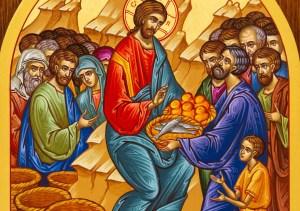
The Bible is full of stories about food. Manna in the desert. Loaves and fishes. Like his Palestinian kin who are known for their hospitality, Jesus is always feeding people. Teaching, yes, but feeding people too.

Continue reading “Loaves, Fishes and Forced Starvation”

Unwrapped

St. Mark’s Episcopal Church in Washington D.C. (PC: Lindsey Jones-Renaud)

By Tommy Airey, re-posted from his weekly newsletter (12.22.2004)

On the first Christmas day, right after Mary the unwed pregnant teen gave birth to her first child, the Gospel of Luke says that she wrapped him in bands of cloth and laid him in a manger.

Because there was no room in the inn.

On Good Friday, much later in Luke’s story, a rich man named Joseph took down the body of Jesus from the cross, wrapped him in a linen cloth and laid him in a tomb.

Continue reading “Unwrapped”

Sabbath Economics

By Ched Myers (above, at the US/Mexico border), a commentary on Luke 12:13-21, reposted from the BCM July 2022 E-News

Note: The comments (and slides) below were crafted for the Los Angeles Catholic Worker community this month. The lectionary reading for the 8th Sunday in Pentecost (July 31st) features the unequivocal, doesn’t-mince-words Jesus offering a warning tale about persons and systems. Those of us who come from economic and social privilege should pay special attention to this passage. So we offer this piece (part of my new book project entitled Jesus against Plutocracy: Sabbath Economics in Luke’s Gospel)…

When we approach this text we need to acknowledge that economics is exceedingly difficult to talk about in most of our churches, more taboo than politics or sex. Jesuit theologian John Haughey summarized the dilemma. Yet no aspect of our individual and corporate lives is more determinative of our personal and political world than economics—and few subjects are more frequently addressed in our scriptures.

To read the rest, click here!

Luxury Communist Jesus

communistAn excerpt from Michael J. Sandford’s “Luxury Communist Jesus: Ideology, the Work Ethic, and the Antiwork Politics of Jesus” (2012).

Jesus discourages his followers from working and encourages them not to worry about the provision of material needs. The gospels give a strong impression, however, that such behaviour will not lead to impoverishment, but rather to abundance. The Jesus of the gospels does not endorse the “worldly asceticism” (Weber) of the Protestant ethic. Rather, Jesus appears to live lavishly, when the opportunity for such indulgence arises, as the comparisons that are drawn between Jesus and his disciples and the ascetic John the Baptist suggest. In Luke’s Gospel the Pharisees and scribes state, “The disciples of John fast often and offer prayers, and so
do the disciples of the Pharisees, but yours eat and drink” (5: 33). Jesus
himself seems to agree that “John the Baptist has come eating no bread
and drinking no wine” (7: 33). On the other hand, Jesus states that people call him “a glutton and a drunkard” (7: 34). In stark contrast to John,
Jesus is accused of living indulgently; an accusation which neither he nor
the narrator rejects. Continue reading “Luxury Communist Jesus”

Third Way Farm’s Internship Program

Third Way FarmA Meaningful Way of Life:
Being an intern at Third Way Farm is a well-rounded, full-bodied experience. Not only does this program deeply immerse a person into the daily rhythms of life on a diversified farm and in the care of its ecosystem, but it also invites participants into a community whose life carries purpose and meaning beyond the confines of the farm itself. Participating in this age-old and ever-critical human work of growing food and caring for the land will open you to pathways of life and wholeness within yourself and the world around you, enriching you in ways that will serve you on whatever journey that lies ahead. Changing the world, amidst the ever complexifying crises of climate change, economic injustice, food justice, and more, begins with remembering and living into who we truly are as humans: members and caretakers of this rich web of abundant, God-given life in Creation. If we learn together how to lovingly nurture the life all around us, growing wholesome food from the soil under our feet and with the animals that enrich it and us, we will not only bless ourselves, our families, and our local community with live-giving food, but will be contributing to the preservation of this world for generations to come. So, we invite you to come, learn, grow, and be transformed with us as an intern at Third Way Farm!

Whether you are considering sustainable agriculture as a vocation or way of life, or are interested in organic farming and just want to have an experience living it for a season, this internship program is for you! Continue reading “Third Way Farm’s Internship Program”

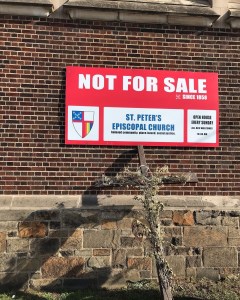
Sermon: St. Peter’s is Not for Sale

IMG_1878Sermon by Denise Griebler,
St. Peter’s Episcopal Church, November 17, 2019

Isaiah 65:17-25
Malachi 4:1-2a
Luke 21:5-19

May we see like God sees and hope like God hopes.  And may we not be afraid to live by that sight and that love in the meantime. Amen.

These scripture passages each get us thinking about the end. Nothing like beginning with the end.  But since we are dealing with these readings so rooted in apocalypse, maybe we are on the right track.

Imagine this community, this city, this country, this world that is going to pieces in so many places – whether by poverty or war or climate reckoning – and hear the words of Isaiah again: “I am about to create new heavens and a new earth; the holy city as a joy and a place where I will rejoice in my people the way they take care of each other – no more inconsolable weeping, no body in distress, babies get to live and old people get to  live our their days.  People enjoy the fruits of their labor, have homes to live in, food to eat.  Predators will cease terrorizing of the vulnerable and they will eat side by side. Healing and peace will come to the whole community. Continue reading “Sermon: St. Peter’s is Not for Sale”

Too Big—and Failing! Jesus’ Cure for Affluenza

DropsyBy Ched Myers, on Luke 14:1-14

Note: This is part of a series of weekly comments on the Lukan gospel readings from the Revised Common Lectionary during year C, 2016. This week’s gospel text is related to last week’s; see the background comments for last week here. Much of the post below is adapted from a sermon given at Downers Grove (IL) First United Methodist Church on 10/10/10.

Luke 14:2-6 is unaccountably skipped over in the lectionary. Yet it is profoundly germane to last week’s reading, and moreover introduces the theme of the whole sequence through 14:24: namely, the issue of how social power and privilege is mirrored in meals, and what to do about it. So I strongly advocate re-instating this beginning episode as part of this Sunday’s gospel. Continue reading “Too Big—and Failing! Jesus’ Cure for Affluenza”

Healing as Liberation from Crippling Debt

DebtBy Ched Myers, on Luke 13:10-17

Note: This is part of a series of weekly comments on the Lukan gospel readings from the Revised Common Lectionary during year C, 2016.

This part of Luke’s gospel offers two symbolic stories about the healing of “political bodies” that signify pathology in the body politic: the “bent over” woman (13:10-17) and the “too big” man (14:1-6). Sadly, the second of these is (literally) skipped over by the lectionary. These intimately related healings bracket a series of Jesus’ sayings concerning the Kingdom as surprise and mystery (13:18-21), the “narrow Way” (13:22-30) and the cost of prophetic discipleship (13:31-35). Continue reading “Healing as Liberation from Crippling Debt”