The Unexpected Victories of Insurgents

ZinnFrom Howard Zinn’s A People’s History of the U.S. (Chapter 24: The Coming Revolt of the Guards):

History which keeps alive the memory of people’s resistance suggests new definitions of power. By traditional definitions, whoever possesses military strength, wealth, command of official ideology, cultural control, has power. Measured by these standards, popular rebellion never looks strong enough to survive.

However, the unexpected victories-even temporary ones-of insurgents show the vulnerability of the supposedly powerful. In a highly developed society, the Establishment cannot survive without the obedience and loyalty of millions of people who are given small rewards to keep the system going: the soldiers and police, teachers and ministers, administrators and social workers, technicians and production workers, doctors, lawyers, nurses, transport and communications workers, garbage men and firemen. These people-the employed, the somewhat privileged-are drawn into alliance with the elite. They become the guards of the system, buffers between the upper and lower classes. If they stop obeying, the system falls.

That will happen, I think, only when all of us who are slightly privileged and slightly uneasy begin to see that we are like the guards in the prison uprising at Attica—expendable; that the Establishment, whatever rewards it gives us, will also, if necessary to maintain its control, kill us.

Certain new facts may, in our time, emerge so clearly as to lead to general withdrawal of loyalty from the system. The new conditions of technology, economics, and war, in the atomic age, make it less and less possible for the guards of the system-the intellectuals, the home owners, the taxpayers, the skilled workers, the professionals, the servants of government-to remain immune from the violence (physical and psychic) inflicted on the black, the poor, the criminal, the enemy overseas. The internationalization of the economy, the movement of refugees and illegal immigrants across borders, both make it more difficult for the people of the industrial countries to be oblivious to hunger and disease in the poor countries of the world.
Empire Cracking: An Interview on Spiritus Christi

spiritusThis interview was taken by Lydia Wylie-Kellermann as part of a writing project for Geez Magazine entitled “She is Breathing: Listening for Another World and an End to Empire.” It was published in the Winter Issue.
Lydia Wylie-Kellermann:What is Spiritus Christi’s story?

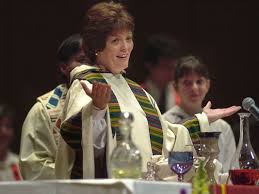
Michael Boucher: What happened at Spiritus Christi in 1998 is often narrated as the community of then Corpus Christi Church moving away from the wider church teachings.  The question always arises, however, “Who moved away from the tradition?” Continue reading “Empire Cracking: An Interview on Spiritus Christi”

Transfiguration

transfigurationBy Wes Howard-Brook and Sue Ferguson Johnson, Commentary on Readings for Feb 7, Transfiguration Sunday

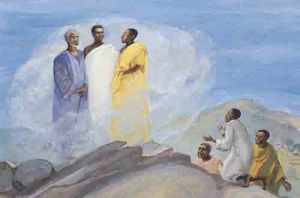
Then from the cloud came a voice that said, “This is my Son, my Chosen; listen to him!”

Our gospel this week finds Jesus and a few companions taking some time out on the earth for what Dorothy Day might have called “clarification of thought” or others have called “illumination.” Luke has just shown that the disciples don’t understand who Jesus is. In the wider narrative context, Luke has Jesus ever more clearly revealing that the divine power he embodies and offers to disciples is not that of the warrior “messiah,” but of the suffering Human One (9.20-26). But the disciples, like so many “Christians” through the ages, cling stubbornly to the hope that he would be the military leader who would remove the Romans by force (see Lk 24.21). Even worse, they seem utterly deaf to Jesus’ Good News of radically inclusive hospitality and leadership from below. Surrounding the Transfiguration scene are numerous situations where we see how out of tune they are with the song Jesus is singing. Consider this sequence of encounters: Continue reading “Transfiguration”

Poetry as Necessity

Eileen Myles
Enter a caption

From a recent New York Times Magazine interview with Eileen Myles:

NY Times Magazine: Many people would be surprised to hear that according to you, poetry is alive and well in America. Our national political conversation has recently seen some rather unpoetic lurches to the right. How do you make sense of that?

Myles: Poetry always, always, always is a key piece of democracy. It’s like the un-Trump: The poet is the charismatic loser. You’re the fool in Shakespeare; you’re the loose cannon. As things get worse, poetry gets better, because it becomes more necessary.

Empire Cracking: Words from Ruby Sales

ruby sales geez

This interview was taken by Lydia Wylie-Kellermann as part of a writing project for Geez Magazine entitled “She is Breathing: Listening for Another World and an End to Empire.” It was published in the Winter Issue.
Lydia Wylie-Kellermann: So, where are the moments for you where you are beginning to see a crack in the empire? Where is resurrection alive and being practiced? What is the story that lingers on your heart and keeps you moving forward? Is this the moment we’ve been waiting for? Is another world being birthed before our eyes?

Ruby Sales: Even if we don’t recognize empire cracking, it is. With Black Lives Matter and brown folks responding to the bigotry of immigration, suddenly we are seeing what has always been there. We are putting words to it again. The more we put it in words, the more empire loses its grip. Which has its downside because the more it loses its grip, the more repressive the empire gets. If you want to see where hope is manifested, it’s in African Americans. We have been getting up and doing the work even with no evidence of making a difference- that is hope. The reason we are so feared is that our very essence and resistance threatens white supremacy. We have to ask the question, “Why would the police shoot someone 137 times?” Saying that black people have rights in a society that says only white people have rights threatens the security of empire.

Messianism Against Christology

MessianismBy Tommy Airey

…the undercurrent of a conflict between lifeways haunts the text.
Jim Perkinson, Messianism Against Christology (2014)

*Note: an abridged version of this review was published in the December 2015 issue of Sojourners Magazine

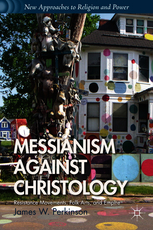
Growing up in the conservative white suburban Evangelical Christian tradition of North America, nothing was more important than the Bible & Jesus. Indeed, is there really anything else? Yet, many like me have grown into adulthood and out of Evangelicalism, not because the Bible & Jesus are no longer important, but because the Bible Answer Men have used their interpretations to justify privilege all over the globe. Continue reading “Messianism Against Christology”

The Yes Men Strike Again!

People do a demonstration of next genera

From the magnificent site CreativeResistance.Org, covering the latest prank pulled off by the Yes Men:

Masquerading as ‘Global Security Response’, the activist duo unveiled the ENDURAsphere, a ‘sort of gated eco-commune for one’

A group calling itself Global Security Response unveiled this unual-looking anti-terrorism device in a press conference at the European Parliament today. Continue reading “The Yes Men Strike Again!”

It Was Not Inevitable

Rebecca SolnitFrom Rebecca Solnit:

Our world is both better (more inclusive, less discriminatory) and worse (think corporate consolidation, ecological devastation, the surveillance state) than the world of fifty years ago. The ways in which it is better happened because people made demands and then acted to realize them. It was not inevitable that Native Americans, women, gays, lesbians, and transgender people would gain rights and respect. The better part of our present happened because of enormous efforts, sometimes over decades or, as with the vote for women, nearly a century of effort and social transformation.

Empire Cracking: An Interview with the NY Catholic Worker

cwThis interview was taken by Lydia Wylie-Kellermann as part of a writing project for Geez Magazine entitled “She is Breathing: Listening for Another World and an End to Empire.” It was published in the Winter Issue.

Lydia Wylie-Kellermann: What is the work that the NY Catholic Worker is doing that is so different from what our culture asks of us?

Joanne Kennedy: Off the top of my head, the paper is different – in the social media twitter-verse the relatively slow nature of our paper and it’s message of more love (and it’s existing for so long) is different. So old it looks new, anyone??

Amanda Daloisio: The work that we do daily- cleaning and cooking; caring for each other’s basic needs, is a gentle reminder of the Little Way. There is holiness to be found in the simplest of tasks and no work is beneath us if it can lessen the burdens of others. We uphold the dignity of manual labor but more than that- we know the joy that can be found there. So often those ideas bump into our upwardly mobile culture! Continue reading “Empire Cracking: An Interview with the NY Catholic Worker”

Empire Cracking: An Interview with Wilderness Way

wildernessThis interview was taken by Lydia Wylie-Kellermann as part of a writing project for Geez Magazine entitled “She is Breathing: Listening for Another World and an End to Empire.” It was published in the Winter Issue.

Lydia Wylie-Kellermann: Biefly, what is Wilderness Way’s story? How did it come to be? What was it in response to? What was it a calling away from and a calling to something different?

Solveig Nilsen-Goodin: Wilderness Way began with a friend of mine coming over one day in 2006 saying he was feeling led to start an alternative church at the margins of Christianity, and something inside of me immediately responded, YES!  We spent the next six months listening for what “at the margins of Christianity” meant to us, and gathering others to join us, and soon the name, Wilderness Way Community, emerged.  The name signifies the particular place we are planting ourselves.  Biblically, the wilderness is the place outside the walls of empire, the place where prophets are called and fed, the place where manna is given and enoughness is taught, the place where John the Baptist initiated those who were defectors from and dehumanized by empire; the place where Jesus was tested and prepared for his prophetic, spiritual leadership.  Wilderness also signifies the wild spaces that emerge and exist without human control.  Within the context of Western civilization (particularly urban contexts) most of us are profoundly cut off from the “natural” world – a disconnection that is having devastating consequences for the planet, the poor, and our very souls.  The values we seek to bring forward are, in fact, values found deep in the wilderness of both scripture and nature: the values of Sabbath, jubilee and shalom. When manifested, these values look a lot like what Jesus called the Kingdom of God, and that’s the new (old) world that is emerging. Continue reading “Empire Cracking: An Interview with Wilderness Way”