
People who believe that
don’t really care about the Bible, though—
he said it with so
much certainty—like he was coached,
like his life depended on being Right every time.
Anything less is a crime.
Continue reading “The Conversation Stopper”

People who believe that
don’t really care about the Bible, though—
he said it with so
much certainty—like he was coached,
like his life depended on being Right every time.
Anything less is a crime.
Continue reading “The Conversation Stopper”
Frodo: I wish the Ring had never come to me. I wish none of this had happened.
Gandalf: So do all who live to see such times, but that is not for them to decide. All we have to decide is what to do with the time that is given to us.
― J.R.R. Tolkien, The Lord of the Rings
 A Summary of Jeffrey Stout’s Blessed are the Organized by Tommy Airey
Democracy, in the sense I am commending, opens up space for minority voices because it is committed both to freedom as non-domination and the avoidance of arbitrary exclusion. Neither of these things can be achieved, according to the tradition of grassroots democracy, unless a lot of ordinary people get organized and actually hold officials accountable. These are things that require action.
Jeffrey Stout
In Blessed Are The Organized: Grassroots Democracy in America (2010), Princeton political science professor Jeffrey Stout recounts a back-and-forth he had with his 20-something son about deeply dysfunctional economic conditions in the U.S. You know the basics: the American worker has been tremendously productive for their company, but isn’t even coming close to sharing the wealth. In fact, since the 1960s, more income went to the top 1% of Americans than the bottom 50% combined. At the end of this casual, fact-filled conversation, Stout’s son proclaimed, “We’re fucked!”
Continue reading “5 Years Later: Blessed Are The Organized”
 By Ched Myers, for the 4th Sunday in Advent (Luke 1:39-55)
Note: This is part of a series of Ched’s occasional comments on the Lukan gospel readings from the Revised Common Lectionary during year C, 2015-16.
Luke 1 is the prolegomenon to the nativity story, and is structured around the stories of two women who, for radically different reasons, cannot conceive. In a nutshell, Elizabeth is too old, and Mary is too young. Their stories are narrated in staggered parallel:
Continue reading “Magnificat: Poor Women’s Voices Liberated”
 By Tommy Airey, an Advent Communion Meditation from Detroit
And maybe this is what heroism looks like nowadays: occasionally high-profile heroism in public but mostly just painstaking mastery of arcane policy, stubborn perseverance year after year for a cause, empathy with those who remain unseen and outrage channeled into dedication.
Rebecca Solnit, Hope in the Dark (2004)
About 40-50 years after the death of Jesus, Luke’s Gospel, the story of Jesus the suffering servant, was read in its entirety in small Christian communities all over the Roman Empire. Out loud. It would take about 90 minutes to two hours. About the length of one of our movies.
Continue reading “These Long Advent Nights”
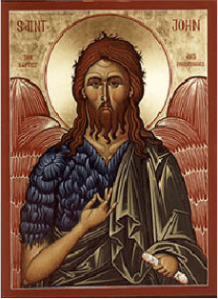 By Ched Myers, the 3rd Sunday in Advent (Luke 3:7-18)
Note: This is one of Ched’s occasional comments on the Lukan gospel readings from the Revised Common Lectionary during year C, 2015-16.
The third week in Advent lingers on Luke’s portrait of John the Baptist, in which we get our most substantive glimpse into this wilderness prophet’s message (right, icon by Robert Lentz, 1984). This reading cuts sharply against the grain of the holiday season, so often defined in corporate-sponsored Christmas culture by commercialization and commodification of all things religious. But the Lectionary’s wisdom seeks to restrain the manic rush into what a young Jewish friend calls “the days of craze,” insisting rather on a sober look at the travails of empire.
Continue reading “The Baptist’s Radical Critique of Entitlement: Repentance as Radical Discontinuity”
 By Justin Ashworth, first published in The Other Journal
Border encounters occur every day in our global and globalizing cities.[1] We consume food touched by people born outside the United States; we purchase things from non-citizens, brush shoulders with them as we go to work. Some of us kiss immigrants goodbye as we head out the door for the day, while others of us are non-citizens ourselves. Our daily lives are filled with border encounters like these, that is, with economic, political, cultural, and personal interactions between citizens and foreigners.[2] But what should be the marks of these encounters? In asking this question, I am not concerned primarily with how cosmopolitan bigwigs interact with each other but rather with how the images of the border that citizens carry around in their heads influence their interactions with border crossers. Are our border images accurate, and what type of ethic do they imply? Continue reading “Healing the Open Wound: Imagining Christian Border Ethics with Gloria Anzaldúa”
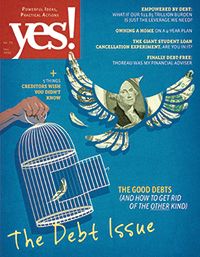 The agreements that we call money and debt can be changed. To do so, however, will require a movement that contests the immutability of the current system and explores alternatives to it.
Charles Eisenstein
*Some highlights from Eisenstein’s recent Yes Magazine article entitled “Don’t Owe. Won’t Pay.” Everything You’ve Been Told About Debt Is Wrong. As always, we encourage readers to click on and soak in the whole text.
—————–
But what about the huge amount of debt that financed large-scale, centralized development projects? Neoliberal ideology says those are to the great benefit of a nation, but now it is becoming apparent that the main beneficiaries were corporations from the same nations that were doing the lending. Moreover, the bulk of this development is geared toward enabling the recipient to generate foreign exchange by opening up its petroleum, minerals, timber, or other resources to exploitation, or by converting subsistence agriculture to commodity agribusiness, or by making its labor force available to global capital. The foreign exchange generated is required to make loan payments, but the people don’t necessarily benefit. Might we not say, then, that most debt owed by the “developing” world is odious, born of colonial and imperial relationships? Continue reading “Organizing to Tackle Debt”

Local chapters of Black Lives Matter and Jewish Voice for Peace coordinated actions in Chicago, Illinois on the weekend of October 24-25, 2015. CPTers attended the events, employing our public witness, human rights documentation, and nonviolent direct action support skills. We’re in the middle of a month-long training of 10 new recruits; people from across the organization—administrative team, field team, and a trainee—participated.
Continue reading “Not Another Nickel”
—————-
Today, almost 20 years after Mr. Clinton signed a law that stopped the federal entitlement to cash assistance for low-income families with children, the argument has solidified into a core tenet influencing social policy not only in the United States but also around the world.
And yet, to a significant degree, it is wrong. Actual experience, from the richest country in the world to some of the poorest places on the planet, suggests that cash assistance can be of enormous help for the poor. And freeing them from what President <a title="More articles about Ronald Wilson Reagan." Continue reading “American Myths About Poverty”

 Radical Discipleship