The Baptist’s Radical Critique of Entitlement: Repentance as Radical Discontinuity

LentzJohntheBaptistBy Ched Myers, the 3rd Sunday in Advent (Luke 3:7-18)

Note: This is one of Ched’s occasional comments on the Lukan gospel readings from the Revised Common Lectionary during year C, 2015-16.

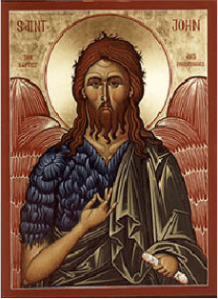
The third week in Advent lingers on Luke’s portrait of John the Baptist, in which we get our most substantive glimpse into this wilderness prophet’s message (right, icon by Robert Lentz, 1984). This reading cuts sharply against the grain of the holiday season, so often defined in corporate-sponsored Christmas culture by commercialization and commodification of all things religious. But the Lectionary’s wisdom seeks to restrain the manic rush into what a young Jewish friend calls “the days of craze,” insisting rather on a sober look at the travails of empire.
Continue reading “The Baptist’s Radical Critique of Entitlement: Repentance as Radical Discontinuity”

Healing the Open Wound: Imagining Christian Border Ethics with Gloria Anzaldúa

Border at NightBy Justin Ashworth, first published in The Other Journal

Border encounters occur every day in our global and globalizing cities.[1] We consume food touched by people born outside the United States; we purchase things from non-citizens, brush shoulders with them as we go to work. Some of us kiss immigrants goodbye as we head out the door for the day, while others of us are non-citizens ourselves. Our daily lives are filled with border encounters like these, that is, with economic, political, cultural, and personal interactions between citizens and foreigners.[2] But what should be the marks of these encounters? In asking this question, I am not concerned primarily with how cosmopolitan bigwigs interact with each other but rather with how the images of the border that citizens carry around in their heads influence their interactions with border crossers. Are our border images accurate, and what type of ethic do they imply? Continue reading “Healing the Open Wound: Imagining Christian Border Ethics with Gloria Anzaldúa”

Organizing to Tackle Debt

Yes!The agreements that we call money and debt can be changed. To do so, however, will require a movement that contests the immutability of the current system and explores alternatives to it.
Charles Eisenstein

*Some highlights from Eisenstein’s recent Yes Magazine article entitled “Don’t Owe. Won’t Pay.” Everything You’ve Been Told About Debt Is Wrong. As always, we encourage readers to click on and soak in the whole text.
—————–
But what about the huge amount of debt that financed large-scale, centralized development projects? Neoliberal ideology says those are to the great benefit of a nation, but now it is becoming apparent that the main beneficiaries were corporations from the same nations that were doing the lending. Moreover, the bulk of this development is geared toward enabling the recipient to generate foreign exchange by opening up its petroleum, minerals, timber, or other resources to exploitation, or by converting subsistence agriculture to commodity agribusiness, or by making its labor force available to global capital. The foreign exchange generated is required to make loan payments, but the people don’t necessarily benefit. Might we not say, then, that most debt owed by the “developing” world is odious, born of colonial and imperial relationships? Continue reading “Organizing to Tackle Debt”

Not Another Nickel

Black Youth Project 100 leader Charlene Carruthers (center, seated) reminds her comrades that they are there because the Chicago mayor wants to allocate an additional $200 million to Chicago police department.
By Sarah Thompson, Executive Director of Christian Peacemaker Teams (CPT)

Local chapters of Black Lives Matter and Jewish Voice for Peace coordinated actions in Chicago, Illinois on the weekend of October 24-25, 2015. CPTers attended the events, employing our public witness, human rights documentation, and nonviolent direct action support skills. We’re in the middle of a month-long training of 10 new recruits; people from across the organization—administrative team, field team, and a trainee—participated.
Continue reading “Not Another Nickel”

American Myths About Poverty

Photo: A Church in Northwest Detroit on Rosa Parks Blvd.
Northwest Detroit on Rosa Parks Blvd.
Some highlights from Eduardo Porter’s recent New York Times piece “The Myth of Welfare’s Corrupting Influence on the Poor“…just more evidence that social analysis must always trump “conventional wisdom.”
—————-

Today, almost 20 years after Mr. Clinton signed a law that stopped the federal entitlement to cash assistance for low-income families with children, the argument has solidified into a core tenet influencing social policy not only in the United States but also around the world.

And yet, to a significant degree, it is wrong. Actual experience, from the richest country in the world to some of the poorest places on the planet, suggests that cash assistance can be of enormous help for the poor. And freeing them from what President <a title="More articles about Ronald Wilson Reagan." Continue reading “American Myths About Poverty”

Giving Up The Trump Card

LilyFrom our interview with Dr. Lily Mendoza, the author (with her sister Leny) of Back From the Crocodile’s Belly (2013):

For me, the challenge of decolonization and re-indigenization demands a giving up of all forms of supremacy, including that of Christian supremacy—the claim to having the one right formula, the ultimate trump card, the final word. I know of many Christians who struggle with the notion that the Christian story is only one story among many. But I am all too familiar with the damaging effects of the more typical insistence that the Christian story is the only true one—no matter the attempts to wrap it in benevolent and compassionate missionary work. Can Christians engage with others on equal ground without pulling out the trump card in the end? Can they give up the trump card altogether?

Arrested Development

DSC00819 2By Tommy Airey

The hope of a secure and livable world lies with disciplined nonconformists who are dedicated to justice, peace and brotherhood.
Martin Luther King, Jr.

On a Wednesday morning last Spring, just a week shy of his 66th birthday, despite aching knees from decades pounding the basketball court, Bill powered up the three flights of stairs to my office in the old Episcopalian Church overlooking downtown Detroit. I knew something was stirring since he usually whips out his flip phone and sends me a text message if he needs anything while working in his makeshift cubicle downstairs—that, and his eye-of-the-tiger stare down he gave me when he arrived breathless. Obviously, it was game day.
Continue reading “Arrested Development”

A Web of Interconnected Lives

farm workersFrom Daniel Rothenberg in With These Hands: The Hidden World of Migrant Farmworkers Today:

When we reach into a bin to choose an apple, orange or plum, our hands stretch out in much the same way as a farmworker’s hands—harvesting our nation’s fruits and vegetables, piece by piece. While the produce may have been mechanically sorted and packed, supercooled, chemically treated, waxed, and shipped hundreds, if not thousands, of miles, often the last hand to touch the fruits and vegetables we buy was that of a migrant farmworker. Through the simple act of purchasing an orange or a head of lettuce, we are connected with a hidden world of laborers, a web of interconnected lives, with hands on both ends.

Cultural Appropriation: Of Dreadlocks, Cell Blocks, and Stolen Rocks (like Plymouth)

columbusBy James W. Perkinson, September 29, 2015

Invited by a friend to respond to the recent blog of philosophy professor, Crispin Sartwell, “Should Miley Cyrus Wear Dreadlocks?” I would throw this into the mix. Yes, it is cultural appropriation “all the way down,” but as with ingesting spoiled food, some things come back up. The culture wars rage on, as globalization’s surface sign that something deeper is afoot. The question of taking someone else’s style cannot really be judged except in consideration of the entire regime of planetary “taking” writ large.
Continue reading “Cultural Appropriation: Of Dreadlocks, Cell Blocks, and Stolen Rocks (like Plymouth)”