A Post Evangelical Pilgrimage, Part III

Christian Peacemaker Teammate Art Gish in Hebron in 2003 standing in front of an Israeli tank to try to stop it destroying a market in the Old City (AP Photo).
We mislead ourselves and others when we try to play down the extremity of the Christian vocation and the total demands it makes.
John Main

*This is the final post in a three-part series exploring more compelling ways to follow Jesus.

During the summer of 2013, Lindsay and I took a 75-day, 12,000-mile road trip. We simply wanted to meet people whose lives of faith were compelling. We wanted to get a taste test of what some might call “Movement Christianity” or “Radical Discipleship” (radical in Latin means “roots”), a particular strand of faith and action that goes all the way back to the roots of Judeo-Christian faith: Moses’ contemplative meeting with the Divine at the burning bush and his ensuing confrontation with the beastly bastards of Egyptian Empire, calling the underdogs out of enslavement and into a whole new Way of being.
Continue reading “A Post Evangelical Pilgrimage, Part III”

Kansas City Here We Come: The Pink Mennos Dis-Cover Diversity

pink mennosTo achieve healing and hope for the Mennonite Church through the inclusion and welcome of lesbian, gay, bisexual, transgender and queer (LGBTQ) individuals and their supporters.
Pink Menno Vision Statement

Originally posted on the Pink Menno website:

At the Mennonite Church USA (MCUSA) bi-annual convention (in Kansas City, MO), Pink Menno will convene a symposium focused on intersectionality. “On the Way: Dis-Covering Diversity” will be held in Pink Menno’s hospitality space in Room 2504B of the convention center, right around the corner from the Grand Ballroom on Level 2.
Continue reading “Kansas City Here We Come: The Pink Mennos Dis-Cover Diversity”

When Nonviolence Is Preached

coatesFrom TA-NEHISI COATES:

When nonviolence is preached as an attempt to evade the repercussions of political brutality, it betrays itself. When nonviolence begins halfway through the war with the aggressor calling time out, it exposes itself as a ruse. When nonviolence is preached by the representatives of the state, while the state doles out heaps of violence to its citizens, it reveals itself to be a con. And none of this can mean that rioting or violence is “correct” or “wise,” any more than a forest fire can be “correct” or “wise.” Wisdom isn’t the point tonight. Disrespect is. In this case, disrespect for the hollow law and failed order that so regularly disrespects the community.

81 Years Later: The Barmen Declaration

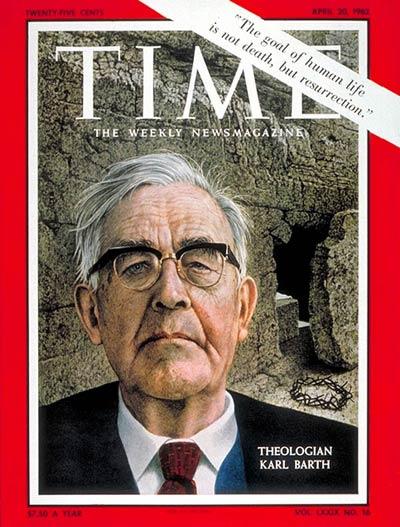
karl barthWe reject the false doctrine that the Church could have permission to hand over the form of its message and of its order to whatever it itself might wish or to the vicissitudes of the prevailing ideological and political convictions of the day.
An Excerpt from the Barmen Declaration, May 29-31, 1934

This weekend, we celebrate the anniversary of the birth of the “confessing church” in Germany, standing up against the idolatry of the State. This is a nice summary from the United Church of Christ “beliefs” page:

The Barmen Declaration, 1934, was a call to resistance against the theological claims of the Nazi state. Almost immediately after Hitler’s seizure of power in 1933, Protestant Christians faced pressure to “aryanize” the Church, expel Jewish Christians from the ordained ministry and adopt the Nazi “Führer Principle” as the organizing principle of church government. In general, the churches succumbed to these pressures, and some Christians embraced them willingly. The pro-Nazi “German Christian” movement became a force in the church. They glorified Adolf Hitler as a “German prophet” and preached that racial consciousness was a source of revelation alongside the Bible. But many Christians in Germany—including Lutheran and Reformed, liberal and neo-orthodox—opposed the encroachment of Nazi ideology on the Church’s proclamation. At Barmen, this emerging “Confessing Church” adopted a declaration drafted by Reformed theologian Karl Barth (above photo) and Lutheran theologian Hans Asmussen, which expressly repudiated the claim that other powers apart from Christ could be sources of God’s revelation. Not all Christians courageously resisted the regime, but many who did—like the Protestant pastor Dietrich Bonhoeffer and the Roman Catholic priest Bernhard Lichtenberg—were arrested and executed in concentration camps. The spirituality of the Barmen Declaration profoundly influenced many of the first generation of pastors and laypeople who formed the United Church of Christ in 1957


Unmothered & In Halves: From The Center of Babaylan Studies Conference

Bearing our rituals: carrying a part of the Ifugao Hut Healing Project. Photo by Jana Lynne Umipig.
By Melissa R. Sipin

*This post is excerpted from a longer piece entitled “Lamuwan Kata: Experiencing Loob at CfBS Conference,” written in the aftermath of The Center of Babaylan Studies Conference, last weekend.

Lamuwan kata means “we are one.” It speaks of the relational connectivity that ties a tribe, a community, a people together. It spoke volumes to me this past weekend at the Center of Babaylan Studies Conference held in Glouster, Ohio, a very small, almost hidden town on the outskirts of Columbus. I came to the conference seeking guidance, hoping to quell a heavy, unmothered heart that burdened me since youth. And I say “unmothered” in so many ways: unmothered by my biological mother who abandoned me a few months after I was born; unmothered by the country I grew up in, America, as if I were an outsider, a pariah, in the city that raised me with its unloving arms; and unmothered by diaspora–unmothered because the land that gave birth to my ancestors was colonized and enslaved, and the caprices of history flung its children to the farthest corners of the earth.
Continue reading “Unmothered & In Halves: From The Center of Babaylan Studies Conference”

A Post-Evangelical Pilgrimage, Part I

evangelical TimeBy Tommy Airey

*The first in a three-part series exploring more compelling ways to follow Jesus.

…the essence of Christianity is itself an essentially contested concept.
James McClendon, Doctrine (1992)

I was inducted into North American Evangelical Christianity in 1983 while attending the Christian elementary school where my mom got a job teaching 5th grade. I was in the 4th grade and my teacher, whom I loved, rhythmically proclaimed:

God said it, I believe it and that settles it.

This was after daily prayer and Bible readings in class. End of conversation. No debate or diversity. It’s settled. Period. I remember the rush of certainty and triumph that would flood my heart and mind.
Continue reading “A Post-Evangelical Pilgrimage, Part I”

The War on Drugs Fails

gabor mateFrom Gabor Mate in In The Realm of Hungry Ghosts: Close Encounters with Addiction (2009):

The War on Drugs fails—-and is doomed to perpetual failure—-because it is directed not against the root causes of drug addiction or of the international black market in drugs, but only against some drug producers, traffickers, and users. More fundamentally, the war is doomed because neither the methods of war nor the war metaphor itself is appropriate to a complex social problem that calls for compassion, self-searching insight, and factually researched scientific understanding.

Pentecost: Divine Polyculture vs. Imperial Monoculture (Genesis 11 and Acts 2)

pentecost1By Ched Myers

Note: This is part of an ongoing series of Ched’s brief comments on the Revised Common Lectionary during year B, 2015.

How is it that we heard, each of us, in our own native tongue?
Acts 2:8

Since the dawn of colonization, the Americas have been defined by the struggle between dominant culture ideologies of conformity imposed by those in power, and grassroots cultural diversity among those on the margins. This tension between fantasies of racial supremacy and realities of racial diversity remains one of the supreme challenges facing the U.S., and thus our churches, today. The future of North American society depends upon our ability to live peaceably and justly with human diversity — and the same can be said of the human experiment as a whole. The question is whether we can, in church and in society, forge models of coexistence-with-congruence rather than unity-by-uniformity.
Continue reading “Pentecost: Divine Polyculture vs. Imperial Monoculture (Genesis 11 and Acts 2)”

The Only Path to Resurrection

abundant table farm projectRepost from The Abundant Table Farm Project–a quote from Antoine de Saint-Exupéry in Flight to Arras (1969):

Life always bursts the boundaries of formulas. Defeat may prove to have been the only path to resurrection, despite its ugliness. I take it for granted that to create a tree I condemn a seed to rot. If the first act of resistance comes too late it is doomed to defeat. But it is, nevertheless, the awakening of resistance. Life may grow from it as from a seed.