
“Once social change begins, it cannot be reversed. You cannot un-educate the person who has learned to read. You cannot humiliate the person who feels pride. You cannot oppress the people who are not afraid anymore. Cesar Chavez
Category: Subverting Empire

The Only Path to Resurrection
 Repost from The Abundant Table Farm Project–a quote from Antoine de Saint-Exupéry in Flight to Arras (1969):
Life always bursts the boundaries of formulas. Defeat may prove to have been the only path to resurrection, despite its ugliness. I take it for granted that to create a tree I condemn a seed to rot. If the first act of resistance comes too late it is doomed to defeat. But it is, nevertheless, the awakening of resistance. Life may grow from it as from a seed.
What Keeps Us Alive
 By Lydia Wylie-Kellermann. Published in Geez Magazine’s Spring issue.
If each hour brings death
If time is a den of thieves
The breezes carry a scent of evil
And life is just a moving target
you will ask why we sing…
We sing because the river is humming
And when the river hums
The river hums
We sing because cruelty has no name
But we can name its destiny
We sing because the child because everything
Because the future because the people
We sing because the survivors
And our dead want us to sing
(Excerpt from Mario Benedetti’s Por Que Cantamos) Continue reading “What Keeps Us Alive”
Housing Justice
 From Jill Shook, who is teaching an innovative course this summer on housing–through the lens of biblical Jubilee:
Ever since the Great Recession, low income people in record numbers have been deprived of their assets and displaced from their homes—from land meant to be used in a way so that all can have access to decent shelter. This is a form of systemic violence that violates the principles of Jubilee justice found throughout the Bible, from Leviticus to the Book of Acts. As Christians, we are called to take action to assist not only the refugees from war and violence but also those displaced in gentrified cities, where rents are soaring.
Continue reading “Housing Justice”
Good Friday in Detroit: It’s a Sad Day
 Today, the Detroit Peace Community walked the Stations of the Cross through the city as it does each year, led by the question: Where is Jesus being crucified in this time and place? Were a station written to represent each injustice that has Detroit in its grip at this moment, we would be walking for weeks rather than a mere three hours on Good Friday afternoon.
Continue reading “Good Friday in Detroit: It’s a Sad Day”
Siouxper Man & Siouxper Woman
From Steven Paul Judd, Kiowa and Choctaw artist: “I just want to make cool stuff for Indians to have, and that gets white people to think. I want to make the stuff I never got to see as a kid.”

Back from the Crocodile’s Belly: Philippine Babaylan Studies and the Struggle for Indigenous Memory
 S. Lily Mendoza is a native of San Fernando, Pampanga in Central Luzon, Philippines. Lily is especially known in the Philippines and beyond for her pathbreaking work on indigenization and indigenous studies. She is a scholar and associate professor of Culture and Communication at Oakland University in Rochester, Michigan.
RD: What is the crocodile’s belly? Where does the title come from?
LM: I don’t know if I should even dare tell you what our original title was. But it was Towards a Postcolonial Indigeneity: Babaylanism as Critical Pedagogy for Diasporic Struggles (laughter). Continue reading “Back from the Crocodile’s Belly: Philippine Babaylan Studies and the Struggle for Indigenous Memory”
The Movement For God’s Beloved Community
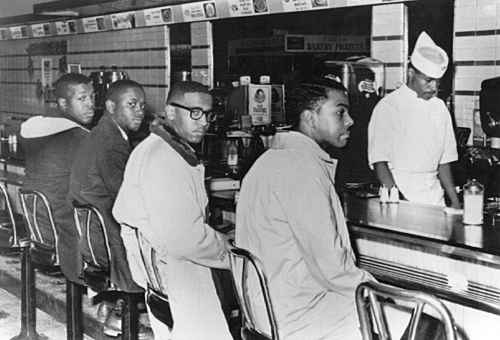 Today, we honor those nonviolent freedom fighters who sparked the sit-in movement at lunch counters exactly 55 years ago. It is also the 50th anniversary of the first mass arrests in Selma–Dr. King and more than a thousand demonstrators, including more than 500 children were jailed on February 1, 1965 (many these same children prayed for Sheriff Clark’s speedy recovery from exhaustion outside a hospital days later). Lastly, we celebrate the 60th birthday of Ched Myers, a man who has committed his life to the legacy of Jesus & Martin Luther King. This is an excerpt from an article he published 10 years ago in Transmission (U.K) titled “Was Jesus a Practitioner of Nonviolence? Reading through Mark 1:21-3:19 and Martin Luther King”, an appropriate piece of vision-casting for all of us who dare to resist like it’s 1960 Greensboro & 1965 Selma:
At the end of their lives, Jesus and King were each hemmed in by all the factions of their respective political terrains. They had to navigate death threats from without, dissent from within their own movements, and had as colleagues only a relatively tiny group of feckless companions. But that is how it always is struggling for the Kingdom of God in a world held hostage by tyrants, terrorists, militarists, and kingpins, unaided by ambivalent religious leaders and insular academics and utterly distracted young folks. Despite all this, however, both Jesus and King chose nonviolent love without compromising their insistence upon justice. They believed that the movement for God’s Beloved Community was worth giving their lives to—and they invite us to do the same.
Breakin’ Down Messianism With Dr. Jim Perkinson
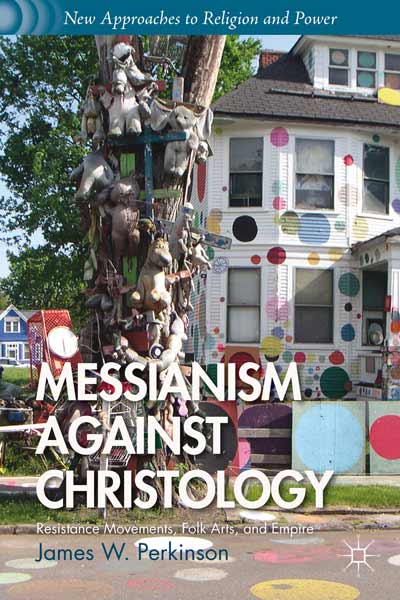 Jim Perkinson is a long-time activist and educator from inner city Detroit, where he has a history of involvement in various community development initiatives and low-income housing projects. He holds a PhD in theology from the University of Chicago and is in demand as a speaker on a wide variety of topics (especially race, class & colonialism). He is also a recognized artist on the spoken-word poetry scene in the inner city. Many of his works are published. In this interview, we home in on his 2014 work Messianism Against Christology: Resistance Movements, Folk Arts and Empire.
————–
RD: What’s the difference between “messianism” and “christology?”
J-Perk: Messianism Against Christology: Resistance Movements, Folk Arts and Empire is a work committed to re-thinking the Christian tradition from the point of view of social movements rather than magnified individuals. Jesus was a movement man—as were Moses and Elijah before him, and John the Baptist alongside him. “Messianism” is a word drafted into service as a movement term. Rather than focus on a great individual called “Jesus” comprehended as “the Christ,” the book examines his effort as part of a broader resistance initiative. The social movement launched by John was already in motion when Jesus first opts to begin public action. Continue reading “Breakin’ Down Messianism With Dr. Jim Perkinson”

