A Prayer From/For Iraq

Lord, 
The plight of our country
is deep and the suffering of Christians
is severe and frightening.
Therefore, we ask you Lord
to spare our lives, and to grant us patience, 
and courage to continue our witness of Christian values
with trust and hope.
Lord, peace is the foundation of life;
Grant us the peace and stability that will enable us
to live with each other without fear and anxiety,
and with dignity and joy.
Glory be to you forever.
Prayer by Chaldean Catholic Patriarch of Iraq, 
His Beatitude Louis Rafael Sako

Openings At The Minneapolis Mennonite Worker

Exciting opportunity from the Mennonite Worker in Minneapolis:

We have residential openings in September or October: preferably a couple or folks who are willing to share a room. Please spread word: we’re moving into some exciting new directions as a community and would love to be joined with folks who not only want to live in an intentional Christian community, but would like to help give shape to our next season of ministry. In the next several months, we’ll be launching the Gene Stoltzfus Center for Creative Peacemaking, starting a community business (more on that below), and releasing a new educational initiative…

The Mennonite Worker is an urban intentional community committed to following Jesus’ way of hospitality, simplicity, prayer, peacemaking, and resistance. We are a Mennonite congregation whose way of life together is deeply influenced by the Catholic Worker movement.

Read more here. Apply here.

A Day of Mourning

Today, we lament the 69th anniversary of the atomic bombing of Hiroshima in 1945. This is a reflection from John Dear, posted last year over at Huff Post:

In 1981, while traveling in Europe, some friends and I visited Dachau, the Nazi concentration camp outside of Munich. Most of it was razed to the ground, but the original fences and barbed wire remained, along with a few buildings. That was enough to send chills down the spine. It was too much for me to take in. It’s still too much for me to take in.

Upon leaving, I noticed the beautiful suburban neighborhood surrounding Dachau. The houses, green trees, streets, shrubs, shops–it could have been any suburb in the U.S.–and it was right next to the Nazi concentration camp. I was shocked and asked the officials, “Was Dachau like this 35 years ago? Were these homes here?” Yes, they answered. They smelled the smoke–and went on with their lives.

The normality of evil! The suburban life of evil, the resigned acceptance of the big business of death right in one’s backyard–that’s what I saw in Dachau, and that’s what I saw again on Sunday as I drove up the mountain to join the annual Hiroshima commemoration peace vigil at Los Alamos, New Mexico, the birthplace of the atomic bomb, and headquarters of the U.S. nuclear weapons industry. I think it’s the most evil place on earth.

It’s also one of the most stunning locations in North America–the steep red cliffs, the pine trees, the Rio Grande down below, the distant mountains. And on the mesa, this beautiful, normal every town with its Starbucks, restaurants, hotels, churches, and hospital–and nuclear weapons labs which work overtime to prepare the end of the world.

Los Alamos is in the second richest county in the nation, with more millionaires per capita than anywhere else, even though the surrounding counties are some of the poorest. New Mexico recently returned to first place in child hunger and child poverty among the fifty states. Yet at Los Alamos, we spend billions building weapons of mass destruction. It’s the world’s most dangerous terrorist camp.

It’s a cliché to speak of the normality of evil, not to mention its banality or legality, but in Los Alamos, the big business of death surrounds you like nowhere else. Everyone is given over to death. They’ve gotten used to death, they’ve made peace with the bomb. They’ve become possessed by “Lord Nuke,” and they don’t know it. It’s like walking into a zombie movie, like stepping into “Invasion of the Body Snatchers.”

It was pouring rain, with thunder and lightning, on Sunday, so we did not process through town on our regular peace march. Instead our little crowd gathered in the stone shelter overlooking Ashley Pond, the exact place where the Hiroshima bomb was built. As in the past, we recalled the book of Jonah, put on sackcloth and ashes, and sat in silence for thirty minutes to “repent of the mortal sin of war and nuclear weapons and beg the God of peace for the gift of nuclear disarmament.”

After our silent sitting, I offered a few reflections. Then we turned to one another and shared our feelings about our prayer, Los Alamos, Hiroshima, our warmaking country, and the Gospel of peace. Then we had a conversation and a closing prayer.

“You and I are trying to wake up and stay awake, to open our eyes and keep our eyes open, to be conscious of the fullness of life and the evil in our midst,” I said. “We’re trying to non-cooperate with evil, to wake others up, to call for the abolition of nuclear weapons and the reallocation of these billions of dollars for death instead for pro-human services–for food for the hungry, homes for the homeless, universal healthcare, education and decent jobs and dignity and well-funded international nonviolent conflict resolution. This is the holy task God has given us–to be abnormal people of nonviolence in a world of normalized violence.”

Among the disturbing aspects of Los Alamos are the packed churches. The nuclear weapons Labs are made up predominantly of Christians with the full support of the local churches, including the rich, large Catholic parish of the Immaculate Heart of Mary. This is an incomparable blindness, or worse, it is comparable to the packed churches in the neighborhoods of Dachau and Auschwitz, where Mass and prayers were attended regularly by the Nazi officials who then spent the rest of their days killing our sisters and brothers.

This is a great blasphemy, and we need to name it as such. Jesus was nonviolent and called us to be peacemakers and to love our enemies, I pointed out; all Christians and all Christian churches are called to be nonviolent and to love enemies, not to support preparations to vaporize them. Christians who work at the Labs, like everyone there, should quit their jobs and find new nonviolent, life-giving work and join the movement to abolish nuclear weapons.

Silent contemplative prayer is perhaps the best response to the culture of death which is Los Alamos. Sitting in sackcloth and ashes centers us in mindfulness and brings us to a clearer realization that we are all in this together, that we all share some complicity with this culture of death, that none of us are exempt. We tried to repent like the people of Nineveh, to take responsibility for our part in the culture of war, and to ask our Higher Power for the sobriety of nonviolence. It was, of course, a modest gesture, but it’s a start.

“God of peace, bless us as we repent of the sin of nuclear weapons and war,” we prayed at the end. “Bless everyone here in Los Alamos and the world. Bless us all with the gift of a world without war, poverty and nuclear weapons.” In the end, we felt our prayer was heard.

And that was the surprise. Everyone left consoled, renewed and hopeful. Why? Perhaps because we were not alone. If we had gone there on our own, we would have felt despair, or worse, we would have turned away and felt nothing like walking zombies. But sitting together in a communal spirit of peace and prayer, we felt uplifted. Perhaps it was because we were addressing reality, the proverbial dead elephant in the room. Perhaps most of all, it was because we tried to engage the God of peace about this work of ultimate evil. The consolation everyone felt was God’s response. That was a great blessing.

August 6th marks the 68th anniversary of the U.S. atomic bombing of Hiroshima, and August 9th, marks Nagasaki. These dates invite us to reflect on the “normalcy” of our culture of death, and how much we fit into it. Do we want to be like the suburban people of Dachau or Los Alamos, or can we peacefully say no to the culture of death, try to help each other wake up to the fullness of life, and turn to the God of peace for the gift of nuclear disarmament?

That’s what Hiroshima asks of each one of us.
——————————————–
And Courtesy of Veteran’s For Peace:

Praying in Front of the Pentagon

The Dorothy Day Catholic Worker House in Washington D.C. has maintained a weekly peace vigil at the Pentagon since 1987. This is an excerpt from a piece that Art Laffin wrote for the The National Catholic Reporter in October:

This morning I was alone there and had an opportunity to be present to hundreds of civilian and military Pentagon workers, a number of whom acknowledged my “Good Morning” greeting.

During the vigil I prayed in repentance for my own complicity in our culture of violence and for a conversion of my own heart to the Gospel. I prayed, too, that all who work at the Pentagon as well as in the larger military-industrial complex, and who are responsible for directing, planning, and implementing overt and covert military interventions throughout the world have a conversion of heart away from war, weapons, killing and torture, and towards God’s way of nonviolence, justice and peace.

I also prayed for and remembered the victims of U.S. warmaking and poverty, past and present. And I prayed for all those seeking peace and reconciliation in war zones, all peace prisoners and all who are held captive, including those detained in Guantanamo, some of whom are still on a hunger strike.

I finally prayed that the Pentagon would one day be converted and that each of the five sides of the building be transformed into: a center for nonviolent conflict resolution training; a center for developing and providing alternative and renewable energy sources; a medical treatment center; a daycare center; and a bakery.

Organizing to Stop Detroit Water Shut-Offs

From Rev. Bill Wylie-Kellermann, reporting from Detroit:

An Open Letter from Detroit Religious Leaders and Allies
July 24, 2014

Ho, everyone who thirsts, come to the waters
Let the one who has no money, come… (Isaiah 55:1)

Friends in Faith and Fellow Citizens:

In our traditions water is a free grace, part of the great gift that underlies all creation. We drink it as life itself. We wade through it to freedom. And in conversion we are immersed and sprinkled and cleansed. We wash our feet, so to pray. In season we know to honor it even by fasting from it. It is the lifeblood of the planet, circulating as river and rain. Water is the very emblem of the commons, what we hold together as one. We share it beholden to local indigenous peoples who understood, understand this deeply. For governments which serve the people, a water system is a public trust, held in trust for this generation and those to come. For the United Nations access to clean potable water is counted a human right.

In Detroit the largest basin of fresh water in the world flows by us through the river, “the strait.”
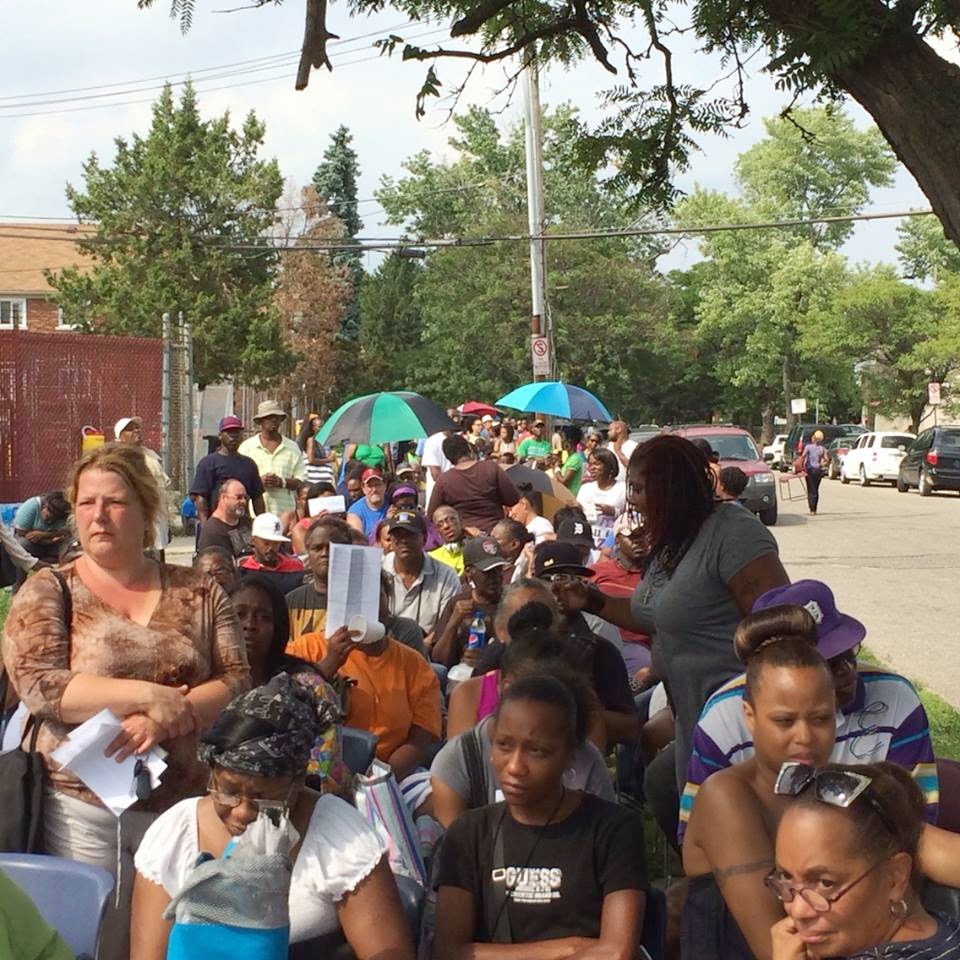
But in Detroit, under emergency management, as many as 150,000 homes are threatened with shut-off, up to 3,000 per week, largely by private contractors. People, including children, the elderly and infirm, wake up in the morning to find themselves unable to drink, cook, wash, or flush toilets. In fact, two thirds of these homes are occupied by children. People without water fear losing their children to protective services. They can be driven from their homes, their neighborhood, their city.

On June 18, 2014 a complaint charging a violation of human rights was filed with the United Nations. Three Special Rapporteurs have already responded in a written statement, stressing the urgency of the situation: “Disconnection of water services because of failure to pay due to lack of means constitutes a violation of the human right to water and other international human rights.”

As religious leaders and communities we join our voices to say: In the name of humanity stop the shut-offs.

To Detroiters we say, alert, defend and protect your neighbors from shut-off. To Faith communities we say, become stations of water distribution (for information and guidance on this call 1-844-42WATER), as well as places of education, community and resistance. To Water workers, we say refuse to cut off your fellow citizens. To the Water Board, we say reverse this inhuman policy: turn their water back on. To the City Council, we say stop compounding this travesty with rate increases and other complicity. Revive and implement the Water Affordability Program. To the Governor we say: cease privatization and call off this action taken under emergency management.

To our God we pray, defend the children, the least, the poor. Help us to do so this day. Let your justice roll down like waters and righteousness like an ever flowing stream.

Civil Disobedience At Hancock Air Base

Repost from Ched Myers at Bartimaeus Cooperative Ministries:

Earlier today our dear mentor Liz McAlister (below) and eight Atlantic Life Community activists were arrested protesting at the main gate of Hancock Air Base, in Syracuse, New York. Hancock is the home of the 174th Attack Wing of the New York State Air National Guard, which pilots weaponized MQ9 Reaper drones over Afghanistan – killing and terrorizing an uncountable number of civilians. We pray for these dear friends of ALC.

Baptized With Water & Fire in Detroit

water-photoRe-post from the Jeanie-Wylie Community in West Detroit (July 10):

Two months ago, I listened in horror as Charity told the story of her water being shut off. She tried to appeal to the contractors to give families a few minutes to at least fill their bathtubs. In frustration with the workers response, she called the police. When the cops showed up, they arrested her, telling her she “needed to be taught a lesson.” Her story went on as she described the conditions at the Detention Center on Mound Rd which is now the only place people are taken, is state run, and the conditions are horrendous. As Charity recounted the story, you could feel the power rising in her bones and her voice. A long time water and food activist, she said that the fight has begun. That if there was anything she would be willing to go down for- it would be water. “We need to wage a campaign of love in this city.”

On July 8, Charity Hicks joined the ancestors. On her way to speak at a panel on water in New York, she was hit by a car waiting at the bus stop. I ache. The city aches. Her words, her spirit, her smile, her intentionality, her deep connectedness with the earth and humanity, are running through my head non-stop. I feel so angry and heartbroken at her passing.

Today, a large group of us stood outside Homrich which is the contractor the Water Department is paying to shut off water to up to 150,000 homes by thefall. The trucks leave at 7am and drive into neighborhoods shutting off this basic human right with no warning to residents. No drinking water. No cooking. No cleaning. No way to flush a toilet! Children are put at risk. Today we stood in front of the gates, calling to mind Charity. Dedicating the action to her. Waging love. Resisting the water shut offs is indeed a campaign of love. We have lost site of love, of neighbor, of human dignity, of a city working for the people. Profit has become so much higher a priority than the health and lives of the people.

Ten were arrested today. Pastor Denise Griebler, Sr. Mary Ellen, Teresa Kelly, Justin Wedes, Elena Herrada, Jim Perkinson, Pat Driscoll, Agnus Hitchcock, Pastor Bill Wylie-Kellermann, Fr. Tom Lumpkin (and Baxter Jones in full spirit and readiness). The consequences of these mass shut offs are almost impossible to comprehend. This is our city, our community, our neighbors. This is water- the basic life sustaining force that runs through our bodies and our lands. Love has been waged today. It is one part of an amazing love happening through phone banks taking calls and offering support, door to door canvassing and education, water stations around the city getting drinking water into homes, rallies calling for an immediate end to the shut offs. I am grateful to be a part of this city and community and movement. Love is getting stronger, pouring down the streets, and aint going to stop til each child has safe, clean water to nourish their bodies and souls. Wage love. Charity Hicks. Presente.

The Future of Church

great-despression-the-american-way
From Tom Airey at Easy Yolk:
————————————-
It is incumbent on the community of faith to discern and name the crisis and to distinguish, as clearly as it possibly can, between truth and error, even between life and death.
Bill Wylie-Kellermann, Seasons of Faith & Conscience: Kairos, Confession, Liturgy (1991)

Much has been made about the declining church participation of the Millennial Generation. Scientific surveys, studies and solutions have all been offered to bring them back to the fold. The real question, however, for people of faith & conscience committed to the struggle for church renewal & fundamental social change, is not why they have supposedly left or even how we can get them to come back. Our time, energy & resources should be focused on how we ought to live to be a faithful and compelling witness to what is Real & Transcendent. To what Dr. King called “the Beloved Community” and what Jesus called “the Heavenly Reign.”

I write as a longtime follower of Jesus (this year, I celebrate my 30-year anniversary of commitment to “the Way”) and, particularly, one who, at middle-age, had grown jaded with the conservative Evangelicalism of my youth. I have wrestled with Christian faith–through prayer, passionate dialogue, reading, writing & formal seminary education–and come out the other side to embrace an Anabaptist faith that daringly offers the nonviolent cross instead of the patriotic flag, the identity & vocation of church community instead of ingrained ethnic heritage & family patterns and discipleship to Jesus’ teaching instead of the American dream of upward mobility.

What initially compelled me and converted me to the 500-year Anabaptist Christian tradition was its historic focus on living out the way of Jesus simply & sacrificially, no matter what the price. The Anabaptists have existentially known the social & political tension of what Mennonite theologian John Howard Yoder described as “doing ordinary things differently.” Ultimately, the price of social non-conformity has been death, imprisonment, social rejection & scapegoating. This task continues to be the challenge of a church’s “relevancy” during the coming-of-age of the Millennial Generation.

The definitive series of crises and catastrophes that we must name, engage and confront faithfully is best summarized, I believe, consistently in the writings of African-American literary giant bell hooks: imperialist white supremacist capitalist patriarchy. This global Situation has largely been justified & supported by 1st World Christian churches who have focused on a spiritualized & futurized faith located in the heart and lived out in performance-driven, spectatorship models of church ministry divorced from socio-political realities. It has, by and large, become Dr. King’s nightmare:

The church must be reminded that it is not the master or the servant of the state, but rather the conscience of the state. It must be the guide and the critic of the state, and never its tool. If the church does not recapture its prophetic zeal, it will become an irrelevant social club without moral or spiritual authority.

Millennials are, quite frankly, just as apathetic, cynical, indifferent & distracted as every other generation and privileged upwardly mobile (sub)urban (mostly)white young people will continue to follow the same cycle as their parents and grandparents, joining respectable, “Bible-believing,” infotainment-oriented churches that do not confront the imperialist white supremacist capitalist patriarchy that ruthlessly defines our context. We not only owe it to the next generation of Jesus followers, we owe it to our-Gen-X-and-Baby-Boomer-selves to live out a faith that disturbs & disrupts a status quo which continues to be a meager existence for multitudes.

Sure, we can tweet and text and use other kinds of technology to communicate the radical message of Jesus to a younger audience. We can also fully affirm the God-given dignity of gays and lesbians who worship & serve in our communities. Additionally, we can emphasize the vital need for transparency, therapy & 12-step style meetings to heal from our dysfunctional family systems and the counterfeit coping mechanisms that we’ve been patterned into. After all, Millennials are crying out for authenticity and stability from their elders. But our focus must be cosmic, not cosmetic. Systematic, not symptomatic.

A decade ago, my Fuller Seminary professor Nancey Murphy outlined an Anabaptist faith that was uniquely positioned to transcend the will-to-power that Nietzsche exposed as deeply interwoven into the human condition. Murphy highlighted four Anabaptist distinctives: separation-of-church-and-state, nonviolence, revolutionary subordination & simple living. Following Murphy, I propose that Anabaptist communities all over North America (re)commit to these distinctives specifically, as both constructive and confrontational practices that overtly engage with the ongoing catastrophe of imperialist white-supremacist capitalist patriarchy.

We Anabaptists have an opportunity to be both prophetic & pastoral to the Millennial generation. And the fact is that the economic Game simply isn’t working for the next generation. Skyrocketing student debt, outsourced jobs, intensifying income inequality & the industrialized effects of climate change will plague the youngest among us the most. But this crisis is an opportunity for Millennials to be saved from the American default narrative of upward mobility via the market & the military. The hope is that, if Millennials can’t win, then they will divert and subvert “conventional wisdom” and become saved and healed in their commitment to sustainable convictions and practices.

Christian churches (whether Anabaptist, Reformed, Evangelical or Catholic) that directly confront the disaster of American imperialist white-supremacist capitalist patriarchy with creative & constructive laboratories of separation-of-church-and-state, nonviolence, revolutionary subordination & simple living will not be large & culturally powerful. They will, however, be islands of refuge in a sea of Empire. They will be holdouts of hope, continuing to participate with what the very best of the Anabaptist Christian tradition has consistently practiced.

The Anabaptist distinctives will expose the myth of a Christian nation, emphasizing a radical discipleship movement that is voluntary & challenging, always placing value on the freedom to obey God without state help or hindrance (separation-of-church-and-state). It will seek truth through dialogue, opening the floor to all voices. Peace will be a series of processes and practices, dedicated to the dignity of everyone (nonviolence). It will participate with all people of faith and conscience in imaginative experiments of social justice (revolutionary subordination). Lastly, participants in this movement will have no need to defend our economic privilege, placing us into a legitimate position to actively advocate for policies that benefit our neighbors, foreign and domestic (simple living).

People of fervent faith and critical consciousness hold out hope that the intentionality of radical discipleship communities will intersect with the intuition of the Millennial generation. In the coming decade, the youthful and energetic will come to know, more and more, that indifference or ignorance or cynicism towards the crisis of imperialist white-supremacist capitalist patriarchy is unsustainable, destructive, unloving & unChristian. No doubt, this work will be challenging. But there are model faith communities dotted all over North America that have been heavenly laboratories experimenting in hellish circumstances for decades. Let’s follow their lead and do this together.