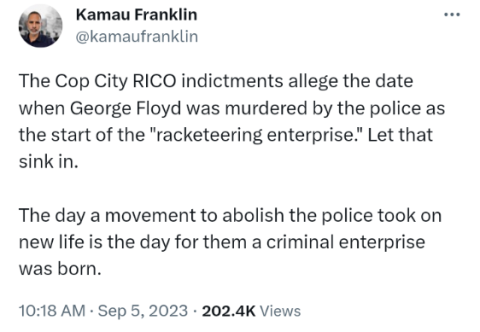
This week, 61 community organizers working to block the building of Cop City in Georgia were charged with organized crime. The original Jesus movement was also considered by authorities a criminal enterprise. As “democracy” is diminished, we ask ourselves what our solidarity with the Stop Cop City movement might mean in both word and deed.
By Walter Brueggemann, re-posted from Labor Day 2020
Covenantal faith in the Bible refuses all dualisms and holds together matters of spirituality and economics. It is always a both/and, never an either/or. In the practice of the church, however, an accent on things spiritual has largely muted the accent on economics that is so prominent in the Bible. In more affluent churches, it is predictable that at times economics will be muted and spirituality made larger. In less affluent churches there is a temptation at times to disregard the heavy burden of economics in the Bible and present instead an extravagant vision of another world to the neglect of this one.
Given that recurring tilt that distorts the Bible, it is my estimate that church leadership now must redress this distortion by paying acute attention to economics in the Bible and in our society.
For many church leaders this will entail not only close, attentive study, but the learning of new interpretive categories and skills as well. Such a redress of energy and attention is not only evoked by our present social circumstance but required by the biblical testimony itself.
I’ve been working on a book project over the past few years. It has evolved into a series of shorter reflections focused on reconstructing a biblical spirituality committed to collective liberation for those of us who have been in a process of deconstructing fundamentalist, evangelical, conservative Catholic or denominational expressions of Christian Supremacy. This reconstruction project pivots on the Power of love, the only force that can fuel us to live for Something Else.
I believe that this Something Else is rooted in the radical act of repenting from the American Dream, the corporate-sponsored conventional wisdom that comes at the awful expense of this agonizing statistic: the US and Canada comprise 5% of the world’s population – and consume over 30% of the world’s resources. I am calling the North American context the 5/30 Window, a play on what my white Evangelical pastors referred to as “the 10/40 Window,” the African, Asian and Middle Eastern regions of “unreached” people who live between ten and forty degrees north latitude. I am flipping the script and saying that the souls of dark-skinned Buddhists, Hindus and Muslims who live on the other side of the world do not need to get saved. We do.
With a long, storied activist history (Dan and Phillip Berrigan had a favorite room and frequently led retreats and organized actions there) and an 80-year history of supporting LGBTQI Christians, it’s the kind of place radical disciples should know about. And there are a number of retreats coming up that you might be interested in attending:
Come explore how the wilderness prophets are relevant to spiritual care and action in a time of climate crisis and discern your own prophetic call for this time. We’ll read scripture, engage scripture and spend time in contemplation in the more-than-human world
One of the great challenges faced by westerners who oppose the political status quo today is the way the narrative managers of both mainstream factions continuously divert all political energy away from issues which threaten the interests of the powerful like economic injustice, war, militarism, authoritarianism, corruption, capitalism and ecocide and toward issues which don’t threaten the powerful at all like abortion, racism, sexism, homophobia and transphobia.
This method of social control serves the powerful in some very obvious ways, and is being used very effectively. As long as it remains effective, it will continue to be used. The worse things get the more urgent the need to fight the class war will become, anf the more urgent the need to fight the class war becomes the more vitriolic and intense the artificial culture war will become in order to prevent political changes which inconvenience the powerful. This is 100 percent guaranteed. And what’s tricky is that all the vitriolic intensity will create the illusion that the culture war has gotten more important, when in reality the class war has.
Well I love the word. I first heard the term used, I think, in high school when I lived in Arkansas by fishers to describe big old fish or turtles that had algae growing on their backs. In research for the book, I came across the term describing Confederates who evaded the draft by hiding out. The word was really evocative and multilayered, and when I dug further into its use and etymology, I found that it seemed to be a derogatory term sort of like the more modern “redneck,” and there is some suggestion that it came from the Carolina swamps and used in that same disparaging way to describe poor folks who were so slow moving that they had moss growing on their backs. I was really taken when I found a report during the Reconstruction period after the Civil War recounting a gun fight between the Ku Klux Klan and a group called the “Mossy-backs.” So for me, the word conjures a complex meaning with allusions of ecological connection, but also perhaps an unwillingness to fight wealthy people’s wars or to tolerate explicitly white supremacist institutions. That’s the sort of backwardness I can get behind. I found “mossback,” with its multivalent meaning really helpful, since I’ve been looking for metaphors that contribute to the somewhat odd admixture of ecological well being with racial and economic analysis that the word connotes. Of course, I’m doing some fanciful reading, as it’s highly unlikely that the Mossy-backs had a robust racial analysis, or that Confederate deserters were thinking much beyond themselves and their families. But I want to reclaim the word and use it insofar as it moves us toward the kind of environmental and racial solidarity that I believe our times require.
Read the entire interview here. It’s really really good.
By Ric Hudgens, a pastor and author rooted in Northern Illinois
*Note: Three years ago as the covid pandemic was just picking up speed we observed the funeral of John Lewis. I wrote this essay that week. The lessons abide.
The funeral of John Lewis at Ebenezer Baptist Church last week was like an event from another world. Lewis was literally on the frontlines of some of the most remarkable years in our nation’s history. He not only lived a long life (“longevity has its place” said Dr. King, who was killed at 39), but remained engaged, relevant, and prophetic to the end. Case in point perhaps, the editorial Lewis wrote for publication on the day of his funeral (“Together We Can Redeem the Soul of America,” New York Times, July 30, 2020).
Everyone gathered in that historic church where King, Jr, and King, Sr were once ministers (and Rev. Raphael Warnock so ably serves today). I watched the entire service remotely, yet savoring the familiar contours of Black Baptist funerals. Despite the pandemic, everyone was masked, and microphones were switched after each speaker. It was a funeral, much like many others I’ve attended—unique perhaps only by the guests’ notoriety and the length of the service.
A brilliant Twitter thread from Alisa Lynn Valdes, M.S., an author, journalist and film producer from New Mexico
This quote, from the @nytimes review of the OPPENHEIMER film: “He served as director of a clandestine weapons lab built in a near-desolate stretch of Los Alamos, in New Mexico”…
It was inhabited by Hispanos. They were given less than 24 hr to leave. Their farms bulldozed.
Many of those families had been on the same land for centuries. The Oppenheimer’s crew literally shot all their livestock through the head and bulldozed them. People fled on foot with nowhere to go. Land rich, money poor. Their land seized by the government.
All of the Hispano NM men who were displaced by the labs later were hired to work with beryllium by Oppenheimer. The white men got protective gear. The Hispano men did not.









 Radical Discipleship