The Reverse Card

By Tommy Airey

Last week, in Southern California, we got to spend an entire afternoon at the beach with our nephews. We were on boogie boards for most of it. The next morning, Riley and his brother Mason played a couple games of UNO with their Aunt Linds while I made them pancakes. Riley won both times. When we were driving them back to their dad’s place, Riley pulled out an UNO reverse card from his pocket.

Riley said he carries the card with him because it possesses the power to reverse any of the bad stuff that might happen in real life. He said there’s a YouTube clip that shows a guy getting pulled over by a cop. He flashes his UNO reverse card and the cop lets him go without a ticket or jail time. Riley said the blue UNO reverse cards are the most powerful – then the red, the green and the yellow. In that order. He said that all the other fourth-graders at his school last year respected the power of the UNO reverse card too.

Continue reading “The Reverse Card”

The Impossible

From Judith Butler, who attended Occupy Wall Street in 2011 and was asked to clarify what demands were being made.

People have asked, so what are the demands? What are the demands all of these people are making? Either they say there are no demands and that leaves your critics confused, or they say that the demands for social equality and economic justice are impossible demands. And the impossible demands, they say, are just not practical. If hope is an impossible demand, then we demand the impossible – that the right to shelter, food and employment are impossible demands, then we demand the impossible. If it is impossible to demand that those who profit from the recession redistribute their wealth and cease their greed, then yes, we demand the impossible.

Quotes

From Rebecca Solnit, re-posted from social media (July 7, 2023)

I collect quotes, starting a new document every year I paste them into as I encounter them. The collections go back several years. Here’s a few from 2023’s album.

“We are all here to serve each other. At some point we have to understand that we do not need to carry a story that is unbearable. We can observe the story, which is mental; feel the story, which is physical; let the story go, which is emotional; then forgive the story, which is spiritual, after which we use the materials of it to build a house of knowledge.” – Joy Harjo

“American racism has many moving parts, and has had enough centuries in which to evolve an impressive camouflage. It can hoard its malice in great stillness for a long time, all the while pretending to look the other way. Like misogyny, it is atmospheric. You don’t see it at first. But understanding comes.” -Teju Cole

“Being queer saved my life. Often we see queerness as deprivation. But when I look at my life, I saw that queerness demanded an alternative innovation from me. I had to make alternative routes, it made me curious, it made me ask this is not enough for me.” – Ocean Vuong

Continue reading “Quotes”

Sublime Madness

An excerpt from Chris Hedges’ Obama-era Truth Dig article “A Time for ‘Sublime Madness.'”

The theologian James H. Cone captures this in his masterpiece “The Cross and the Lynching Tree.” Cone says that for oppressed blacks the cross was a “paradoxical religious symbol because it inverts the world’s value system with the news that hope comes by way of defeat, that suffering and death do not have the last word, that the last shall be first and the first last.” Cone continues:

That God could “make a way out of no way” in Jesus’ cross was truly absurd to the intellect, yet profoundly real in the souls of black folk. Enslaved blacks who first heard the gospel message seized on the power of the cross. Christ crucified manifested God’s loving and liberating presence in the contradictions of black life — that transcendent presence in the lives of black Christians that empowered them to believe that ultimately, in God’s eschatological future, they would not be defeated by the “troubles of this world,” no matter how great and painful their suffering. Believing this paradox, this absurd claim of faith, was only possible in humility and repentance. There was no place for the proud and the mighty, for people who think that God called them to rule over others. The cross was God’s critique of power — white power — with powerless love, snatching victory out of defeat.

Continue reading “Sublime Madness”

Do Something That Won’t Compute

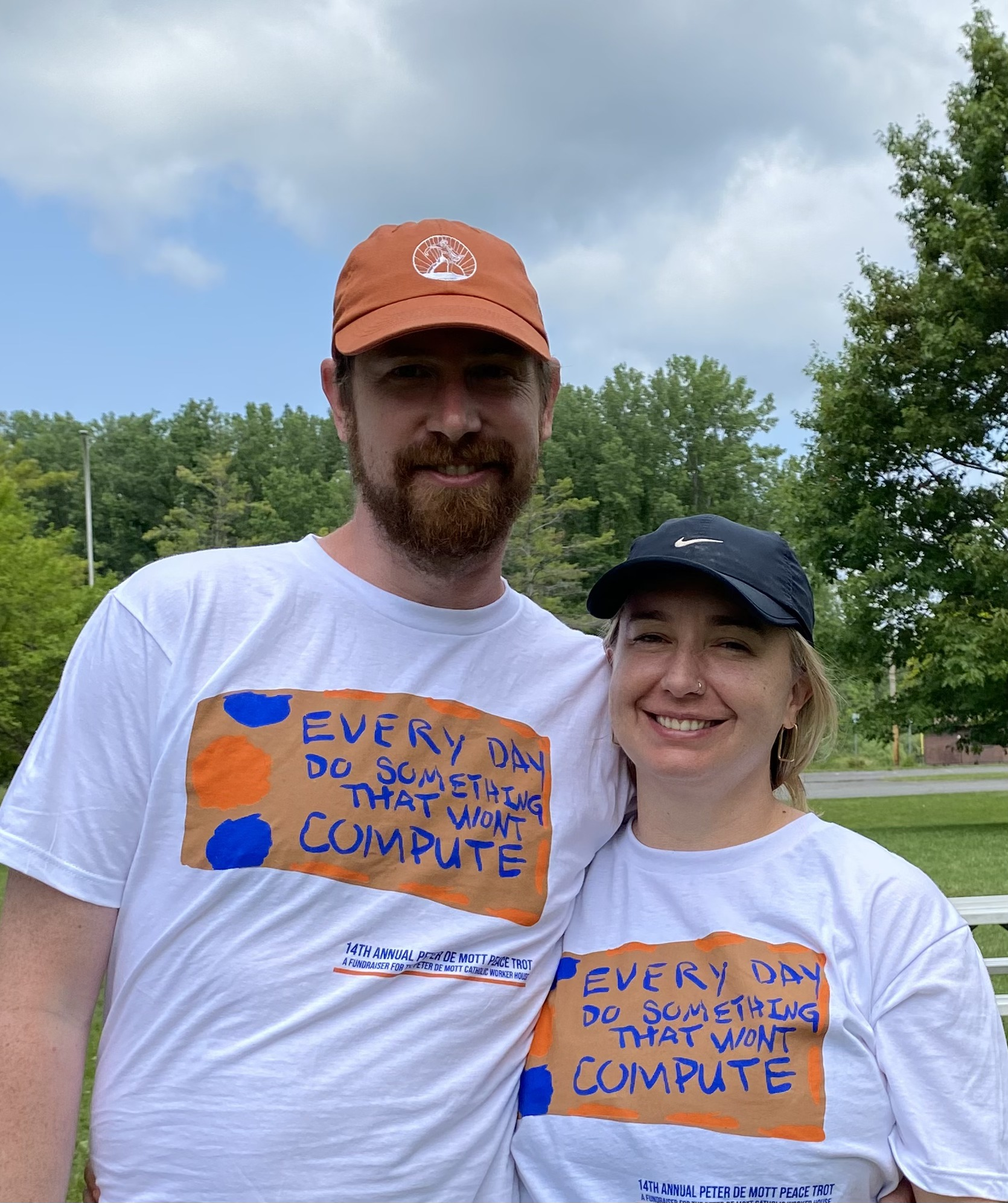
Plenty of radical runners participated in the 14th Annual Pete De Mott Peace Trot last weekend, on Father’s Day, in Ithaca, New York. The race is named after the veteran Catholic peace activist who spent time in federal prison for numerous anti-war protests. This is the pre-race pump up speech from Pete’s daughter Cait De Mott Grady (above, with Mike Williams of Three Lyons Creative).

My mom asked me to say a few words about this year’s Peace Trot t-shirt. The shirt is based on a ceramic tile I made this spring with words from a Wendell Berry poem called Manifesto: The Mad Farmer Liberation Front. The full poem is on the back of this year’s t-shirt, and I encourage you to give it a read.

For those who knew my dad, you likely heard him recite the Mad Farmer poem. This poem was a mantra for my dad, a poem he knew by heart, a poem he looked to as a guide, and a poem whose wisdom became a part of everyday life.

The first stanza of this poem calls out the dominant culture of the United States – a culture that Dr. King powerfully named for us as a culture of rampant materialism, militarism, and racism.

Continue reading “Do Something That Won’t Compute”

True Prophets

An excerpt from a 1993 interview with Walter Brueggemann entitled “Why Prophets Won’t Leave Well Enough Alone.” Thank you Rev. John Maine (Kitchener, Ontario) for passing it along!

I believe the large truth surrounding us today is that the white, male, Western, colonial hegemony has collapsed by the mercy of God.  The collapse of that hegemony means that we have a chance to reorganize and reconfigure all social relationships.  True prophets are prophets who act in the direction of that collapse and are working at reorganizing social relationships, and false prophets are people who want to keep pretending that they can jack up the white, male hegemony and keep it going.  The pastoral task, then, is to help people face the reality of the collapse and relinquish those old assumptions of privilege, priority, and power

A God Who Confuses

By Tommy Airey

And at this sound the crowd gathered and was confused… – Acts 2:6a

Last weekend, I preached a Pentecost sermon at a church down in Kentucky. The text brought me back to my roots. When I was ten, I transferred to the Christian school where my mom got hired to teach 5th grade. Every single morning, we pledged allegiance to the American flag, to the Christian flag and to the bible. We would pray together. We would read something from the scriptures – and then my teacher, Mr. Cavallaro, who I absolutely loved, would proclaim, “God said it. I believe it. And that settles it.” His triumphalism is all it took to hook me.

I was ten – and I was being scripted into Christian Supremacy. My pastors and teachers propagated a world that was black and white, saved and damned. They taught me that we get to heaven by believing what God said, but also that some people are just better than others. Some people earned their wealth, their power, their sun-splashed perch overlooking the Pacific. Other people made bad decisions. They live in ghettos, reservations, barrios, slums, cells and socialist countries because they swerved from God’s Holy Word. Game Over.  

Continue reading “A God Who Confuses”

Christian Nationalism: An Existential Agreement with God

By Rev. Graylan Scott Hagler

Newt Gingrich broke onto the national political scene with his “Contract with America.” It was the offering of an agreement, that if the public allowed the Gingrich coalition to lead, that coalition would then deliver on a number of points in the contract. Whether you agreed with the framing of this contract or not it conjured the image of the covenant between God and the people in the wilderness established through Moses on Mt. Sinai. There is an “If” and “then” equation to a covenant. One act is related to the other. One thing is related to the next. One thing is required in order to get to the other thing. A covenant is where at least two parties enter into an agreement.

So-called Christian Nationalism addresses the concept of a covenant, or a contract. In this view, America is the promise of God, and blessings will unfold, fulfillment will be realized, and the country will be the “City on the Hill” as long as its people uphold their part of the bargain. If the nation fails in upholding its agreement the blessings will be squandered, the country will be in decay, and the hopes found will become lost. Hence, we hear the assertions that America was founded on Christian values and principles, and its laws should reflect that. Christian norms should be upheld lest the country fall into decadence and decay. All of the assumptions, of course, are built on concepts of a conquering god, patriarchy and white supremacy. The cultural wars are attempts to uphold these sense of values, and keep the country from falling into perceived decay and obsolesce. Therefore, other religions, other peoples, like immigrants of darker hue, defy the dominant idea of “American”. Blended sexual and family structures, bended genders, and expanding expressions of sexuality suggest a crisis and the need to assert and re-assert the perceived so-called Christian American agreement into the covenant or the blessings and the nation will eventually be lost. This is where the tension emerges. 

Continue reading “Christian Nationalism: An Existential Agreement with God”

“As a Mighty Wind”: Or, Which Pentecost?

By Jim Perkinson, a homily for St. Peter’s Episcopal Church, Detroit, MI (May 28, 2023)

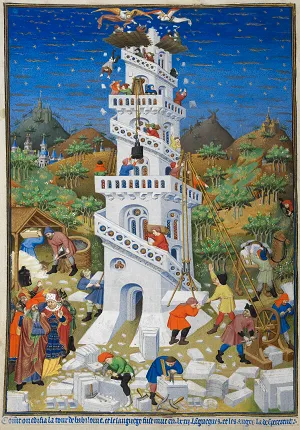
So, Pentecost!  We will begin deep in the weeds.  Literally.  “Pente-cost”—in Greek, the 50th day!  But 50th day after what?  After Passover.  But why 50?  Well, 49 + 1.  Huh?  We scratch our heads.  But of course, the early Christians, though working in the language of the Greeks—pentekoste—are translating practice and memory of the Hebrews.  So hard this biblical faithfulness business—plunges us straight into serious cross-cultural labors and mistakes.  Such a big history of mistakes!  More on that later.  But the Hebrews! They didn’t call it Pentecost, but Shavuot, the Feast of Weeks.  7 weeks after Passover, but with the counting starting on the 2nd day of Passover—so 49 + 1. 

Ok—but then, what anchors Passover, when does it begin?  Ah, now we’re getting down to it, yes, getting down, “gettin’ down,” heavy on the down beat!  But what is down?  What direction?  There—pointing to your feet?  Yes, but what is down there?  A tile floor, you say?  And under that?  Wood floor joists?  And under that?  Pipes?  Yes, yes, and a basement and then cement.  And, and . . . But finally, even in the city, we get to it.  Earth.  What all of life stands on and grows in.  The big assumption.  The Big Momma we take for granted again and again! 

Continue reading ““As a Mighty Wind”: Or, Which Pentecost?”