Racism is a Demonic Possession

billFrom yesterday’s Interfaith Council for Peace and Justice press conference (Detroit, MI) in response to the white Christian “protest” at the Capitol in Lansing.

My name is Bill Wylie-Kellermann. I’m a United Methodist pastor in Detroit, recently retired from St Peter’s Episcopal Church, and a member of Michigan Poor Peoples Campaign: A National Call for Moral Revival.

I speak as a white male Christian outraged at the public display of white supremacy in these demonstrations against the health requirements of Michigan under COVID 19. Continue reading “Racism is a Demonic Possession”

Let Us Imagine

ZinnFrom Chapter 24 of Howard Zinn’s A People’s History of the United States (2000).

Let us imagine the prospect-for the first time in the nation’s history–of a population united for fundamental change. Would the elite turn as so often before, to its ultimate weapon–foreign intervention–to unite the people with the Establishment, in war? It tried to do that in 1991, with the war against Iraq. But, as June Jordan said, it was “a hit the same way that crack is, and it doesn’t last long.” Continue reading “Let Us Imagine”

Interrogation of Everything

D18_185_015Sheldon C. Good, executive director of The Mennonite, Inc., interviewed Ibram X. Kendi about antiracism and the church by email Sept. 3. The interview, edited for clarity, appears below. The editorial in the October issue of The Mennoniteavailable here, includes part of the interview.

Kendi is author of How to Be an Antiracist. He won the 2016 National Book Award for Nonfiction for his book Stamped from the Beginning. He is the founding director of the Antiracist Research and Policy Center at American University in Washington, D.C.

1. You make the case in How to Be an Antiracist that the word “racist” has been removed from its proper usage. How did that happen?

The most virulent racists define racist as anyone who uses the r-words, race or racism. They say, racist is a pejorative term, it is the equivalent of saying I don’t like you, as Richard Spencer once said. Anyone who categorizes people by race, who calls someone racist, is the real racist, they say. Obviously, they are deeply defensive, and deeply in denial. As such, they don’t want to be called racist. They shut down and close up when they do. Some racial reformers have agreed and view “racist” as an attack. So they don’t use the term either. But racist is a descriptive term, not an attack. It describes when a person is saying there is something wrong or right with a racial group. It describes when a person is supporting racist policy with their action or inaction. Continue reading “Interrogation of Everything”

A Kind of Consciousness

anzalduaGloria Anzaldúa describing “the new Mestiza” in her book Borderlands/ La Frontera: The New Mestiza (1987).

She puts history through a sieve, winnows out the lies, looks at the forces that we as a race, as women, have been a part of. . . She reinterprets history and, using new symbols, she shapes new myths. She adopts new perspectives toward the dark-skinned, women and queers. She strengthens her tolerance (and intolerance) for ambiguity. She is willing to share, to make herself vulnerable to foreign ways of seeing and thinking. She surrenders all notions of safety, of the familiar. Deconstruct, construct. She becomes a nahual, able to transform herself into a tree, a coyote, into another person. She learns to transform the small “I” into the total self.

**In an interview in 1991, Anzaldúa elaborated:

Typically, for me, the “new Mestiza” is a kind of border woman who is able to negotiate between different cultures and cross over from one to the other and therefore has a perspective of all those different worlds that someone who is mono-cultural cannot have. And because she has that kind of perspective, tiene conocimiento: she has an understanding of what’s going on in all these different terrains. And so her interpretation is based on perceiving more about the different realities in this world than someone who is just mono-cultural…The new Mestiza for me is a feminist, is definitely a feminist, whether she calls herself that or not. And she’s different from the old mestiza because it’s no longer just a question of blood, it’s no longer a matter of one being Indian or black or Asian or Spanish; you may have those bloods and be raised in a white, middle-class world, or you may be a white woman but be raised in a Chicano community. So it goes beyond just the biological mestiza… there’s such a thing as a cultural mestiza. It’s a kind of consciousness.

Reading History Through the Prophets

ZundAn excerpt from Ched Myers’ classic article “Easter Faith and Empire: Recovering the Prophetic Tradition on the Emmaus Road.” These comments are posted just in time for this weekend’s Gospel text Luke 24:13-35
Luke tells us that Jesus addresses these fit-to-be-tied disciples as “fools”
(24: 25). But the Greek term anontoi refers simply to those who don’t
quite get it, who find the truth as yet unintelligible (cf. Romans 1:14;
Galatians 3:1,3} He knows their hearts are “sluggish” (Greek, bradeis),
as indeed are ours. Because we, like Cleopas and company, forever refuse to embrace the counterintuitive wisdom of the Hebrew prophets.

The prophets tell us to defend the poor, but we lionize the rich. The prophets tell us that horses and chariots cannot save us, but we are transfixed by the apparent omnipotence of modern military technology. The prophets tell us to forgo idolatry, but we compulsively fetishize the work of our own hands, Above all, the prophets warn us that the way to liberation in a world locked down by the spiral of violence, the way to redemption in a world of enslaving addictions, the way to true transformation in a world of deadened conscience and numbing conformity is the way of nonviolent, sacrificial, creative love. But we who are slow of heart–a euphemism for not having courage–instead remain fiercely loyal to ever more fabulous myths of redemptive violence, practices of narcissism, and delusions of our own nobility.

the wind from the tomb

JPerk
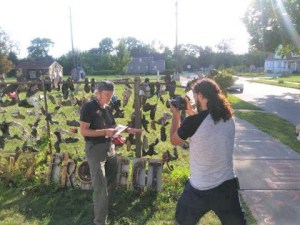
Dr. Jim Perkinson offering a spoken word at the Heidelberg Project in Detroit, MI

by jim perkinson, 04.19.2020, St. Peter’s Episcopal Church (Detroit, MI)

we worry now
about breath
where it has been
whose kiss it carries and whose
nostril-curl in zephyr-spins
of night or day or twirling
door-gush rushing to the street
and we now see how primal
is the air of earth, the river
whence we cruise and where
we move, like fish-in-flow or
a swallow on the wing at dusk—we,
feet on dust, head up-thrust and strolling Continue reading “the wind from the tomb”

Never Forget

Deschutes National ForestBy Ric Hudgens, Quarantine Essay #22, originally posted to Facebook on April 18, 2020. Ric is posted all his essays to Medium

Every day for the past month, something has stunned me. I’ve been unable to respond. I’m astonished by the news stories I’m hearing. I see and hear horrifying things.

The world has never been an entirely pleasant place. Horrifying things happen all the time. But now perhaps I’ve slowed down enough to feel and see the full weight of them.

I’m not surprised by the inequalities revealed in this crisis. They have been there for anyone to see who wanted to look. The callous disregard for human life by those who claim to be “pro-life” doesn’t surprise me. Their understanding of “life” has always been very narrow, partisan, and racist. Continue reading “Never Forget”

A Few From Freire

Paulo-FreireIn these days, we need more Paulo Freire.

The more radical the person is, the more fully he or she enters into reality so that, knowing it better, he or she can transform it. This individual is not afraid to confront, to listen, to see the world unveiled. This person is not afraid to meet the people or to enter into a dialogue with them. This person does not consider himself or herself the proprietor of history or of all people, or the liberator of the oppressed; but he or she does commit himself or herself, within history, to fight at their side.
Pedagogy of the Oppressed Continue reading “A Few From Freire”

Simply Saying “Racism” Without Context is Harmful

jyarlandBy Jyarland Daniels, executive director of Harriet Speaks, an organization doing diversity differently providing a Black voice and perspective in diversity, equity, & inclusion

I write this because I teach and talk about race, diversity, and equity for a living, so there aren’t too many topics in this space that I am silent on. However, I prefer to “think fast, and speak slow” and try to offer thoughtful insights (vs regurgitation) where/if I can. I’m not here to be right or wrong — just to think.

The facts speak for themselves. There is a disparity between not only who contracts this virus, but also in the death rate. Black people are most likely to experience both. But just touting this data (as is too often being done) and attaching the word “racism” to this situation is incomplete, alarming, and confusing. And, I find some of it paralyzing; discussing race without steps to take can have that effect. Continue reading “Simply Saying “Racism” Without Context is Harmful”

the second coming of easter

Water Shift
A pre-pandemic water shift in Detroit, MI.

By Jim Perkinson

empty churches preaching empty tombs
to empty pews, a vision of gloom,
the doom of the poor now creeping
close in corona-spoor knocking even
at the door of the rich and who would
have thought it all could upend
in a single dash of air-splash, invisible,
carrying not quite living code from animal
to our abode everywhere, leading all
but rash, bible-brash evangelical hubris
to hunker in shelter, or fear-trembled,
in hovels or dense-packed streets of
homeless retreats or refugee tents
a world of babel towers
and fake news showers and glowering, bulge-veined purveyors of cover
for the bankers and oil exec wankers to push profit-margins to the edge of the cliff . . . Continue reading “the second coming of easter”