Stop the Bombing

cptA word from friends at Christian Peacemaker Teams.

Stand in solidarity with the members of the “Hear Us Now: Stop The Bombing!” campaign in Iraqi Kurdistan.

Sign this open letter to the Kurdistan Regional Government demanding they take action to stop all cross border bombings and respond to the needs of those affected.

A few minutes past noon on 10 July 2019, 18-year-old Zeitun had just begun to serve lunch for herself and her two brothers, Sirwan (16 years old) and Ali (21), when shells began to explode near the family’s cucumber and tomato fields in the area of the Barbezin heights (in the sub-district of Sidekan, Iraqi Kurdistan). The three siblings had stayed behind working in the field after the rest of the family left to attend a funeral in their hometown of Diana.  Continue reading “Stop the Bombing” →

Diving Into the Wreck

Catherine
Dr. Catherine Meeks recording the audiobook version of Passionate For Justice, a book she co-authored with Rev. Nibs Stroupe.

A word from Dr. Catherine Meeks (originally posted to social media on May 17, 2020).

These days for me are just like yours, some of them are far better than others. Today is a better day. So I want to share out of that space with you this morning.

I have been thinking about Dr. Vincent Harding, historian, speechwriter for Dr. King and all around holy man and his vision of us  “building up a new world in this country.” These thoughts have been accompanied by my writing and thinking about reparations and all of these thoughts are contextualized by this Covid-19 era and what seems to be a new wave of white violence against African Americans. Continue reading “Diving Into the Wreck” →

Today: The 24-Hour Covid Vigil

vigilA Message from Naming The Lost.

As we approach Memorial Day, Americans are mourning the 80,000+ of our loved ones and neighbors whose lives have been lost to COVID-19 (and the hundreds of thousands more worldwide). They are our siblings, our parents, our children, our nurses and grocery clerks, our first responders and teachers, they are the working people who do the essential work of keeping our families and communities safe. Continue reading “Today: The 24-Hour Covid Vigil” →

A Spiritual Pandemic

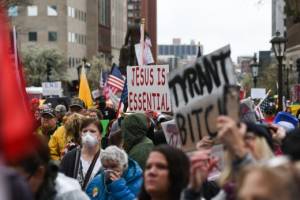
Lansing, April 30
Lansing, Michigan (April 30, 2020)

By Tommy Airey

*Note: I submitted this op-ed to The New York Times, Washington Post, Los Angeles Times and The Oregonian. None of them printed it. So I submit it to you.

The white Christians marching with their flags and firearms on state capitals and main streets make it clear: they have neither a care nor a clue about how COVID-19 is disproportionately killing non-white populations. While they protest, Black residents in Detroit shelter-in with water taps shut-off, Indigenous peoples attempt to contain outbreaks on reservations with limited access to health care and Immigrants around the country work the front-lines at unsafe meat processing plants mandated to stay open by an executive order. Unfortunately, the spectacle of the fascist few takes the focus off the rest of us white folk—the silent, enabling masses—also careless and clueless. The coronavirus may be novel, but the overwhelming disregard for Black and Brown life is not. Continue reading “A Spiritual Pandemic” →

Racism is a Demonic Possession

billFrom yesterday’s Interfaith Council for Peace and Justice press conference (Detroit, MI) in response to the white Christian “protest” at the Capitol in Lansing.

My name is Bill Wylie-Kellermann. I’m a United Methodist pastor in Detroit, recently retired from St Peter’s Episcopal Church, and a member of Michigan Poor Peoples Campaign: A National Call for Moral Revival.

I speak as a white male Christian outraged at the public display of white supremacy in these demonstrations against the health requirements of Michigan under COVID 19. Continue reading “Racism is a Demonic Possession” →

Let Us Imagine

ZinnFrom Chapter 24 of Howard Zinn’s A People’s History of the United States (2000).

Let us imagine the prospect-for the first time in the nation’s history–of a population united for fundamental change. Would the elite turn as so often before, to its ultimate weapon–foreign intervention–to unite the people with the Establishment, in war? It tried to do that in 1991, with the war against Iraq. But, as June Jordan said, it was “a hit the same way that crack is, and it doesn’t last long.” Continue reading “Let Us Imagine” →

Interrogation of Everything

D18_185_015Sheldon C. Good, executive director of The Mennonite, Inc., interviewed Ibram X. Kendi about antiracism and the church by email Sept. 3. The interview, edited for clarity, appears below. The editorial in the October issue of The Mennonite, available here, includes part of the interview.

Kendi is author of How to Be an Antiracist. He won the 2016 National Book Award for Nonfiction for his book Stamped from the Beginning. He is the founding director of the Antiracist Research and Policy Center at American University in Washington, D.C.

1. You make the case in How to Be an Antiracist that the word “racist” has been removed from its proper usage. How did that happen?

The most virulent racists define racist as anyone who uses the r-words, race or racism. They say, racist is a pejorative term, it is the equivalent of saying I don’t like you, as Richard Spencer once said. Anyone who categorizes people by race, who calls someone racist, is the real racist, they say. Obviously, they are deeply defensive, and deeply in denial. As such, they don’t want to be called racist. They shut down and close up when they do. Some racial reformers have agreed and view “racist” as an attack. So they don’t use the term either. But racist is a descriptive term, not an attack. It describes when a person is saying there is something wrong or right with a racial group. It describes when a person is supporting racist policy with their action or inaction. Continue reading “Interrogation of Everything” →

A Kind of Consciousness

anzalduaGloria Anzaldúa describing “the new Mestiza” in her book Borderlands/ La Frontera: The New Mestiza (1987).

She puts history through a sieve, winnows out the lies, looks at the forces that we as a race, as women, have been a part of. . . She reinterprets history and, using new symbols, she shapes new myths. She adopts new perspectives toward the dark-skinned, women and queers. She strengthens her tolerance (and intolerance) for ambiguity. She is willing to share, to make herself vulnerable to foreign ways of seeing and thinking. She surrenders all notions of safety, of the familiar. Deconstruct, construct. She becomes a nahual, able to transform herself into a tree, a coyote, into another person. She learns to transform the small “I” into the total self.

**In an interview in 1991, Anzaldúa elaborated:

Typically, for me, the “new Mestiza” is a kind of border woman who is able to negotiate between different cultures and cross over from one to the other and therefore has a perspective of all those different worlds that someone who is mono-cultural cannot have. And because she has that kind of perspective, tiene conocimiento: she has an understanding of what’s going on in all these different terrains. And so her interpretation is based on perceiving more about the different realities in this world than someone who is just mono-cultural…The new Mestiza for me is a feminist, is definitely a feminist, whether she calls herself that or not. And she’s different from the old mestiza because it’s no longer just a question of blood, it’s no longer a matter of one being Indian or black or Asian or Spanish; you may have those bloods and be raised in a white, middle-class world, or you may be a white woman but be raised in a Chicano community. So it goes beyond just the biological mestiza… there’s such a thing as a cultural mestiza. It’s a kind of consciousness.

Reading History Through the Prophets

ZundAn excerpt from Ched Myers’ classic article “Easter Faith and Empire: Recovering the Prophetic Tradition on the Emmaus Road.” These comments are posted just in time for this weekend’s Gospel text Luke 24:13-35. 
Luke tells us that Jesus addresses these fit-to-be-tied disciples as “fools”
(24: 25). But the Greek term anontoi refers simply to those who don’t
quite get it, who find the truth as yet unintelligible (cf. Romans 1:14;
Galatians 3:1,3} He knows their hearts are “sluggish” (Greek, bradeis),
as indeed are ours. Because we, like Cleopas and company, forever refuse to embrace the counterintuitive wisdom of the Hebrew prophets.

The prophets tell us to defend the poor, but we lionize the rich. The prophets tell us that horses and chariots cannot save us, but we are transfixed by the apparent omnipotence of modern military technology. The prophets tell us to forgo idolatry, but we compulsively fetishize the work of our own hands, Above all, the prophets warn us that the way to liberation in a world locked down by the spiral of violence, the way to redemption in a world of enslaving addictions, the way to true transformation in a world of deadened conscience and numbing conformity is the way of nonviolent, sacrificial, creative love. But we who are slow of heart–a euphemism for not having courage–instead remain fiercely loyal to ever more fabulous myths of redemptive violence, practices of narcissism, and delusions of our own nobility.

the wind from the tomb

JPerk
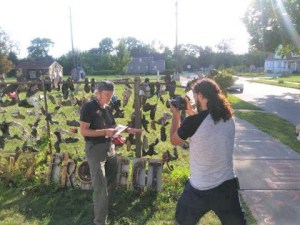
Dr. Jim Perkinson offering a spoken word at the Heidelberg Project in Detroit, MI

by jim perkinson, 04.19.2020, St. Peter’s Episcopal Church (Detroit, MI)

we worry now
about breath
where it has been
whose kiss it carries and whose
nostril-curl in zephyr-spins
of night or day or twirling
door-gush rushing to the street
and we now see how primal
is the air of earth, the river
whence we cruise and where
we move, like fish-in-flow or
a swallow on the wing at dusk—we,
feet on dust, head up-thrust and strolling Continue reading “the wind from the tomb” →