Changing Out Our Western Lenses

Randy WoodleyFrom the introduction of Randy Woodley’s May 2019 Sojourners Magazine piece “The Fullness Thereof.”

CHANGE YOUR LENSES, please. Okay, maybe you can’t simply change lenses right now, but would you at least notice the lenses you are currently wearing? If you are like, say, 99.9 percent of us in the U.S., you have been influenced by a very particular set of perspectives that interpret life from an Enlightenment-bound Western worldview.

All of our lenses have various perspectival tints, but Western worldviews seem to have several in common, including the foundational influence of Platonic dualism, inherited from the Greeks. This particular influence absolutizes the realm of the abstract (spirit, soul, mind) and reduces the importance of the concrete realm (earth, body, material), disengaging them from one another. In dualistic thinking, we are no longer an existing whole. Continue reading “Changing Out Our Western Lenses”
Dad’s “Heart Shield” Bible

By Ken Sehested

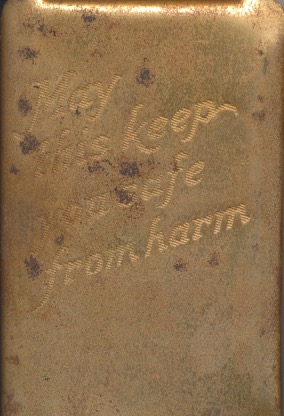
Pictured below is my Dad’s “Heart Shield” Bible, a copy of the New Testament on to which a metal plate front cover has been attached. The engraved cover, now smudged by corrosion, reads “May this keep you safe from harm.” It was sold by the Know Your Bible Sales Company of Cincinnati, Ohio, manufactured by the Whitman Publishing Company, Racine, Wisconsin, and was designed to fit into a soldier’s uniform shirt pocket. Multiple stories exist of soldiers reportedly spared serious injury when bullets struck this tiny piece of body armor.

Dad's _Shield and New Testament_

An inscription inside the cover indicates that Dad’s sister, my Aunt Juanita, gave him this gift. No date is listed, but it was sometime before Dad landed with the first wave of soldiers storming Omaha Beach in the June 1944 Allies’ D-Day invasion on the French coast in World War II. Dad was among the fortunate survivors, though he carried for the remainder of his life a piece of German artillery shrapnel embedded in bone behind his right ear. Continue reading “Dad’s “Heart Shield” Bible”

To Flip the Script of What a Christian Minister Can Be

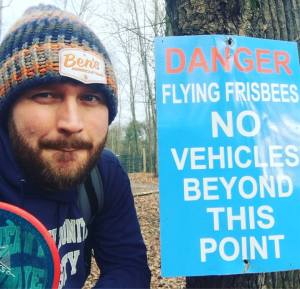
Ben2By Ben Wideman, campus minister for the 3rd Way Collective in State College, PA

*This is part of a series of pieces from contributors all over North America each answering the question, “How would you define radical discipleship?” We will be posting responses regularly on Mondays during 2019.

Discipleship is a word that gets tossed around a lot in campus ministry. It is at the core of many different organizations on our campus. We even have a campus ministry that was founded at Penn State and now present on more than a dozen campuses across the country called DiscipleMakers. Most of these organizations see discipleship as a sending call to embody a literal biblical call to make non-believers or non-practicing Christians into disciples of Christ (based on the Matthew 28 passage often referred to as the Great Commission). Continue reading “To Flip the Script of What a Christian Minister Can Be”

Freedom Movements

RubyFrom the front porch of Mother Ruby Sales (May 19, 2019).
Do freedom movements seek to build a new table or do they seek to gain more seats at a broken down one? Do they create new powerful people or do they create new token elites? Do nonviolent movements use the same language to talk about ourselves and lives that we learn from the guardians of power or do we speak in new and multiple tongues that express the largeness of our individual and collective lives?

Confronting U.S. Warring Madness

CPT IK
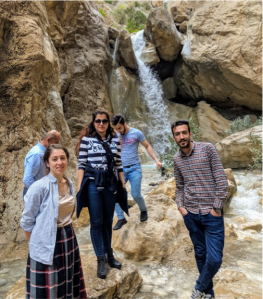
Rebekah, Runak, Kamaran (foreground left to right), and I hiked to a cave and waterfall. PC: Weldon Nisly                  

An excerpt from the monthly update of Weldon Nisly, a retired Mennonite pastor and part-time member of the Christian Peacemaker Teams Iraqi Kurdistan (CPT IK) delegation. 

A few years ago, after 25 years as a human rights and women’s rights activist, Gulistan Saeed decided to seek change within the political system. Elected as a Member of Parliament of the KRG, she was granted her request to serve on the human rights committee.

Gulistan welcomed the CPT IK team to the KRG Parliament and listened as we shared the Deraluk families’ sorrow and request for assistance. She promised to take their case to her committee and to an independent Kurdish human rights committee to help the families find their missing loved ones. She also expressed eagerness to work with CPT on future human rights cases and encouraged CPT to bring these Deraluk families to Erbil to meet with other Members of Parliament. She recommended that CPT and the families have a press conference to help the people of Iraqi Kurdistan and the world hear the traumatic impact of Turkey’s cross border bombing of civilians. Continue reading “Confronting U.S. Warring Madness”

Radical Discipleship: An Invitation to be Led by the Spirit in Prayer

JoBy Rev. Joanna Lawrence Shenk

*This is part of a series of pieces from contributors all over North America each answering the question, “How would you define radical discipleship?” We will be posting responses regularly on Mondays during 2019.

A version of this article was first preached at First Mennonite Church of San Francisco on March 31, 2019

During Lent this year I experienced a stripping away, a reorientation in a vulnerable and uncomfortable way. I recognized my need for God and guidance by the Spirit anew. It has led to questions such as:

Where is the Spirit at work?
Am I attentive enough to follow the Spirit’s leading?
Am I courageous enough to follow?
Do I actually need God or do I think I’m okay with my analysis and intention to do good in the world?


In this time prayer has become a central practice. Continue reading “Radical Discipleship: An Invitation to be Led by the Spirit in Prayer”

Ideological Remoulding

Bullets
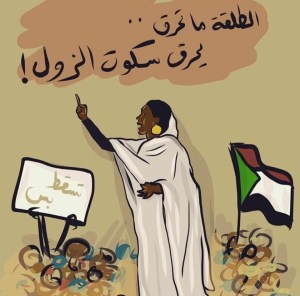
Bullets Don’t Hurt. The Silence of the People Does. Khartoum, Sudan, 2019 (Source: http://www.thetricontinental.org).

An excerpt from a recent newsletter “Radical Change Must Fall Like a Gentle Mist, Not a Heavy Downpour” at The Tricontinental, an international, movement-driven institution focused on stimulating intellectual debate that serves people’s aspirations.

Change comes at different tempos. Political change – the removal of a government – can be swift. Slower yet is economic change, with systems of production far less easy to pivot than the ejection of a government. Harder to change social systems, institutions such as the family, which have deep roots not only in our consciousness but also in our infrastructure (consider how our housing is built, to facilitate an ideological view of the ‘family’). But the hardest of all to change are the rigidities of culture, the tap roots of norms and customs that go deep into the centre of human experience. Prejudices of all kinds – racism and patriarchy – lie far beneath the surface, requiring what Zhou Enlai called ‘ideological remoulding’ to alter them. ‘It cannot be done with haste’, Zhou Enlai says several times in his speech. Such cultural work takes time. It has to dig gently into the earth to investigate the tap root, digging deeper to understand its power. Radical change has to confront culture’s blockages. Two kinds of work are necessary: cultural work, to stretch the imagination, and political work, to undermine the power of nasty cultural forms.

The Intensity of the Witness

ClarenceFrom the Essential Writings of Clarence Jordan, founder of Koinonia Farm and author of the Cotton Patch paraphrase of the New Testament.

The history of the Christian movement demonstrates that the intensity of persecution is geared, not to the moral level of the non-Christians, or persecutors, but to the intensity of the witness of the Christian community. The early believers were not persecuted because the Romans were such bad people. In fact, on big occasions they would throw a thousand or two helpless people into the amphitheater to be clawed to pieces by lions, but the thought of atomizing [with a nuclear bomb] a whole city probably would have horrified them. The strong conviction of the believers might not have caused the Romans to persecute them, but there could have been no persecution without such faith. One wonders why Christians today get off so easily. Is it because unchristian Americans are that much better than unchristian Romans, or is our light so dim that the tormentor can’t see it? What are the things we do that are worth persecuting?

To Enlist

J PerkAn excerpt from Detroit-based theologian Dr. Jim Perkinson’s classic piece “Theology and the City: Learning to Cry Struggling to See.

*To live in a suburb “neutrally” is to participate in the American fiction of innocence.

…In complex, globally interdependent societies like those we now live in, theology that is not simply ideology requires a kind of militancy. It must enter a fray that is neither gentle nor innocent. But it has not ever been different for Christian “God talk.” In the first centuries of the church’s life, for instance, the early meaning of paganism was both “rural-dweller” and “noncombatant.” To become a believer in the early church meant to enlist. In the Roman imperial order, a sacramentum was an oath of loyalty taken by a soldier to Caesar. For Christians living under that imperial regime, celebrating “sacraments” like the Eucharist was a practice of political resistance in a struggle that engaged war-making as its nonviolent, but combative opposite. From the beginning, Christianity has been about spiritual warfare, when it has not forgotten its calling. And Christian theology in the mix is the articulation of where God is most likely to be encountered in the ongoing conflict.

Those Deemed Different

NephsBy Tommy Airey, last Sunday’s silent sermon 

So when Peter went up to Jerusalem, the circumcised believers criticized him, saying, “Why did you go to uncircumcised men and eat with them?” Then Peter began to explain it to them, step by step…
Acts 11:2-4

When they heard this, they were silenced. And they praised God, saying, “Then God has given even to the Gentiles the repentance that leads to life.”
Acts 11:18

I give you a new commandment, that you love one another. Just as I have loved you, you also should love one another. By this everyone will know that you are my disciples, if you have love for one another.
John 13:34-35

In a previous life, I was the athletic director at a large public high school and an associate pastor at an Evangelical church plant at the same time. My single life and my Purpose Driven protein shakes subsidized my 80-hour workweek. It was a life of adventure. One week I was on a short-term mission trip to Nigeria. The next week I was dealing with the fallout of a teacher-and-coach who was sleeping with one of his students. Continue reading “Those Deemed Different”