
 Now’s the time to sign up for the 2019 Bartimaeus Kinsler Institute in Southern California in mid-February. This year the theme is Indigenous Justice and Christian Faith: Land, Law, Language. Meet people just like you who want to join in with the solidarity of sharing the experience, hope, pain and joy of Justice!
Category: Subverting Empire
Radical Discipleship in a Time of Extinction
 By
By *This is the first of a year-long series of posts from contributors all over North America each answering the question, “How would you define radical discipleship?” We will be posting responses regularly on Mondays during 2019.
“Radical discipleship” is one way of stating the call of the gospel. At face value, it means something like “following the root” (“radical” comes from the Latin “radix,” meaning “root”). But Christianity since Constantine has become so much the creature of urban imperial regimes that we typically approach the language of roots and plants as metaphor—nice “conceits” from earlier times that we have more literally “left behind” in our collaboration with a high-tech takeover of the planet. Indeed, in evangelical circles the great hope of the age in books going by the “Left Behind” nomenclature is to be “raptured” out of the mess of history and the barbarity of nature. The vision of salvation is one of exiting everything to do with earthly living—such as plant bodies growing, root-systems exchanging with soil, or animals eating and reproducing. Indeed, if heaven offers any “food” delights (like pizza or beer, in my paradise)—they will surely not issue in bacterial-driven metabolic processing and defecation or entail beheading of wheat or fermenting yeast or fungi handing off nitrogen to roots! (Not to mention anything as scandalous as sexual intercourse!) Continue reading “Radical Discipleship in a Time of Extinction”
Truth, Trust, and Power
 A CALL FOR CONTENT from our co-conspirators at Jesus Radicals for their third issue of Rock! Paper! Scissors!
Tools for anarchist + Christian thought
Issue 3: Truth, Trust, and Power
Guest Editor: Ted Lewis
In the field of restorative justice, which seeks to address and repair harm in relationships, two elements have been central to people’s experience: truth-telling and trust-building. In this way, truth and trust (which share word origins in a number of languages) work together to bring about healing and restoration between people and even communities. In this third issue of Rock! Paper! Scissors! Tools for anarchist + Christian thought, we seek to wrestle with the tensions of speaking truth and building trust in the midst of power-imbalances in relationships and in movements for justice. Continue reading “Truth, Trust, and Power”
What is Your New Years (R)evolution?
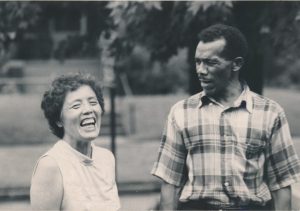 By Marcia Lee, Healing by Choice!, a women of color healing circle in Detroit, MI
Now that Christmas is over, you may be thinking about what new years’ resolutions you want to make and how you want to show up in this new year. I want to invite you to consider, instead of a resolution, to make a New Years (R)evolution. Grace Lee Boggs (right) taught us that the next revolution needs to be a (r)evolution = the re-evolution of ourselves and our community. Although it is helpful to have goals for how we want to grow as individuals, we live in the context of the times we live in and in God’s time. Continue reading “What is Your New Years (R)evolution?”
Mary’s Promise: God’s Gonna Trouble the Water

By Kim Redigan, an Advent reflection on Luke 1:39-55 for the Faith Outreach Committee of the Detroit Peoples Water Board
For a very long time now, I have been on a mission to liberate the white porcelain hands of Mary from clerics and capitalists who have turned our tough sister into little more than a cooing dove. A saccharine symbol of passivity. A willing tool of the patriarchy. A voiceless virgin who is venerated but never listened to, much less followed.
If I had a dollar for every time I squirmed in church pews and internally screamed, “No, no, NO!!!!!” as Mary was hijacked in homilies that completely denied her humanity and political-cultural context, I could pay for several of the exorbitant water bills that have resulted in shutoffs for so many of our neighbors. Continue reading “Mary’s Promise: God’s Gonna Trouble the Water”
Loving our Way through the Darkest of Days (Advent Week Four)
 From our comrades at The Wilderness Way in Portland, OR:
Week Four’s Skill of Loving is HONORING:
I honor your feelings and ideas. I recognize your right to think and feel as you do, as well as my own.
Connection with Christian Scriptures — Luke 2: 1 – 20
This text is the classic “Christmas Story” — the story of the birth of Jesus in the Gospel of Luke. The practice of honoring in this story is captured by one simple sentence that comes near the end of the story. “But Mary treasured all these things and pondered them in her heart.” Continue reading “Loving our Way through the Darkest of Days (Advent Week Four)”
Strengthening Community, Nurturing Souls, Amplifying Hope
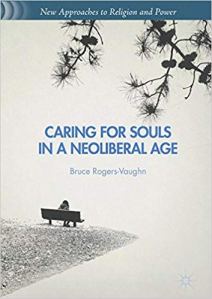 By Tommy Airey, a review of Bruce Rogers-Vaughn’s Caring For Souls in a Neoliberal Age (2016)
It’s the economy stupid. This was the pundit-driven explanation for Bill Clinton’s victory almost three decades ago. It is also the root of our present crises. What we’ve been hearing is true. Times have changed. Not so much in the past two years. More like the past thirty. Yet as depression, addiction, panic attacks, suicide and debt have all skyrocketed, pastoral attempts to get at the roots of the pain and suffering can tend towards family dynamics, relational patterns and trauma.
These factors are real and important. However, in his recent Caring For Souls in a Neoliberal Age, Bruce Rogers-Vaughn implores readers that there are interweaving socio-political powers that shape us in destructive ways too. We must dismantle racism and hetero-patriarchy. But Rogers-Vaughn writes, “Any form of identity politics that ignores class, therefore, will be fated to support the ongoing domination of neoliberal interests” (216). It’s the profit-driven, wage-reducing, deregulating, free trading economy stupid. Continue reading “Strengthening Community, Nurturing Souls, Amplifying Hope”
Journaling on the outside of the Jail
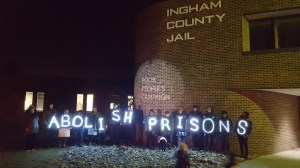 By Lydia Wylie-Kellermann
This Advent my dad, Bill Wylie-Kellermann, spent 10 days in jail for an action he was part of in the spring with the Poor People’s Campaign. Each night I journaled and shared them on facebook. It was a practice that held my heart steady in a rather chaotic week and a half.
Day 1 of Dad in Jail for Advent
“But who will….”
My morning was crappy. Both kids with tantrums leaving it almost impossible to get everyone where they needed to be on time. On the way to school, I pulled a completely unnecessary turn around, scraped a log next to someone’s driveway which pulled off my bumper.
So, I am driving down 96 to concerning sounds of things scraping against my tires and wind rushing through the exposed mechanics of my car. I am running late, but trying to still make it to see my dad and Tommy Tackett turn themselves in at court today. I want to get video statements. I want to help alert press releases with on the ground information. I want to say thank you to my dad and hug him goodbye. Continue reading “Journaling on the outside of the Jail”
Don’t Wake a Sleeping Dragon
By: Anonymous
A few weeks ago I was sitting in Jose’s kitchen, waiting for his monthly phone call. Once a month he gets a call on a voice-recognition system: at some point during a two hour window, the phone will ring. He answers, then has to call back within three minutes. A machine recites a string of numbers, which he repeats, and then he is okay for another month. Since getting Administrative Closure of his case a few years ago, this has been the only contact he has had with the immigration folks. Finally the phone rang. I watched as he called back, heard him repeat the string of numbers. And repeat it again, and again, four times altogether. Finally he turned to me, ashen-faced. “It says it’s going to report me,” he said. Continue reading “Don’t Wake a Sleeping Dragon”
Loving our Way through the Darkest of Days
From our comrades at The Wilderness Way in Portland, OR:
“They came to Jericho. As he and his disciples and a large crowd were leaving Jericho, Bartimaeus son of Timaeus, a blind beggar, was sitting by the roadside. When he heard that it was Jesus of Nazareth, he began to shout out and say, ‘Jesus, Son of David, have mercy on me!’ Many sternly ordered him to be quiet, but he cried out even more loudly, ‘Son of David, have mercy on me!’ Jesus stood still and said, ‘Call him here.’ And they called the blind man, saying to him, ‘Take heart; get up, he is calling you.’ So throwing off his cloak, he sprang up and came to Jesus. Then Jesus said to him, ‘What do you want me to do for you?’ The blind man said to him, ‘My teacher,* let me see again.’ Jesus said to him, ‘Go; your faith has made you well.’ Immediately he regained his sight and followed him on the way.”–Mark 10:46-52
Week Three’s Skill of Loving is RESPONDING TO NEEDS:
“I will respond to your needs and be there for you, within the limits of my value system, when those needs are made known. I also take the responsibility to make my needs known.” Continue reading “Loving our Way through the Darkest of Days”

