Do you ever wonder about how early church thinkers viewed wealth and poverty? Have the messages on stewardship that you’ve heard from the pulpit sounded contradictory to Scripture — or have you not heard many messages from church leadership on money at all?
If you’re curious to learn more on your journey of connecting your financial decisions with your faith, we invite you to join us for a live webinar: Scandalous Money with Miguel Escobar.
Escobar is an author and director of strategy and operations at Episcopal Divinity School. His book, The Unjust Steward: Wealth, Poverty, and the Church Today, explores Christianity’s complicated and conflicted relationship with money. He will join us for a live Zoom webinar on Wednesday, April 24, from 7:00-8:30 pm Eastern.
“The idea of sumud has become a multifaceted cultural concept among Palestinians: it means steadfastness, a derivative of “arranging” or “saving up”, even “adorning”. It implies composure braided with rootedness, a posture that might bend but will not break.” – Hala Alyan
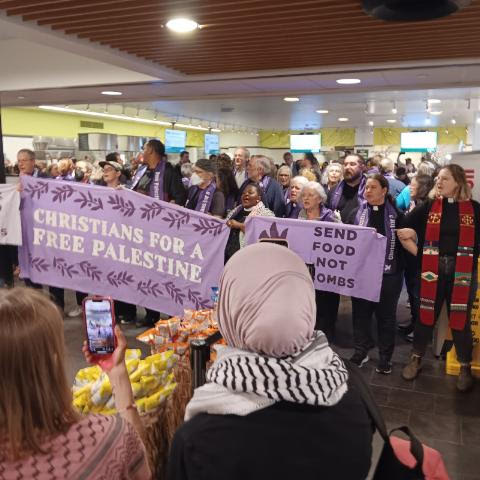
This week, on the anniversary of the execution of Dietrich Bonhoeffer, I watched my spouse get arrested. Lindsay joined dozens of other members of Christians for a Free Palestine publicly calling out the role of the American government and American churches in supporting the apartheid state of Israel’s decades-long occupation and blockade of Gaza, now spiraling into a genocide. After a short worship service of confession, communion and commission under a Magnolia tree a stone’s throw from the Capitol in DC, these parents, professors, engineers, social workers, retired seniors, seminary students and ordained ministers bee-lined for the cafeteria in the basement of the US Senate building. They planned to get “lunch” together.
The cafeteria was crowded and noisy. The Jesus people were ready to turn over tables. But they walked in casually, blended right in, played cool, waiting for their cue. Then, a few of the faithful started singing.
Palestine will be free. Palestine will be free We will not avert our eyes. Palestine will be free.
Over and over again. They rose from their seats and walked to the front of the line and locked arms behind banners that read Send Food Not Bombs and Christians for a Free Palestine and Woe to you who Slay the Hungry and Break Bread not Bodies. They stood in front of the cashiers to block customers from paying. They locked arms, connecting the dots and telling the truth together with loud, coordinated chants. It was more than a symbolic action. If American leaders won’t let Gaza eat, then they don’t deserve to eat lunch. A minor inconvenience compared to forced starvation.
***
In that moment, I was reminded of something I once heard from Lindsay, who not only has a criminal record, but is also a licensed marriage and family therapist. These two credentials are connected. The year after Minneapolis police murdered George Floyd, she told me that whenever we repress or guard or just go along to get along with something that is counterfeit, then the counterfeit will inevitably come out sideways. If we stay silent in the face of injustice, exploitation and oppression built on disinformation, myths and lies, then it will do something serious to the deepest parts of who we are. Because the soul is a web that connects everyone to everything else.
Living otherwise means living according to the Great Economy.
Wendell Berry’s notion of the Great Economy contrasts with what he terms the Little Economy. The Little Economy is the industrial, globalized economic system that prioritizes profit and exploitation of resources over sustainability and community well-being. Berry’s discussion of the Great Economy is a central theme in his critique of contemporary society and his vision for a more sustainable and harmonious way of living.
The Little Economy has had detrimental effects on our environment, local community, and the human spirit. The Great Economy reveals the interconnectedness of economy, ecology, and culture. In some places, Berry literally equates the Great Economy with what Jesus called the kingdom of God. (See the essay “Two Economies” in The Art of the Commonplace: Agrarian Essays, 2003).
By Bill Wylie-Kellermann, an Easter vigil homily from Detroit
So good to be in this service, in this hour and house – thanks to all who have returned or stepped up to make it happen. I speak the thanks of many hearts.
Two memories always wash over me when I come to this service.
One, is of 1983 when at the inspiration of Tom Lumpkin, seven of us including Maria West and Gordon Judd, walked the easter vigil onto Wurtsmith AFB when first-strike cruise missiles were then being loaded on B52s. We cut the fence, breaking the seal on death, walked down the 3 ½ mile runway, pausing at a small building to spray paint “Christ Lives! Disarm” and there renewed our baptismal vows – renouncing Death and all its works – finally partaking eucharist on our knees at the open gate to the high security area of loaded bombers. Our Easter declaration, that we were free to unmake these weapons, changed then and there my understanding of resurrection.
The other is during the service in this sanctuary, in 2001 – as we gathered in a circle to receive eucharist, just as Jeanie Wylie was passing the bread to her daughter, she went into a seizure. The circle were all people who had loved and supported her through her brain-tumored illness, so folks beside her instinctively lowered her to the floor and the loaf and cup continued round. Before it was complete she was sitting up and insisted on receiving. By the time we sang Jesus Christ is Risen Today, her voice was back and almost full throated. She herself lived a resurrected life. Today when we invoke the ancestors and saints, join our voices with them, she, like others we name, will be present to us. Holy Holy Holy – Hosannah in the Highest.
The conclusion of an Easter proclamation from Palestinian Pastor Rev. Mitri Raheb(read or listen to the whole article here)
As Indigenous residents in the birthplace of Jesus, we know that there can be no true peace for anyone here without peace for all. The current onslaught will not destroy hateful and extremist ideologies. It’s a historic injustice that is only fueling further injustice and destroying our ancient community in the process.
We cannot presume to know what comes after a cease-fire and the release of all captives, including both Palestinians and Israelis. But we know that without a cease-fire today, Palestinians (Muslim and Christian alike), Israelis, the region and the world will be pulled into a dark spiral of misery, reprisal and instability. We will continue to cry out: Stop. And we will continue to practice hope.
In the West Bank, with major streets closed by the Israeli occupation, we are locked in our cities behind concrete walls that transformed our cities into “Bantustans.” We are entombed by a heavy stone. We keep asking: Who will roll away the stone? We have been living for more than seven decades, keeping a long Easter vigil. We keep asking if and when Sunday will come, when this oppression will end, when will we obtain our freedom to live in dignity and to reach our full potential.
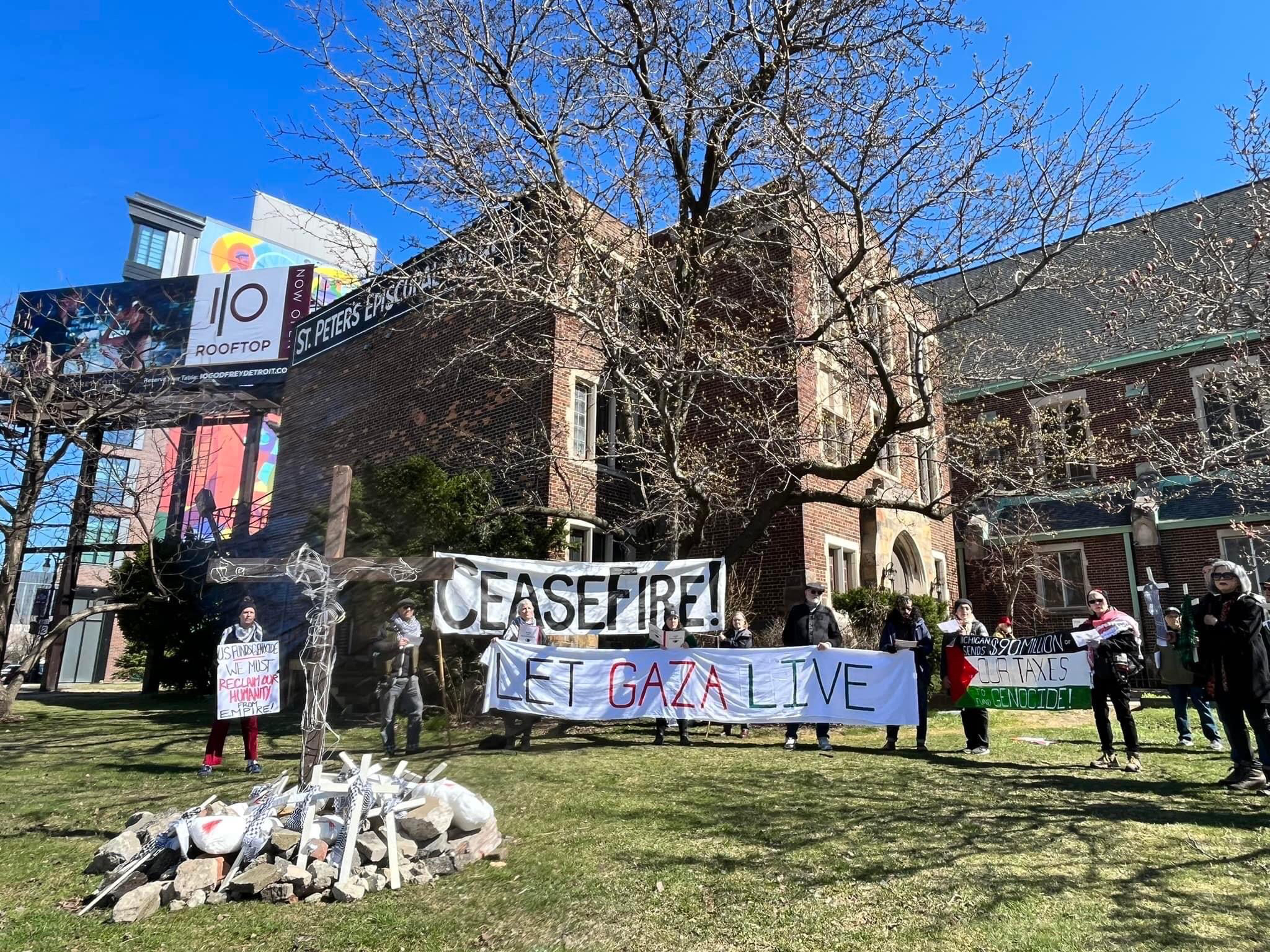
Every Good Friday, a motley crew of radical disciples walks the streets of Detroit with a large, awkward wooden cross. They stop at “stations” where life is being crucified in the city. This year, these Detroiters are homing in on the image of rubble. Empire is bombing Gaza. Empire is bulldozing ghettos. It’s part of a settler-colonial supremacy story that seizes land for wealthy and powerful elites. Ad agencies and mainstream media and political parties – and, yes, Christian churches – play their part in hiding the collateral damage. As Palestinian pastor Munther Isaac proclaimed in his viral Christmas sermon, the crucified are buried under the rubble. Christians are called to join Jesus in there. To work. To bear witness. To worship. As we wait expectantly for Something Else to resurrect the dead and discarded into newness of life. The post below is the introduction to Detroit’s Good Friday Stations of the Cross Walk. [artwork above: Lucia Wylie-Eggert]
For more than forty years, we have placed a wooden cross against the brick wall on the backside of the Manna Meal soup kitchen. We pass the booklets, ring the gong, raise our voices, and read these words. Then we walk. Together. On this journey of repentance. A word in the ancient context that referred to a soldier switching sides during a battle.
We walk the streets of Detroit asking:
Where is Christ crucified today – and what does it mean for us to repent, to switch sides and join him in the rubble created by empire?
Each year our route is different and distinct. The faces of victims and executioners rise up to us from a particular time and place. The imperial powers that we recognize today are the same and not the same as before – and they are all threaded together, entangling us in a settler-colonial web of death and domination. We name them again. We name them anew.
Another compelling offering from The Alternative Seminary.
A SEVEN-WEEK ONLINE COURSE 7:00 – 9:00 pm EST Tuesday evenings, April 2 – May 14, 2024
In the United States today, we are witnessing the ascendancy of Christian Nationalism – a dangerous heresy in which “American Jesus” is a gun-toting, law-and-order, pro-military, pro-capitalist, and largely racist Messiah of the Domination System.
We urgently need to recover the authentic Jesus of the Gospels. Together we will explore the radical and revolutionary mission and vision of Jesus in the midst of the Empire and false idols of his time. What does Jesus mean in proclaiming “the reign of God”? How does his life embody that new spiritual and social reality? What kind of discipleship community does he call people to? We will reflect on how the Gospel addresses issues of politics, economics, power, healing, community, and suffering. We will struggle with how this Jesus challenges us to be a Beloved Community in these insane and dangerous times.
This course, which begins in Easter Week in the light of the Resurrection, will be led by Will O’Brien, coordinator of the Alternative Seminary.
Over the next three weeks, the Christian season of Lent will overlap with the Muslim holy month of Ramadan, which started yesterday at sundown. Yesterday. When a billion Christians read the Gospel text where the radical rabbi Jesus tells the wealthy and powerful Nicodemus that Jesus himself must be lifted up on a cross – just like Moses lifted up the serpent in the wilderness.
Jesus was giving a little sermon on the story in the Hebrew bible about the post-exodus Israelites getting bit by poisonous snakes. God tells Moses to make a bronze snake, put it on a pole and raise it up whenever someone gets bit – so they can look up at the snake and be healed. Jesus says that he is now playing the role of the bronze snake.
In the Gospel story, Jesus will inevitably be lifted up on a cross. Because he paved a path that threatened those who clung to their privilege, power and wealth. Radical Christian spirituality roots salvation in gazing at Jesus up on that imperial cross.
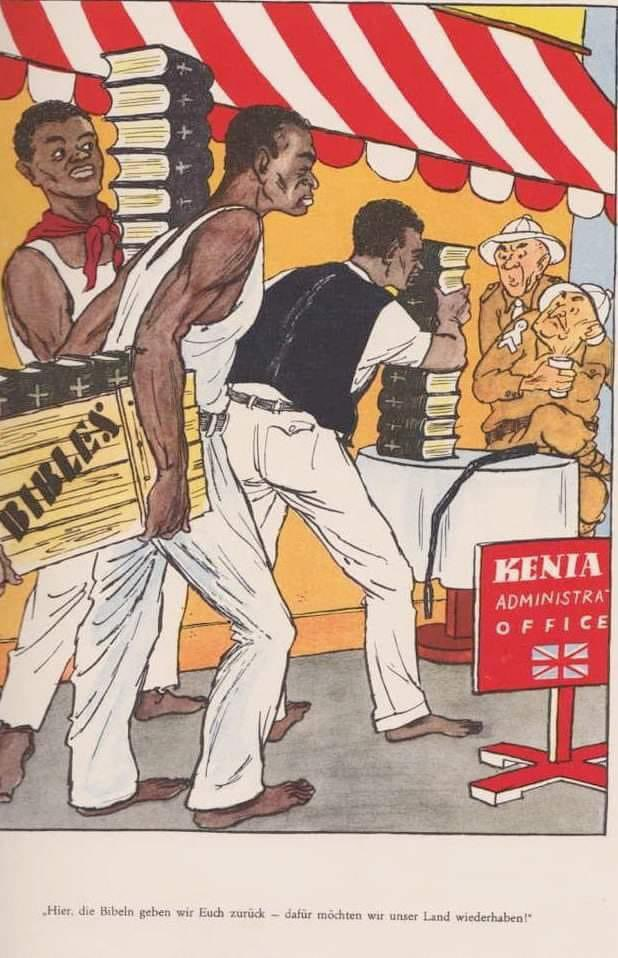
East German cartoon from 1953 showing Kenyans returning crates of Bibles to the British colonial office: ‘We are giving you your Bibles back – give us our land back!’ (thank you Joe Bassey for posting to Twitter)
Another compelling offering from Alternative Seminary.
Whose Liturgy Is It Anyway? Reclaiming Christian Liturgy as the People’s Work
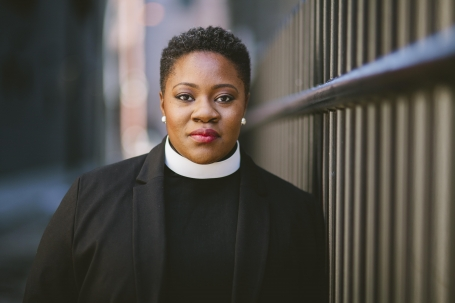
A Three-Part Series Led by Rev. Naomi Washington-Leapheart (above)
Saturdays, March 9, 16, 23. 10:00 am- 12:00 noon EST. $100
Familiar and traditional liturgy in Christian worship can be a source of comfort. But liturgies left unexamined can do harm. In this series, we’ll explore various liturgical forms and ask – whose liturgy is this and what “work” is this liturgy doing?