“BINDING THE STRONG MAN”: Jesus’ Master Metaphor

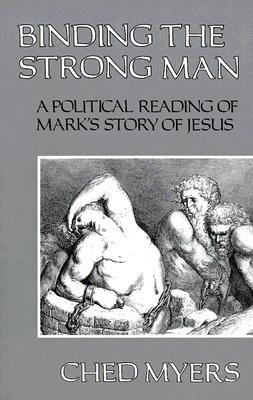
BindingBy Ched Myers, for the 2nd Sunday of Pentecost (Mk 3:20-35)

Note: This is an ongoing series of Ched’s brief comments on the Markan gospel readings from the Revised Common Lectionary during year B, 2015.

The first major narrative cycle in Mark’s gospel (1:16-3:6) ends with Jesus’ rejection by the authorities in a Capernaum synagogue. The following episodes serve to regenerate the story by a withdrawal and summary scene (3:7-12) and then by a reconsolidation moment (3:13-19a). The latter mountaintop scene boldly re-contextualizes two of the most revered traditions of Israel: God’s covenant with Moses on Sinai, and Moses’ founding of the free tribal confederacy in the wilderness. Jesus, who has taken the torch from the prophets, prepares to pass it on to twelve disciples he has called, named, and commissioned to proclaim, heal and exorcize (3:14f). Shortly they will be sent out to practice this charge – a second regenerative episode that follows upon another synagogue rejection (6:1-13). Continue reading ““BINDING THE STRONG MAN”: Jesus’ Master Metaphor”

A Post-Evangelical Pilgrimage, Part II

MLKBy Tommy Airey

*This is the second post in a three-part series exploring more compelling ways to follow Jesus.

On the one hand we are called to play the good Samaritan on life’s roadside; but that will be only an initial act. One day we must come to see that the whole Jericho road must be transformed so that men and women will not be constantly beaten and robbed as they make their journey on life’s highway.
Martin Luther King, April 4, 1967

In a conversation we were having on a prairie highway about 30 kilometers north of Saskatoon, Ched Myers, predictably, got pedagogical. “When we become jaded or wounded, one of three things happens,” he exhorted.

1. We blame others and stay in denial, inflicting our pathologies on to others.
2. We bail out or burn out, escaping into a myriad of copings.
3. We traverse the road-less-traveled: we do the hard work of personal inventory.

Over the course of the past decade, as my Evangelical categories crumbled in the face of experience, theological reading, deep dialogue, prayer and social analysis, I’ve struggled through all three of these phases.
Continue reading “A Post-Evangelical Pilgrimage, Part II”

Aslan is on the move

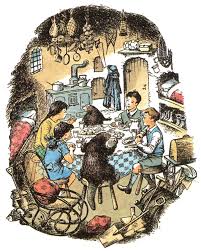
lion witch wardrobe“They say Aslan is on the move perhaps has already landed.”

And now a very curious thing happened. None of the children knew who Aslan was any more than you do; but the moment the Beaver had spoken these words everyone felt quite different. Perhaps it has sometimes happened to you in a dream that someone says something which you don’t understand but in the dream it feels as if it had some enormous meaning—either a terrifying one which turns the whole dream into a nightmare or else a lovely meaning too lovely to put into words, which makes the dream so beautiful that you remember it all your life and are always wishing you could get into that dream again. It was like now. At the name of Aslan each one of the children felt something jump in its inside. Edmund felt a sensation of mysterious horror. Peter felt suddenly brave and adventurous. Susan felt as if some delicious smell or some delightful strain of music had just floated by her. And Lucy got the feeling you have when you wake up in the morning and realize that it is the beginning of the holidays or beginning of summer. – C.S. Lewis, The Lion, the Witch, and the Wardrobe.

A Post-Evangelical Pilgrimage, Part I

evangelical TimeBy Tommy Airey

*The first in a three-part series exploring more compelling ways to follow Jesus.

…the essence of Christianity is itself an essentially contested concept.
James McClendon, Doctrine (1992)

I was inducted into North American Evangelical Christianity in 1983 while attending the Christian elementary school where my mom got a job teaching 5th grade. I was in the 4th grade and my teacher, whom I loved, rhythmically proclaimed:

God said it, I believe it and that settles it.

This was after daily prayer and Bible readings in class. End of conversation. No debate or diversity. It’s settled. Period. I remember the rush of certainty and triumph that would flood my heart and mind.
Continue reading “A Post-Evangelical Pilgrimage, Part I”

Pentecost: Divine Polyculture vs. Imperial Monoculture (Genesis 11 and Acts 2)

pentecost1By Ched Myers

Note: This is part of an ongoing series of Ched’s brief comments on the Revised Common Lectionary during year B, 2015.

How is it that we heard, each of us, in our own native tongue?
Acts 2:8

Since the dawn of colonization, the Americas have been defined by the struggle between dominant culture ideologies of conformity imposed by those in power, and grassroots cultural diversity among those on the margins. This tension between fantasies of racial supremacy and realities of racial diversity remains one of the supreme challenges facing the U.S., and thus our churches, today. The future of North American society depends upon our ability to live peaceably and justly with human diversity — and the same can be said of the human experiment as a whole. The question is whether we can, in church and in society, forge models of coexistence-with-congruence rather than unity-by-uniformity.
Continue reading “Pentecost: Divine Polyculture vs. Imperial Monoculture (Genesis 11 and Acts 2)”

The Pedagogy of Place: The Whisper of the Wind

DSC00079By Tommy Airey, the final post in a series about how we learn from our location about what is truly Divine
————–
In this country American means white. Everybody else has to hyphenate.
Toni Morrison

Immediately, he made his disciples get into the boat and go on ahead to the other side…
Mark 6:45

The wind is deceptive in Detroit. When it is at your back, you forget it’s even there. On the bike, on my way to the church, the electronic marquee at the Prince Valley Supermercado registers 25 degrees. I doubt it. I’m traveling fast and I’m working up a sweat. But at the end of the work day, trekking west back to the block, I have a stubborn epiphany, once again, that the wind was there all along. Now it’s 40 out, but the wind is blustering my face off, cracking my lips into a pot pie crust. It’s virtually impossible to complete the journey without cussing. A lot.
Continue reading “The Pedagogy of Place: The Whisper of the Wind”

The Pedagogy of Place: Psalms & Seinfeld

DSC00005By Tommy Airey, the 2nd post of a 3-part series about how we learn from our location about what is truly Divine

Sometimes the road less traveled is less traveled for a reason.
Jerry Seinfeld

When I met Reggie on a Tuesday morning a few weeks ago, he was beaming a world-class smile. He was copping a holy swagger. After his second cup of coffee, he hollered at me from his seat 20 feet away: “is it the 7th?” His curiosity was cut off by another guest asking me for a cup of hot tea with sugar. Reggie flew into a spontaneous fit of rage. Shortly thereafter, he approached me to apologize for the outburst: he just needed a confirmation of the date, he explained, so he could resume his daily reading of the Psalms.
Continue reading “The Pedagogy of Place: Psalms & Seinfeld”

An Easter Vigil Word

mary magdalene Preached by Denise Griebler at the Detroit Peace Community/Catholic Worker/ St. Peter’s Episcopal Church Easter Vigil on Mark 16:1-8.

16 When the sabbath was over, Mary Magdalene, and Mary the mother of James, and Salome bought spices, so that they might go and anoint him. And very early on the first day of the week, when the sun had risen, they went to the tomb. They had been saying to one another, “Who will roll away the stone for us from the entrance to the tomb?” When they looked up, they saw that the stone, which was very large, had already been rolled back. As they entered the tomb, they saw a young man, dressed in a white robe, sitting on the right side; and they were alarmed. But he said to them, “Do not be alarmed; you are looking for Jesus of Nazareth, who was crucified. He has been raised; he is not here. Look, there is the place they laid him. But go, tell his disciples and Peter that he is going ahead of you to Galilee; there you will see him, just as he told you.” So they went out and fled from the tomb, for terror and amazement had seized them; and they said nothing to anyone, for they were afraid.

The other day I cyber-stumbled on a new childrens’ book called Rad American Women from A to Z – it’s a picture book that teaches kid’s a little women’s history along with the ABCs. A is for Angela (as in Davis) – Z is for Zora (as in Neale Hurston). There’s even X for the women whose names we do not know.   It’s a collection form AtoZ of courageous, badass women we want our kids and our grandkids to know. Continue reading “An Easter Vigil Word”

The Pedagogy of Place: The Art of Coping

By Tommy Airey, the first post of a 3-part series about how we learn from our location about what is truly Divine
——————
Every town has the same two malls: the one white people go to and the one white people used to go to.
Chris Rock

About a month ago, I drove just across 8 mile (the border between Detroit and Southfield) to visit the mall that white people used to go to. I went for one reason: it was closing that week and everything was 60-80% off. I was the only white dude in there. It felt good because it was like I was breaking Chris Rock’s rules.
Continue reading “The Pedagogy of Place: The Art of Coping”