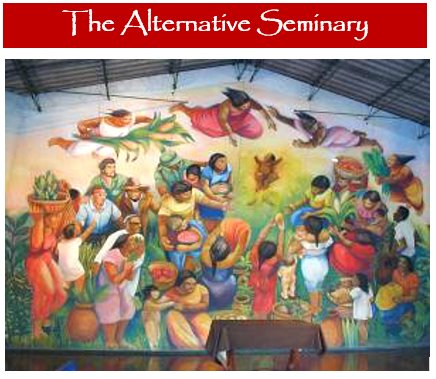
Another compelling event from Will O’Brien of the Alternative Seminary in Philly.
Dear friends,
I am reaching out to many friends and colleagues of the Alternative Seminary with a request that you help promote our upcoming program.
We are once again doing the special Advent program, “The Cross of Christ: Justification for Redemptive Violence or a Call to Gospel Nonviolence?” on Saturday, February 25.
As those of you who have participated in the past know, the program offers a critique of how atonement theology has bred terrible suffering by offering a vision of sacred violence that justifies actual violence, especially again women and minority communities. Starting with resituating Jesus’s crucifixion in historical context, we explore how the cross can be seen as a symbol of nonviolent resistance to oppressive powers. The themes continue to be urgent, especially with the rise of Christian nationalism, in this country and around the world.
The birth of Aya – Harbinger of Lent’s staggering promise Reflecting on the implausible news of finding an infant—alive, literally born amid the earthquake’s rubble
§ § §
Invocation. “When in the dark orchard at night / The God Creator kneeled and prayed / Life was praying with the One / Who gave life hope and prayer.” —English translation of lyrics from “Wa Habibi” (performed by Fairuz), a Christian hymn of the Syriac/Maronite rite. Also known as the Mother’s Lament, the hymn has been performed every year on Good Friday.
§ § §
It is staggering news: The birth of a baby girl, born as her mother, father, and four siblings lay crushed among the earthquake rubble of a five-story apartment building in northern Syria. When rescuers found her, they had to cut the umbilical cord attaching her to her mother, who died sometime in the 10 hours between the building collapse and the rescue.
I am someone who spends a lot more time casting a vision for what’s coming next than composting what’s already happened. It is both a gift – and a growth edge. I am learning that the more I slow down and process the particulars of my suburban past, the more I can subvert the sources that scripted my supremacy. One of those old sources was Gene, the father of one of my best friends. He was a passionate and playful pillar of the community. He was also a purveyor of patriarchy – and he had a profound impact on my early years.
Gene dismissed the perspectives of women with a warm smile and a witty joke. He made it clear that he believed that women were the weaker sex. Why? Because the bible says so. One time, when we were teenagers, Gene read us the passage from I Peter that says that wives must accept the authority of their husbands and that real women – biblical women – should stop obsessing over outward appearances, and instead embrace the lasting beauty of a meek and quiet spirit.
When I started studying the original languages of the bible in seminary, I learned that the word meek, in Greek, is praus, pronounced prah-ooce’. It is a divine strength soaked in gentleness, confidence, humility and open-heartedness. The irony is that Jesus used it to describe himself, not women. Jesus was a Palestinian Jewish rabbi who empowered people who were oppressed by professional religion and Roman culture. Jesus preached that God reigns not from the perches of the powerful, but from within the hearts of weary and burdened people.
The message of Jesus, according to Howard Thurman, focused on the urgency of a radical change in the inner attitude of his people. They had access to divine power and agency. It was rooted in how they responded whenever provoked by their oppressors. Thurman wrote that humility – not fear, hypocrisy or hatred – is the best defense against everything intended to humiliate. “Take my yoke upon you, and learn from me,” Jesus said, “for I am praus and humble in heart, and you will find rest for your souls.”
By Rev. Jeanelle Nicolas Ablola, re-posted from Enfleshed
“We must be solidarious, meaning one with everybody, with the care of the planet, and we must be willing to accompany people’s movements for their rights, justice, peace. And so I put my education and my experience and my commitment to that service.” – Rev. Marta Benavides
I heard a podcast once about humpback whales saving a seal from an orca attack.* One of the whales swam belly up, and put the seal on its belly. When it seemed like the seal might slip off during their escape, the whale would raise a fin to guide the seal back onto its belly.* Humpback whales have been recorded saving other animals, like sunfish and seals, from orca attacks. And scientists can’t agree on why. Some speculate that they may be instinctually wired to interfere with orca attacks because, in doing so, they might save a humpback whale calf. So in their act of trying to help their own family or community get free, they inadvertently help others get free.
10 years ago, I met Rev. Marta Benavides through Churches Witnessing with Migrants (CWWM). In El Salvador, she journeyed alongside Archbishop Oscar Romero. When sharing her experiences and expertise, she would occasionally bring up this concept of being solidarious – “We must be ‘solidarious’ as one vs be ‘in solidarity’ with other’s interests.”*
From Toni Morrison’s Beloved. This is the sermon that Baby Suggs gives one Saturday, sitting in the Clearing while the people waited among the trees. The Clearing was “a wide-open place cut deep in the woods nobody knew for what at the end of a path known only to deer and whoever cleared the land in the first place.”
——————————————————–
Here in this here place, we flesh; flesh that weeps, laughs,
flesh that dances on bare feet in grass. Love it. Love it hard.
Yonder they do not love your flesh. They despise it.
They don’t love your eyes; they’d just as soon pick em out.
No more do they love the skin on your back. Yonder they flay it.
The Spirit of God brings peace, consolation, and perspective in times of personal and collective trauma and tragedies. Having served as a public and parish Christian pastor for over four decades, I have counseled, listened to, cried with people, and have come to know the power of God for uplift, hope, and comfort. I have also known and experienced how God can be used for hurt, ridicule, diminishment, oppression, and exclusion. I have witnessed the goodness of God, and the hurt inflicted on people by human pronouncements of God. I have seen God used for both good and bad, and for liberation and oppression. It is all in the interpretation of God and claims of “truth.”
People seek “truth” in life, after-life, and for living right, and deeply desire to live on the right-side of the “truth”. People come to faith experiences seeking encouragement, strength, and “truth” for living. This is the reason the “Golden Rule” manifests itself in so many forms, ‘Do to others as you would have them to do to you’, and is core to so many faith traditions. However, unfortunately, there are political and economic structures, such as monarchs, empires, forms of governments, and individuals that have deliberately manipulated the concept of God towards material and political ends. They have seized on the desire for “truth” among the masses, by reshaping and remolding the concept of God into materialistic and nationalistic loyalties. Divinity is often exploited and manipulated to maintain systems of power, protect the status-quo by offering equations of absolutism forcing almost slavish obedience upon masses of people who only seek to live in “truth”, and on the correct side of God. Political leaders and governments create a central narrative of God that becomes a form of political orthodoxy, just like faith traditions create orthodoxies. Those who question this authority and its absolutism are criticized, ostracized, ridiculed, villainized, and often killed for endangering the existent order of things. Rev. Dr. Martin Luther King, Jr., for example, was lionized for civil rights, but villianized for his critique of the war in Vietnam. He had violated the political orthodoxy.
By Chava Redonnet, the pastor of Oscar Romero Inclusive Catholic Church which meets in the dining room of the Rochester Catholic Worker. This is the bulletin for Sunday, January 8, 2022.
Dear Friends,
On New Year’s morning, I woke up knowing what the day would hold: Second Christmas, celebrating with the family members who couldn’t make it on Christmas because of the weather. I was surprised to realize that although I was very much looking forward to time with my family, the thought of another Christmas dinner left me feeling… unenthusiastic. As the day went on, texting with my daughters, I realized I was not alone in that. Feeling some mounting stress, I finally texted a list of everything our family has been through in the past two months. Four of us had covid. Three job changes. Two moves, two blizzards, two missed holidays, two surgeries and a car accident. Everyone in the family has had one or more major events happen. We are exhausted! So I pointed that out, and our need for a low-key day. “We’re not going to make up for all that today,“ I said. We changed our dinner plans and ordered pizza.
In the end we had a lovely day, and enjoyed being together. We told stories, we laughed. The pizza was delicious, and no one seemed to miss the fancier meal we had planned. We downsized our expectations and that turned out to be the best thing we could have done.
Written against the backdrop of New Year’s Eve services, 1862, when African Americans gathered to await news of US President Abraham Lincoln’s promised Emancipation Proclamation. Inspired by Revelation 21:1-6a, lectionary text for the New Year’s Eve Watch Night service.