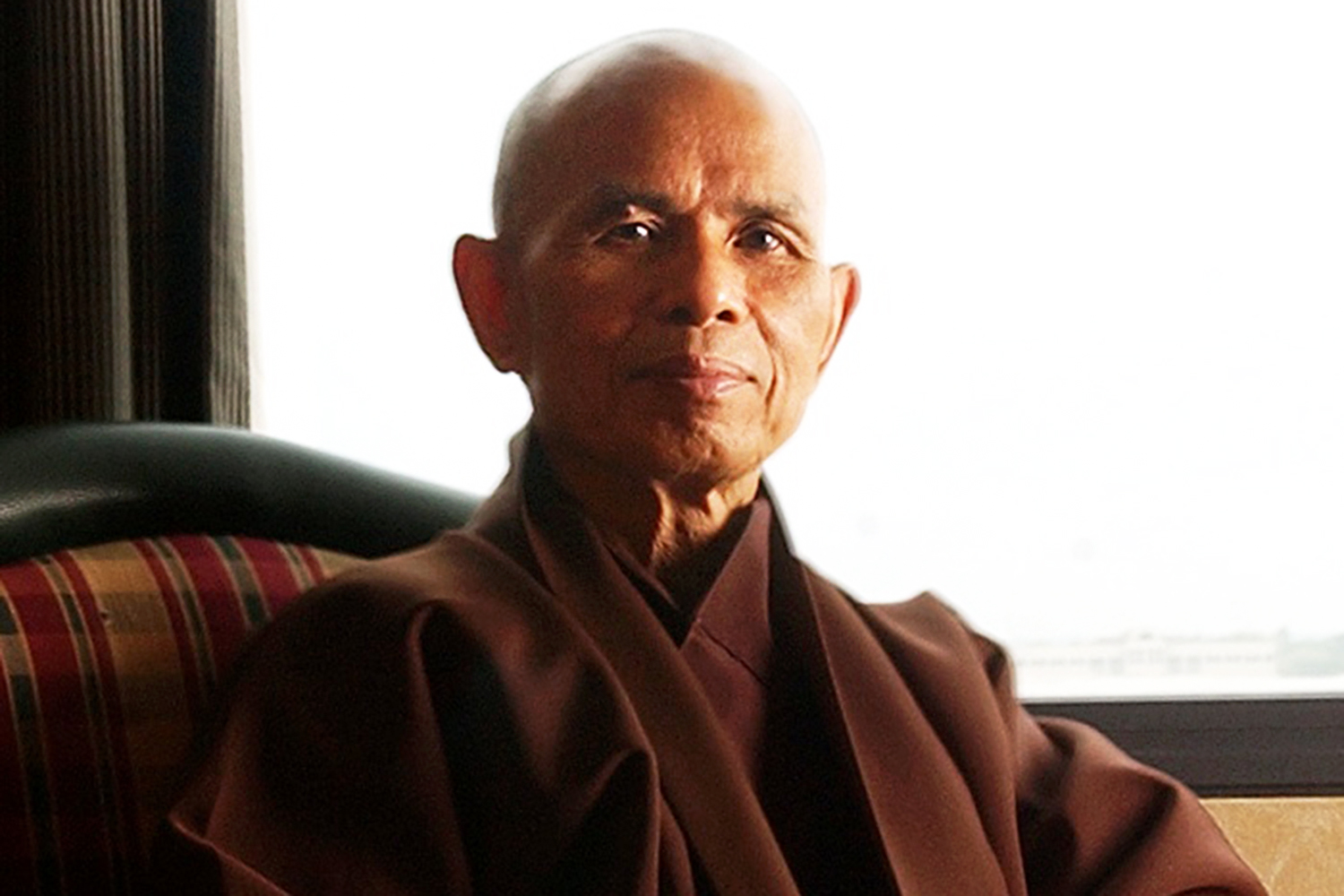
In the past six weeks, our community has lost bell hooks (December 15) and Jim Forest (Jan 13). Then earlier this week, on January 22, the great teacher of engaged Buddhism, Thich Nhat Hanh, passed. All three were linked. bell hooks wrote a foreword to The Raft Is Not the Shore, which are the transcribed dialogues between Thich Nhat Hanh and Daniel Berrigan. The final book that Jim Forest published was entitledEyes of Compassion: Living with Thich Nhat Hanh.
Thich Nhat Hanh also had a connection with Dr. Martin Luther King and Thomas Merton. This places him as a surprisingly central figure in the history of our community. Because I already was finding these intersections fascinating, I was and was not surprised to discover an encounter between Thich Nhat Hanh and the writings of Dietrich Bonhoeffer.
Now Abel was a keeper of sheep, and Cain a tiller of the ground.—Genesis 4:2b
Cain said to his brother Abel, ‘Let us go out to the field. And when they were in the field, Cain rose up against his brother Abel and killed him. Then the Lord said to Cain, ‘Where is your brother Abel?’ He said, ‘I do not know; am I my brother’s keeper?’ And the Lord said, ‘What have you done? Listen; your brother’s blood is crying out to me from the ground!—Genesis 4:8-10
As he went ashore, he saw a great crowd; and he had compassion for them, because they were like sheep without a shepherd; and he began to teach them many things.—Mark 6:34
“I’m more than ever of the opinion that a decent human existence is possible today only on the fringes of society, where one then runs the risk of starving or being stoned to death. In these circumstances, a sense of humor is a great help.”—Hannah Arendt
——————————————
In the ancient world, shepherds tended their flocks on the edge of civilization, on the borderlands, straddling two cultures with the side-eyed and sidelined. Shepherds resisted mass migration to cities, built with resources extracted from somewhere else. What we called “civilization” was sculpted by strong men exploiting the masses. Shepherds were not part of this program. They stayed nomadic, foraging for food, going wherever the grass was growing. Shepherds were dirty people. Outcasts. Their testimony was not trusted in court.
Recently I forwarded the social media link to an article detailing the ways religious piety was intertwined with the violent uprising at our nation’s capitol on 6 January 2021. My ever-thoughtful friend Susan responded with this question: “Scary. How is the best way to counter this descent into the same horrors as German Christians did following Hitler?”
I composed a couple sentences of response. But then a new door opened in my mind; then another, then another. And I ended up writing, over a few days time, the following:
At least at this point, I know of no singular strategy. We are each given opportunities to apply the slight weight of our convictions regarding the Beloved Community in countless small acts.
By Ched Myers, for the 3rd Sunday of Epiphany, reposted from Jan 24, 2016 (Luke 4:14-21)
The setting of this famous story is significant. The obscure village of Nazareth has already been well established in Luke’s narrative as the home place of Jesus’ childhood, from Gabriel’s annunciation (1:26) to the Holy Family’s comings and goings (2:4; 39; 51), to the phrase in this week’s lection “where Jesus had been brought up…” (4:16a). Continue reading “The Nazareth Sermon as Jubilee Manifesto”→
By Wes Howard-Brook and Sue Ferguson Johnson, commentary on John 2:1-11, re-posted from January 2016
“On the third day there was a wedding in Cana of Galilee…”
The rich beauty of this week’s gospel sets the stage for the journey into God and discipleship which follows. In his first public act in John’s gospel, Jesus transforms a wedding which has run out of wine into an overflowing, abundant celebration of the best wine. Every detail of this packed scene is worth pondering deeply. Continue reading “Abundant Joy”→
By Tommy Airey, a seven-minute sermon on Genesis 1:26-27
Then God said, ‘Let us make humankind in our image, according to our likeness; and let them have dominion over the fish of the sea, and over the birds of the air, and over the cattle, and over all the wild animals of the earth, and over every creeping thing that creeps upon the earth.’ So God created humankind in his image, in the image of God he created them; male and female he created them.—Genesis 1:26-27
My spirituality is saturated in the biblical claim that I bear the image of God, that we all bear the royal image of God. Hebrew scribes wrote and edited the book of Genesis after they were captured and exiled to Babylon, an empire that placed “images”—or statues—of their king in public places to remind people who is supreme. Citizens were supposed to bow whenever they passed by. The Hebrew scribes subverted this human hierarchy of value by crafting their own creation story. The scribes stamped every human Being with the royal image of a God of love and compassion who designed a world without a human hierarchy of value. We are all royalty, born to bow in reverence to each other.
By Ched Myers, for The Feast of the Holy Innocents and Epiphany (Matthew 2), re-posted from 2016
This reflection offers biblical context for two feasts of the Christian church: one minor (Feast of the Innocents, Dec 28, 2016) and one major (Epiphany, Jan 6, 2017). These two holy days commemorate the narrative of Matthew 2 (though in reverse chronological order), which we read in Year A. In fact, the “Twelve Days of Christmas”—when re-interpreted through the lens of these two feasts—can truly be a gift to us, if an importunate one. These counter-narratives provide a much-needed corrective to the holiday season’s saccharine sentimentality and cacophonous commercialism, and equally to unreflective year-in-review rituals and banal New Year’s resolution-making. For they demand that we re-center our lives around the testimonies of those who are at risk in a world of imperial violence. Continue reading “Kings vs. Kids”→
An excerpt from Martin Prechtel’s classic 2001 interview with The Sun Magazine.
Every individual in the world, regardless of cultural background or race, has an indigenous soul struggling to survive in an increasingly hostile environment created by that individual’s mind. A modern person’s body has become a battleground between the rationalist mind — which subscribes to the values of the machine age — and the native soul. This battle is the cause of a great deal of spiritual and physical illness.
Join the Alternative Seminary on December 11 for a virtual Bible study, “Peace on Earth and The Politics of Christmas” Alternative Seminary coordinator and contributor to RLC Will O’Brien will lead a program reflecting on the “nativity narratives” in the Gospels of Matthew and Luke to see how they express core biblical themes of justice and liberation. For more information, go to the Facebook page.