The Poor Among You

Poor Peoples CampaignBy Tommy Airey

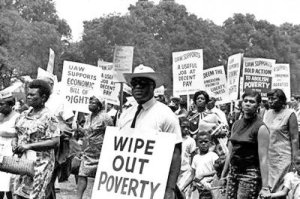
Over the decades, I’ve consistently heard conservative pastors quote their Lord and Savior to dismiss policies and provisions that attempt to systematically help low-income residents. You’ll always have the poor among you (Mark 14:3-9). “See,” they say, referencing the Scripture, “Jesus, is telling us it’s a waste of time to try to alleviate poverty. He promises that the poor will always be with us no matter what we try to do.”

In this episode, Jesus is actually quoting Deuteronomy 15, one of the most crucial junctures in the history of Israel. God is preparing the former slaves of Egypt to live in a new kind of way in the Promised Land. As the old African-American proverb illuminates, it is easier to get the enslaved out of Egypt than it is to get Egypt out of the enslaved. The exodus wilderness was a school, a 12-step-program for recovery from the colonial script. Continue reading “The Poor Among You”

Soul Talk in a Neoliberal Age, Part 1

Mental Health Counseling Conference
PC: Sam Simpkins

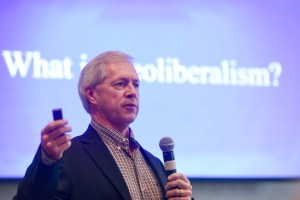
For the next five Fridays, we will pose questions to Dr. Bruce Rogers-Vaughn (right), an ordained Baptist minister, pastoral psychotherapist and Associate Professor of the Practice of Pastoral Theology and Counseling at Vanderbilt Divinity School, and the author of Caring for Souls in a Neoliberal Age (Palgrave, 2019). “Neoliberalism,” he writes, “has become so encompassing and powerful that it is now the most significant factor in shaping how, why, and to what degree human beings suffer.”

This is why Bruce presses for a “post-capitalist pastoral theology” that empowers people to resist the system (instead of adapt to it), to embrace communion and wholeness in relation to others and the earth (instead of functioning in accord with the values of production and consumption) and to pursue interdependent reliance within the web of human relationships (instead of accepting shame-based personal responsibility narratives). Continue reading “Soul Talk in a Neoliberal Age, Part 1”

Amplifying the Conception of You

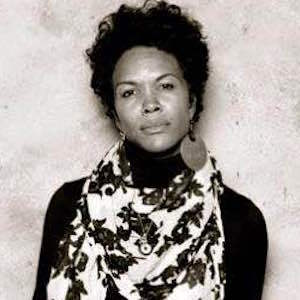
dominiqueAn excerpt from Rev. Dale Fredrickson’s interview with Denver-based poet and activist Dominique Christina.

For my children one of the things that was most useful to me in trying to curate language for them, that would give them the most room, the most space, was to explain to them that you are, we are, I am a concept. A beautiful designed concept, is where the word conception comes from. You are your parents’ best idea. You got here and constructs were forced upon you. We know that a construct is built from without. There’s a rainforest and that’s a concept. But if I clear those trees to build a nightclub, the nightclub is the construct. In creating that construct I had in that clearing things had to die. Things that were organic had to die to accommodate that construct. Continue reading “Amplifying the Conception of You”

Weeping Permits Newness

WalterFrom Walter Brueggemann’s classic The Prophetic Imagination (1978):

I used to think it curious that, when having to quote scripture on demand, someone would inevitably say, “Jesus wept.” It is usually done as a gimmick to avoid having to quote a longer passage. But now I understand the depth of that verse. Jesus knew what we numb ones must always learn again: (a) that weeping must be real because endings are real; and (b) that weeping permits newness. His weeping permits the kingdom to come. Such weeping is a radical criticism, a fearful dismantling because it means the end of all machismo; weeping is something kings rarely do without losing their thrones. Yet the loss of thrones is precisely what is called for in radical criticism.

Five Loaves, Two Fish and a Rack of Ribs

riot ribsBy Rev. Solveig Nilsen-Goodin, Salt and Light Lutheran Church, Portland, OR (Sunday, August 2), Matthew 14:13-21

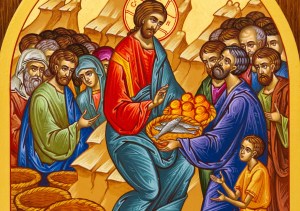
Jesus, a young movement leader, desperate to be alone, grieving, raging, mourning the state-sponsored murder of his cousin, John. A crowd gathers. Thousands upon thousands. They are there so long, learning and listening and longing for change, that it gets late into the night and they are hungry. Some want to say, go home! Fend for yourselves! Go to the store and buy your own food! You’re on your own! But that is not The Way of Jesus. That is not The Way of this movement. And suddenly, seemingly miraculously, food for thousands appears. And the hungry are fed. They feed one another. Because when the system fails or it isn’t designed to care for you in the first place, you have to care for one another. And from that place, create a new way of being in the world. Continue reading “Five Loaves, Two Fish and a Rack of Ribs”

Casting Out Whiteness

George Houser
Bayard Rustin started the original Freedom Riders with George Houser, a white boy who broke rank back in the early 1940’s.

By Tommy Airey

Note: this piece has been edited after it was originally posted. 

“At stake is not just a new cognitive awareness and objectivity about the situation of race, but a new passionate posture and subjectivity founded on a new spiritual interiority.”—James W. Perkinson, White Theology: Outing Supremacy in Modernity (2004)

A year ago, Ruby Sales invited white men to email her if they were interested in convening a conversation about breaking rank from what James Baldwin called “a pantheon of the relentlessly mediocre.” We organized a gathering that she called “The Council on the Way.” I joined her and 22 other white men from New York, Pennsylvania, Michigan, Minnesota, Virginia, Kentucky, Tennessee, California and Oregon for a spiritual conversation centered on a redemptive white male liberation theology. We gathered on Capitol Hill, a stone’s throw from the Supreme Court. We hoped it would be a mustard seed for a movement breaking rank from white male mediocrity. Continue reading “Casting Out Whiteness”

Racism, Exorcism + Baptism

PIPFrom the conclusion of Rev. Bill Wylie-Kellermann’s chapter on racism (“Exorcising an American Demon: Racism is a Principality”) in Principalities in Particular: A Practical Theology of the Powers That Be (2017):

William Stringfellow’s source of authority and hope at the Chicago
conference was tied to baptism:

[Racism] is the power with which Jesus Christ was confronted and which, at great and sufficient cost, he overcame. In other words, the issue here is not equality among human beings, but unity among human beings…The issue is baptism. The issue is the unity of all humanity wrought by God in the life and work of Christ. Baptism is the sacrament of that unity.

As the Ephesians letter (which itself may be read as a baptismal meditation) puts it: the new humanity in Christ’s body breaks down the wall of hostility (2:14–16). In this new humanity which baptism seals and affirms, our relationship to every other human being, every human community, indeed to every creature, is renewed. The wall has no
claim upon us. The powers do not rule in our lives and community. We
have died, with Christ, out from under their spirit and dominion (Eph
2:1–8). Continue reading “Racism, Exorcism + Baptism”

The Sound of the Genuine

ThurmanThe 40th anniversary of Howard Thurman’s Spelman College commencement speech.

There is something in every one of you that waits, listens for the sound of the genuine in yourself and if you cannot hear it, you will never find whatever it is for which you are searching and if you hear it and then do not follow it, it was better that you had never been born…

You are the only you that has ever lived; your idiom is the only idiom of its kind in all of existence and if you cannot hear the sound of the genuine in you, you will all of your life spend your days on the ends of strings that somebody else pulls… Continue reading “The Sound of the Genuine”

Pride: 51 Years After Stonewall

Stonewall InnFrom Richard Cleaver in Know My Name: A Gay Liberation Theology (1995):

I believe that almost any passage of scripture could be used to show that lesbians and gay men have a vital place in the body of Christ. I believe this because of an article of my faith that I hope I can lead you to share. It is this: if Jesus, in his passion and death, freely chose to become a victim of injustice, his sharing of our oppression entitles those of us who are still victims of injustice to demand that any pronouncement of scripture or ecclesiastical authority be judged by whether it helps or hinders our liberation, our becoming subjects of history, not victims only.


You Corrupted Wisdom for the Sake of Splendor

KenBy Ken Sehested

I will likely be considered antiquated, maybe maniacal, even apoplectic when I say we in the US (with derivative outbreaks elsewhere) are under the spell of the demonic, of those who worship death’s malicious craving, specifically the sacrificial scalp of dissenters, of those who do not genuflect in its presence, of any and all who stand in the way of imperial designs, who claim authority to divide the world into makers and takers, to shape all reality in service to the ruthless pursuit of power’s conceit, arrogance being the elixir of indefinite, everlasting rule of the strong over the weak, the privileged over the disdained, the worthy over the maimed. Continue reading “You Corrupted Wisdom for the Sake of Splendor”