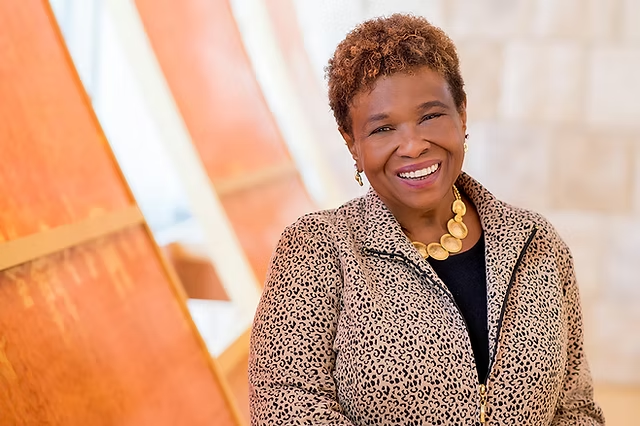
This Advent, we are remembering the activist and theologian Barbara Holmes. Over her lifetime, Dr. Holmes dedicated her prophetic voice of contemplative wisdom to call us on The Way with the Incarnate Jesus. Jesus is the one who has come, is always coming, and is ever present, transforming us into the Creator’s image and likeness.
Over the years, we have attended to Dr. Holmes’ voice crying out in the wilderness against the unspeakable suffering of human and non-human creation — suffering inflicted by human hands, heads, and hearts of warring madness. Although Dr. Holmes died earlier this year, her prophetic voice and spiritual wisdom lives on, crying out to be heard and heeded.
She writes, “When there is a crisis, it takes a village to survive” because “it is the village that enters into crisis.” In her book, Crisis Contemplation: Healing the Wounded World, Dr. Holmes explains: “Crises open portals of deeper knowing. When the crisis occurs, the only way out is through, so we take a cue from nature and relax into the stillness, depending upon one another and the breath of life!”
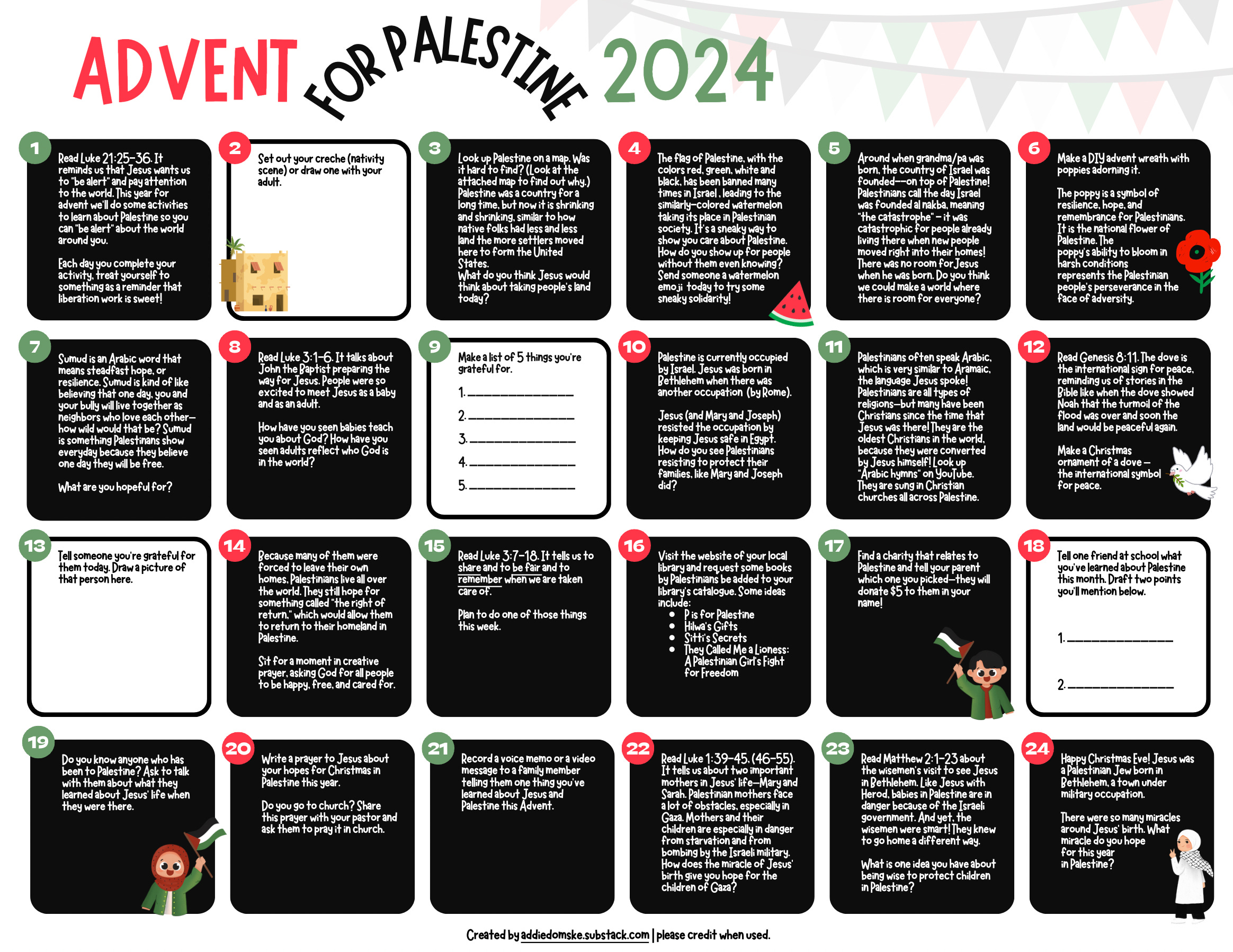
Re-posting this beautiful children’s Advent calendar from the Rev. Stands for the Revolution, the Substack newsletter of Rev. Addie Domske, an ordained minister and trained movement chaplain who lifts up queer abundance and Jesus’ rebellious message.
One thing I want to be when I grow up is a cool, radical auntie.
I have been trying to be good at this role for about 15 years now, starting when the first of my four niblings1 was born. I will find out from them in their collective adulthood if I succeeded.
I have lived far, far away from all four of them for their entire lives, so most of my interactions come from mailing them things, (I had the cutest pen pal relationship with my oldest nibling when he was a wee lad.) A few years ago, I started the tradition of sending them all advent calendars each year based on their interests at the time. This year I’m proclaiming that they are all interested in Palestine, because my spouse and I decided to spend all of our Christmas gift funds for our external families on products from Palestinian artisans.2
This gathering is a Collaboration between Bartimaeus Cooperative Ministries (BCM) and Kirkridge Retreat and Study Center.
Grace Boggs, Detroit organizer and now ancestor, would ask over and over again, “What time is it on the clock of the world?” We cannot deny that we are standing at an urgent and catastrophic moment. We are witnessing an assault on humanity and all of creation from so many directions. From climate disaster to genocidal militarism, to racial and religious supremacy, and so much more.
Our souls are hungering for time and community to be asking what it means to live humanly in this moment. We need to create space for listening and discernment, deep study and imaginative organizing, a diversity of voices and stories, and perhaps more than anything else hope and joy. So, dear friends, we are throwing a festival!
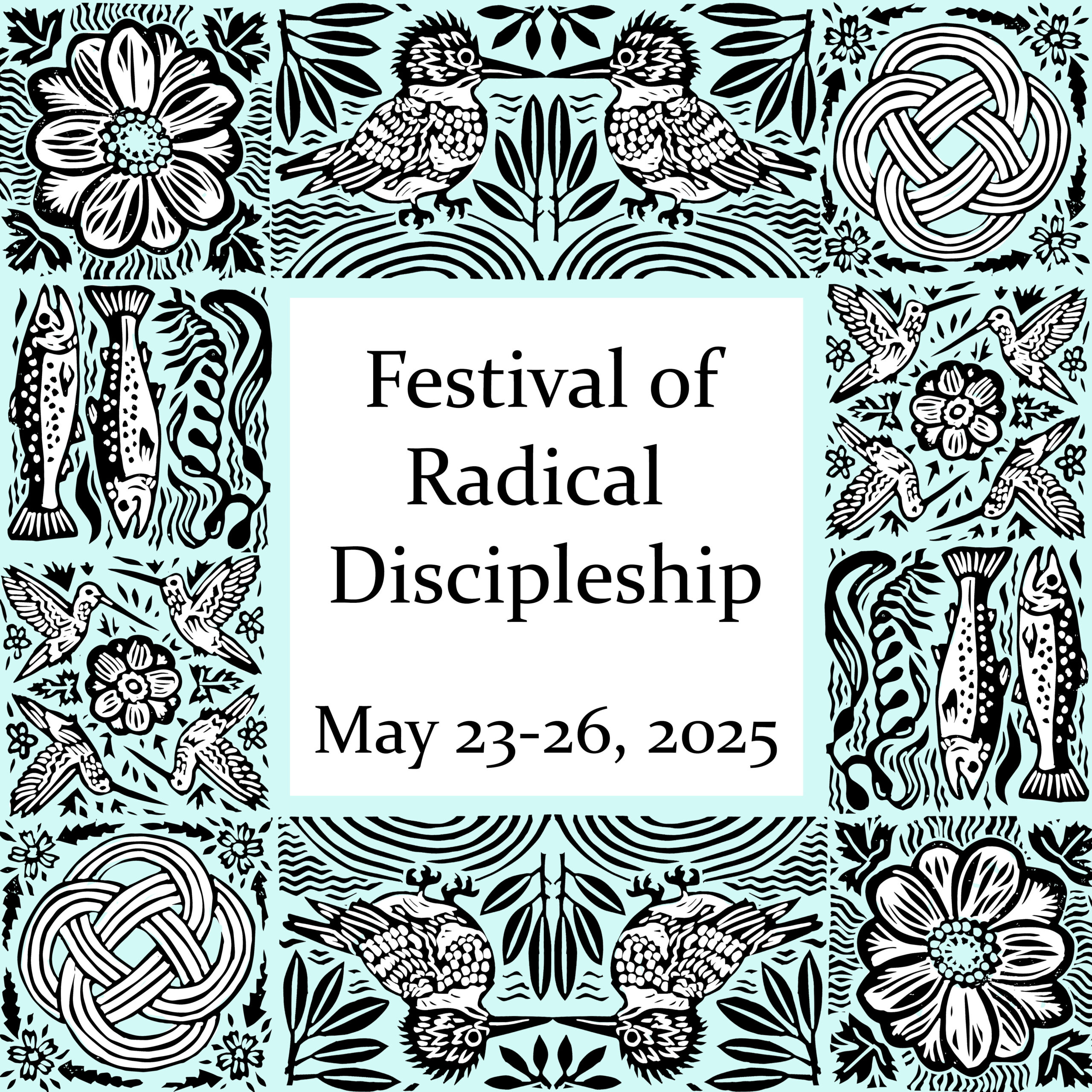
We are hosting the Second Festival of Radical Discipleship- a gathering of kindred spirits rooted in the radical Christian tradition. It will be a time to remember past gospel experiments, discuss current calls to witness and work; and conspire about future collaborations! Come and join the feast.
In our after times, our task, then, is not to save Trump voters—it isn’t to convince them to give up their views that white people ought to matter more than others. Our task is to build a world where such a view has no place or quarter to breathe. I am aware that this is a radical, some may even say, dangerous claim. It amounts to “throwing away” a large portion of the country, many of whom are willing to defend their positions with violence. But we cannot give in to these people. We know what the result will be, and I cannot watch another generation of black children bear the burden of that choice…
Our task, then, is not to save Trump voters nor is it to demonize them. Our task is to work, with every ounce of passion and every drop of love we have, to make the kingdom new! The first step involves what I called…a “revolution of value.” This involves telling ourselves the truth about what we have done. It entails implementing policies that remedy generations of inequities based on the lie. It requires centering a set of values that holds every human being sacred. All of this will be made possible by grassroots movements that shift the center of gravity of our politics…Our task involves shaking loose the warm “swaddling clothes” that secure us in our prejudices and prevents us from confronting our fears. Our task means speaking truth to power and looking the darkness of our times squarely in the face without the security of legend or myth, and without the comforting idea that black people will save you.
An excerpt from an unpublished sermon of Rev. Dr. Edgar Rivera Colon at Faith + Work Firist Unitarian Church of Orange, NJ
When we attend to the tears of a grief-stricken activist, we enact the collective mourning work which transfigures into what Robert Sember names “redemptive solidarity.” The wrenching pain of mourning is the affective antechamber to the possibility of joy and collective forward motion. Our tears are the salt of history that leaven more human futures. Thus, what we at first cognize as interruptions to liberating works are the intervening enabling conditions for the materialization of our deepest desires for social and spiritual transformations. Sember alerts us to the alignment of the “poetry of feeling” and “immanent freedom”: they share a homeplace in the soul work that our times require.
An excerpt from a Biko Mandela Gray tweet yesterday. Gray is an associate professor and director of undergraduate studies at Syracuse University and the author of Black Like Matter (2022).
This is a moment to reflect. It is also a moment to unlearn American theology—by which I mean, it is a moment to absolve ourselves of the idea that presidents are salvific figures. They aren’t. To think this way is to embrace white supremacy.
Anarchy is the move now. And yes, that might include a certain kind of direct action. But more than this, anarchy is a disposition of collective refusal. It is a praxis of collective engagement that is indifferent to institutions and institutionality.
By Tommy Airey, re-posted from his weekly Substack newsletter
In the months after police murdered George Floyd in Minneapolis, I joined counter-protesters at the “White Lives Matter” rally in front of the pier in Huntington Beach, a former sundown town in Southern California. One of the white men who mattered was toting a two-story pole with three flags: the stars-and-stripes, the 18th century “Don’t Tread on Me” rattlesnake and a “Trump 2020: No More Bullshit” banner. He wore a shirt that said, “I stand for the flag and kneel for the cross.”
As I digested his message, I scrolled through all the memory verses stored away in the recesses of my post-evangelical mind. The only passage in the bible that even remotely resembles kneeling for the cross is in the second chapter of Philippians.
The verse from Paul’s letter to a little house church in the Roman colony says that in the name of Jesus, every knee shall bow and every tongue shall confess that Jesus is lord. Context matters. The passage subverts the patriotic supremacy of its day. Back then, every knee bowed to Caesar and every tongue confessed that Caesar was lord.
The first Christians pledged allegiance to Something Else.
By Jim Perkinson, a ten-year retrospective on Radical Discipleship
What has significantly changed – in the world and in yourself? What/Who has inspired you or brought you hope? What are the forms of supremacy that you’ve struggled to break rank with?
So, yes, ten years from Obama through Trump to Biden and now looking the rump of the nation straight in the eye! But it ain’t about the leadership as much as the dealership. The global grip of corporate armature and billionaire priority and militant supremacy grows apace. The Elon Musk flush of political theater with digital warp and AI belches of algorithmic inanity seems virtually (!) unstoppable in the short term. In service overwhelmingly—though not exclusively—of white delusion and confusion that pallor is somehow valor and value, rather than weaponized trauma coming out of the European Middle Ages outfitted with a new weapons technology and an old lie!
What has changed in the world is perhaps Time itself—or at least our relationship to it. The onslaught of a pillaging of the more-than-human world into a technological commodification hell bent on re-engineering seemingly everything grabbable on the planetary surface into a human prosthesis, global in extent, accelerating in pace, arguably exercised by a hyperventilating “more” and “faster” that has no imaginable containment other than a resounding “Halt” trumpeted by a no-longer-patient biosphere speaking in the key of climate extremity.
What has changed in me is a night-sky shift towards the oscillating, incubating, jousting-and-composting Mystery of deep dark running from the planetary core to the astral holes centering galaxies and the song that reverberates between. In grief, I lament the loss of half of human life to the dragon’s tail (Rev 12:1) of light-pollution sweeping almost all the stars from urban vision looking for ancestral constellation and consolation above the flickering glow of now. But then NASA has recently hipped us to a new recognition that Black Holes actually “sing,” echoing a B-flat vibe 57 octaves below middle C in a frequency wave 10 million years long, holding on tune for 2 billion years across that orange hazed horizon. So, thus: the Beauty that is—whether I can see it or not! Irreducibly in motion in complexities of gift-economy reciprocation so far beyond our ken that we fill entire blackboards with equations that “explain” something less than 4 % of all that is (chalking the rest up to “Dark Energy” and “Dark Matter”)!
And no surprise then that I still mark my deepest education as an on-going, 40-year baptism in another kind of “Beautiful Blackness” on Detroit’s east side streets, now being rhizomically linked with Native savvy and syncopation here in Anishinaabe smarts about Great Lakes water-wisdom. That combination is complemented by continuous learning (from my wife) of indigenous Ayta resilience on the sides of Pinatubo’s eruptive divinity. And schooled by such, I am propelled back along my own ancestral root, to Celt and Nordic colloquies with Indo-European-profundities dating to pre-Roman humility still rooted in being taught-by our more-than-human kin before such was warped and decimated by imperial domination and rapacity.
So, the supremacy at issue? A three-fold iteration across 5,000 years of elaboration, beginning in Mesopotamian re-organization of smaller-scale lifeways (hunting-and-gathering, subsistence cultivation, village-based pastoralism) into city-state coercion of labor, surplus extraction, imposed taxation, debt, drudgery, and disease evisceration. Gradually elites began to assemble armatures of trade, technology, and architecture that effectively removed and buffered them from hands-on exchange with plants and animals in elevating themselves figuratively and literally out of reciprocal relations with such, to a controlling, plundering, and decimating accumulation of goods and status whose brutality was destined to be promoted and gaslighted ever after as “civilization” (built on the Latin word “civis” for male-propertied “citizen” players in in the on-going pillage).
Some 3,000 years down the road, that elite-anchored “species supremacy” insisting humans alone had status and worth, gave rise to its most potent religious offspring in the form of Christian supremacy, warping and re-configuring a Galilean back-to-the-land movement seeking to enflesh ancient Sabbath and Jubilee traditions of eco-reciprocity and co-communion into a monopolistic privatization of “truth” and of Earth itself. This led after more than a millennium to Doctrine of Christian Discovery genocide (95% on average) of Native Turtle islanders and enslavement of African peoples as tools of produce and wealth assemblage on the stolen land. Yes, in USA self-conceit—going underground and toxic as the spiritual underpinning of a newly-articulated visual regime of white-skin power and predation. This still regnant supremacy continues to vaunt Euro-heritage and visage over all else, even as it remains ideologically and artifactually entwined with the civilizational and religious supremacies it (supposedly) superseded.
And thus we face today, a biospheric blowback ripping the facade off the entire enterprise that will not much longer tolerate the evident fatuity and stupidity. Inspiration towards life and “ways of being” otherwise—in the face of such—for me is a question of track record. Who has the proven experience of living in place over generations without destroying either themselves or everyone and everything else in that place and without having to reach beyond that particular bioregional bounty to plunder an “elsewhere”? The simple answer to such is “indigeneity” and ancestry. How re-learn what they knew and know? And once again, become worthy recipients of—because co-participants with—such amazing Beauty and Magnificence as Life on this planet yet represents and obviously is.
This Sunday, radical disciples are organizing vigils all over the world to stand in solidarity with Palestinians who are resisting illegal settlements in the West Bank. Check out the Al-Makhrour IG page for locations, or to lead up a vigil in your watershed. Cole Arthur Riley wrote this prayer for the occasion.





 Radical Discipleship