
The Catch

BoatBy Tommy Airey, a meditation on Luke 5:1-11

Once while Jesus was standing beside the lake of Gennesaret, and the crowd was pressing in on him to hear the word of God…

We grope for what is spiritual-but-not-religious. Beyond the rusted institutions. These have utterly failed to meet human need. Too often, the church is a performance, a club, an obligation. So we go beyond the four walls, where Steadfast Love cannot be contained or confined. We come to the shore. Water and trees and birds bring life and hope and wonder. Jesus meets us there. He is the anti-institutional inspiration. He speaks truth and beauty. The word of God.

…he saw two boats there at the shore of the lake; the fishermen had gone out of them and were washing their nets.

At the shore, Jesus beckons us to the simple life. Everything we need is right in front of us. Manna. Boats. Fill-in-the-Blank. Cultivating awareness becomes crucial to the spiritual life. Jesus points to the nets. Like our souls, and everything else that carries heavy burdens, they need washing. Continue reading “The Catch”
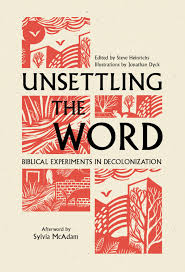
Liberating the Bible from the Hands of the Colonizers

index.jpgA Review of Unsettling the Word: Biblical Experiments in Decolonization

(Edited by Steve Heinrichs)

By Jen Galicinski

A timely, poetic, and prophetic new anthology titled Unsettling the Word: Biblical Experiments in Decolonization has recently been published by the Mennonite Church of Canada and will be re-published by Orbis Books in February 2019. It was edited by Steve Heinrichs, the Director of Indigenous-Settler Relations for the Mennonite Church of Canada and one of the several faith leaders who was recently arrested and spent time in prison for protesting the Trans-Mountain pipeline in Burnaby, B.C. in solidarity with the Musqueam, Squamish, and Tsleil-Waututh peoples.

For Heinrichs, it was working on the book that deepened his profound belief that we must truly listen to the voices of Indigenous peoples, who have been suffering, alongside their wounded land, since contact with European Christian settlers.  He is committed to following The Crucified One by acting in solidarity with crucified peoples, following their leadership towards self-governance and sovereignty over their own lands. Continue reading “Liberating the Bible from the Hands of the Colonizers”

Bread of Heaven

indexBy Katerina Friesen

Lord of the harvest, Grain-sower, Bread-giver, Life-sustainer:

We are astounded by your bounteous love, filled to the brim

with good things. You give us enough, and then some!

Bread of Life, we love You. Though You were pounded down,

You rose up again, broken so all may be fed.

Breath of Heaven, Spirit of All-Things-New,

with You, we are carried through the fire and we rise up,

we rise up again! So we praise Your name, Holy Trinity of Love.

Our Script

BindingWe continue our every-Sunday-celebration of the 30th anniversary of Binding The Strong Man, Ched Myers’ political reading of Mark’s Gospel. This portion is excerpted from the book’s “Aftermath” entitled On Continuing the Narrative of Biblical Radicalism.

The empty tomb at the end of Mark’s Gospel symbolizes that his story, like its subject Jesus, has not ended but lives on. Just as Mark reached back across the centuries to bring the “old story” of Hebrew prophetic radicalism to life again in a new story about Jesus of Nazareth, so does he reach forward across the ages to us, challenging us to continue the story by “returning to Galilee” (Mark 16:7). But how is it that an invitation to “reread” this story is politically subversive? Does not the circle of narrative actually lead the reader away from practice, shutting out the real world and seducing us with one that exists only in our imagination? This is certainly what those who dismiss the fictions of apocalyptic narrative as the wish-dreams of the alienated would have us believe. Continue reading “Our Script”

Wild Lectionary: Nature as Divine Dwelling Place

20180716_124708Fourteenth Sunday after Pentecost
Proper 16 (21) B

Psalm 84:1-3

How lovely is your dwelling place, O LORD of hosts!

 My soul longs, indeed it faints for the courts of the LORD; my heart and my flesh sing for joy to the living God.

 Even the sparrow finds a home, and the swallow a nest for herself, where she may lay her young, at your altars, O LORD of hosts, my King and my God.

By Celina Medrano-Miller

As I write this, I sit on the earth, of the traditional and ancestral territory of the Tsleil-Waututh, Squamish and Musqueam Nations.

I was born on this unceded territory, under the name for the new city which was built, called Vancouver.

My parents both migrated here separately… Continue reading “Wild Lectionary: Nature as Divine Dwelling Place”

There Are Other Clocks

BayoAn excerpt from Bayo Akomolafe’s These Wilds Beyond Our Fences (2017). Dr. Akomalafe is a self-proclaimed “walkout academic,” globally recognized for his poetic, unconventional, counterintuitive, and indigenous take on global crisis, civic action and social change.

The world does not careen toward progress, and human improvement and well-being are not matters owned by the practices of economic development and growth. There are songs that trees know that we haven’t heard; there are alliances that termites and the pheromones they secrete forge that we can learn from; there are wild things that do not know the moral discipline of purpose or the colonizing influence of instrumentality; and then there are murmurations—the waltz of wind, sky, starling, and ground—which are not meant to be spoken about but merely to be seen and appreciated. In short, there are other powers, other agencies, and other clocks. And, perhaps, we release ourselves not only to the performance of our many colors, but we free those in the posh parties that have somehow denied us entry from their secret fears of losing their own seats at the table, when we say, “there are other clocks, and we will not be on time.

Ideology

BindingWe continue our every-Sunday-celebration of the 30th anniversary of Binding The Strong Man, Ched Myers’ political reading of Mark’s Gospel.

…we should instead be about understanding how myth functions as political discourse–in antiquity and today.

Another term for symbolic discourse about social realities and conflicts is ideology.

…There is consensus among both Marxist and non-Marxist scholars that ideological discourse functions in one of two basic ways. It either legitimates or subverts the dominant social order: Berger calls these the “world maintenance” and “world shaking” functions. The legitimizing function seeks to lend plausibility to social reality, “giving normative dignity to its practical imperatives.”

…Ideology can also function to subvert the dominant order pursuing one of two general discursive strategies. The reformist strategy will usually argue its case from reference points within the dominant order, trying to give new meaning to established symbols. These appeals may be for purposes of retrogressive change, as for example in the New Right’s nostalgic call to return to the “traditions of the founding fathers of the USA.” Or the strategy may be progressive, in the sense that the system has yet to realize its own ideological commitments. An example would be Martin Luther King’s appeals to the Bill of Rights in order to attack racial segregation in the USA. Continue reading “Ideology”

Wild Lectionary: Be Careful How You Live

imageedit_2_7567561421Thirteenth Sunday After Pentecost
Proper 15(20)B

Ephesians 5:15-20
John 6:51-58

By the Reverend Doctor Victoria Marie

There is a disconnect between my Roman Catholic tradition’s interpretation of today’s gospel and an interpretation that would be more indicative of the inclusive holistic teachings of Jesus. I think the second reading from Ephesians gives us an insight to the gospel, including today’s passage. Continue reading “Wild Lectionary: Be Careful How You Live”