The Battle for the Bible

BindingWe continue our celebration of the 30th anniversary of Binding The Strong Man, Ched Myers’ political reading of Mark’s Gospel.  Today, as the lectionary once again pivots to the Gospel of John, we share an excerpt from Binding, in which Reagan-era Ched clarifies the ideological nature of interpretation–almost thirty years before 81% of white Evangelicals voted for Trump.

The truth is, the “battle for the Bible” today has increasingly less to do with theological divisions and allegiances and more to do with political and economic allegiances.  This is perhaps more evident in many Third World countries, where churches are becoming polarized along class and ideological lines.  In Latin America, for example, we see the base communities empowering the poor masses through a more popular model of church.  This predominantly Catholic movement has, with almost Protestant fervor, restored Bible study, along with grass-roots social analysis, to a central place in the life of the community.  In stark contrast stand the words of Pope John Paul II in his opening address to the Puebla episcopal conference in 1979: Continue reading “The Battle for the Bible”

Wild Lectionary: Of Raspberries and Eternal Life

August 5-18 picProper 13B, Year B
August 5th, 2018

John 6:24-35

By Svinda Heinrichs

I pondered the Gospel of John passage for this Sunday as I took a walk down the hill into the ever-expanding raspberry patch in the field to the place where the raspberry bushes and forest meet. I ate my fill of the red, juicy, sweet bursts of sunshine and made my way back up the hill marvelling at how the shrubbery had grown up over the two years since we cleared the space to make a better view for ourselves. Continue reading “Wild Lectionary: Of Raspberries and Eternal Life”

I Am Wind

JPerk1By Jim Perkinson, a sermon on John 6:1-12 for the radical disciples who gather at St. Peter’s Episcopal Church Detroit (July 29, 2018)

I preached here earlier this year on Jonah and fish and began that sermon by saying “I am not a fish person.” But then offered that fish were central to the gospel, that Jonah had in fact been saved by a fish, that fish were on par with bread in feeding the multitudes in the wilderness, and that Jesus was even called, in subsequent tradition (notably North African theologian Tertullian) “The Great Fish.” Continue reading “I Am Wind”

Choose Life

20180713_100030By Katerina Friesen

Praising/ Adoring
We are Your field, O Lord,
and we praise You as Your planting, the work of Your hands!
We praise You for Your watchful eye,
for the way You bend over us and smile
as we grow from tender stems to ripe harvest,
for giving us rain and sun in due season.
We praise You because You never give up on us,
but coax new life from barren ground again and again.
We are Your field, O Lord,
and we praise You as Your planting, the work of Your hands!

Affirming Faith
Voices 1: We will not bow down to serve other gods:
the gods of war, the gods of greed, the gods who destroy the Earth.
Voices 2: We will not bow down to the gods of racism,
to gods who make us feel either inferior or superior,
to gods who do not love us, but demand our devotion.
All: We choose life!
Voices 1: We choose to serve the God of Abraham, and Isaac,
the God of Sarah and Rebecca, of Mary and of Jesus,
Voices 2: We choose to serve the God of our ancestors in faith,
of Paul and Lydia, of Menno Simons and Margaretha Sattler,
of Vincent and Rosemarie Harding.
All: We choose life! We will hold fast to the Lord, the God of life.

Sending
God has set before us today life and death. Let us continue
to walk in God’s way, assured that our ancestors walk before us,
that Christ walks with us, and that the Spirit binds us together
and helps us to choose life.


Theology in Pharoah’s Household

BindingWe continue our celebration of the 30th anniversary of Binding The Strong Man, Ched Myers’ political reading of Mark’s Gospel.  Today, as the lectionary pivots to the Gospel of John, we share an excerpt from the Intro of Binding.  

Those doing theological reflection from a vantage point on the peripheries have properly focused upon the themes of liberation in the story of exodus.  We at the center, however, have no choice but to learn to “do theology in pharoah’s household“–that is, to take the side of the Hebrews even though citizens of Egypt.  There is a significant minority of Christians in the U.S.A. and other First World countries who are struggling to find a lifestyle and politics that does just that.  This movement also constitutes the site from which I read Mark. Continue reading “Theology in Pharoah’s Household”

The Wings of My Heart Slowly Begin to Unfold

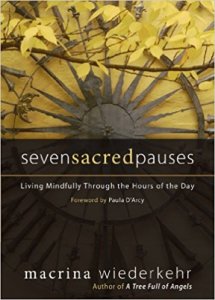
MacrinaA morning prayer from Macrina Wiederkehr’s Seven Sacred Pauses.

Dawn, Most Generous Gift…

The words of Kahlil Gibran are sitting at the gate of my heart this morning: “To wake at dawn with a winged heart and give thanks for another day of loving.”  Words from Psalm 5 are also trying to get my attention: “In the morning you hear my voice; in the morning I plead my case to you, and watch.”  I don’t always rise at dawn and watch for God, nor do I consistently awaken with a winged heart and give thanks for another day of loving.  There are times when the wings of my heart remain folded; yet prayer still happens in me.  There are mornings when I simply sit in silence trying to remember some of the things that need to rise in me: Continue reading “The Wings of My Heart Slowly Begin to Unfold”

Wild Lectionary: It’s not about the bread

raspberryProper 12 (Year B)
July 29, 2018
John 6:1-21

By The Reverend Marilyn Zehr

Jesus said, “Make the people sit down.”  Now there was a great deal of grass in the place; so they sat down, about five thousand in all.  Then Jesus took the loaves, and when he had given thanks, he distributed them to those who were seated; so also the fish, as much as they wanted.  When they were satisfied, he told his disciples, “Gather up the fragments left over, so that nothing may be lost.”

Funny story, true story:  As I write this I am at a large Church Conference as a “guest,” where on Sunday, I heard an inspiring sermon on the feeding of the multitude story as told by Mark.  After worship and communion where we shared a morsel of the Bread of Life dipped in grape juice, we eventually found our way to the cafeteria for lunch.  As a “guest” for a couple of days I had not purchased a meal plan and so was hoping to purchase a random ticket for lunch.  Continue reading “Wild Lectionary: It’s not about the bread”

Jesus is our Messiah because He Broke Laws

crucifixion_of_christ_mdq5jp.jpgShared with us from Friendly Fire Collective.

At the beginning of the 2016 version of The Magnificent Seven, the mine owner Bartholomew Bogue gives a pseudo-sermon to the townspeople of Rose City who do not want to give him their land. He tells them that, in America, democracy is equated with capitalism and capitalism with God. Therefore, by resisting him, they were standing in the way of democracy, progress, and even God. After this blasphemous sermon, he and his men burn the church the townspeople met in. Continue reading “Jesus is our Messiah because He Broke Laws”

Sheep Without a Shepherd

BindingWe continue our celebration of the 30th anniversary of Binding The Strong Man, Ched Myers’ political reading of Mark’s Gospel.  Today’s passage is Mark 6:30-34.

…Mark is decidedly presenting Jesus as an “organizer,” but with the intention of feeding the needy, not plotting a military campaign on Jerusalem.  This however, hardly makes the narrative ideology less subversive!  Indeed, there is an implied political criticism here, which we see if we do not limit the intertextuality to the Joshua tradition.  The “sheep without a shepherd” motif is seized upon by the prophets to criticize the leadership of Israel.  Ezekiel 34 spins a parable around it that specifically condemns class stratification: “I will judge between the fat sheep and the lean sheep” (Ez 34:20).  The ruling class protects its privilege rather than the collective prosperity of the people, becoming predator instead of the shepherd: Continue reading “Sheep Without a Shepherd”

Wild Lectionary: A Contrast of Economies

wild lectionary.pngNinth Sunday after Pentecost
Proper 11(16)

By Rachael Bullock

Psalm 23:1-3
The Lord is my shepherd, I shall not want.
He makes me lie down in green pastures; he leads me beside still waters;
he restores my soul.

If you haven’t noticed, the conversation around fossil fuels can often be a fairly tense one. This is especially true as political discourse in North America becomes increasingly polarized. As I’ve listened most recently to arguments about Kinder Morgan’s pipeline, oil sands in Alberta, the future of environmental policies, I notice that the general arguments in favour of nonrenewable energy rests on the assumption that there is not enough – in general, not just economically. This makes sense given that when discussing “environmentalism” or any other subject, it is never simply a conversation “about the facts”. Rather, it becomes a dialogue in which participants are often not even aware that underlying life experiences, societal messages, and driving ideologies are brought into play. Continue reading “Wild Lectionary: A Contrast of Economies”