Sermon: The Wheat and the Weeds: A Riddle of Love?

index
Photo by Jessica Rose

By Jim Perkinson, St. Peter’s Episcopal Church, Detroit, July 23, 2017

Such a rich lectionary offering this morning, I am hard put to choose among the Hebrew scripture, the Greek epistle, and the Aramean gospel.  I could easily focus on Jacob’s experience with a dreaming-stone, propping up his tired head on his way upstream from Isaac’s abode in Canaan, charged with not taking a wife from among the indigenous Canaanites, but going north and east to Aramean kin, from whence his ancestor Abraham had fled originally (Gen 28:10-19a).  The stone, likely a meteorite, births vision—Jacob seeing a ladder like a cosmic tree, granting movement between this world and the Spirit-World for angelic folk, the Powers in their proper role, and hears, speaking from the rock, the same great I AM that Moses will hear much further down the road speaking from a bush.  Continue reading “Sermon: The Wheat and the Weeds: A Riddle of Love?”

The Flesh

AORAn excerpt from Ambassadors of Reconciliation, Volume I by Elaine Enns and Ched Myers of Bartimaeus Cooperative Ministries:

Therefore, from now on we regard no one from a human point of view. Even though we once knew Christ from a human point of view, we know him no longer in that way.  Therefore, if anyone is in Christ, there is a new creation: everything old has passed away. See, everything has become new! (II Cor 5:16-17) [1]

The apostle urges disciples to view the world no longer “from a human point of view”—literally, “according to the flesh.”   The “flesh” (Gk sarx) does not refer to our bodies or our sexual passions, the widespread misunderstanding of Christian pietism. [2] Rather, it is one of Paul’s favorite metaphors for the deeply-rooted, socially-conditioned worldview we inherit from our upbringing. It is the sum total of personal and political constructs and conventions that define what it means to be a member of a given culture—in other words, the way most folk think and act. A key example of the perspective of the “flesh” that we raise throughout this project is the dominant assumption that the “moral” response to violation is punishment. To challenge this cultural conviction quickly engenders passionate and often irrational resistance that is both broad (i.e. the majority opinion) and deep (welling up from the core of individual psyches). This is the power of the “flesh” in Paul’s sense. Continue reading “The Flesh”

Decolonizing Psalms

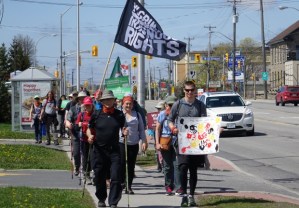
PilgrimageBy Kathy Moorhead Thiessen, Christian Peacemaker Teams (CPT) Delegate

Originally posted in the April-June 2017 CPT newsletter  

I co-led the Pilgrimage for Indigenous Rights on April 23-May 14, 2017. As I walked–kilometer after kilometer–I listened to music. One song, based on Psalm 23 struck my soul. I know that this psalm is often read at times when people need comfort. I thought about the role of Christianity in colonization of the indigenous peoples of Canada. I imagined that the young children forced into residential schools run by the churches had been forced to listen to the King James version of this psalm- in situations where they were not able to derive comfort. Everything presented was foreign and they were not given space to draw on what they knew to be good and right.
Continue reading “Decolonizing Psalms”

Sermon: Creations Groans: In the snow, the seeds, and our breath

IMG_1319(1)By Lydia Wylie-Kellermann, co-editor of http://www.radicaldiscipleship.net
Day House, Detroit Catholic Worker
July 16, 2017

Isaiah 55:10-11, Psalm 65,
Romans 8:18-23, Matthew 13: 1-9

This week I noticed some large scratchy leafed plant pop up on our driveway. It winded its way out of a narrow patch of dirt between a rotting log and the spot where we prop our gate open when we are driving in and out. It has unmistakable orange flowers, each day it is multiplying in size. The seed must have planted itself in the small bit of soil after rotting there from neglect after celebrating the season when the veil is thin. It has always been my dream to have a huge pumpkin patch. So, for now, I am cherishing this unexpected gift. I have dragged more logs over to protect it and will give it whatever space it needs. I can’t open our gate all the way and I drive into the driveway in the most peculiar way. It feels like a little miracle that I get to tend and delight in each day. Continue reading “Sermon: Creations Groans: In the snow, the seeds, and our breath”

God in Everything

Just JesusFrom the late theologian Walter Wink, in his book Just Jesus: My Struggle to Become Human (2014):

God is not just within us, but within everything. The universe is suffused with the divine. This is not pantheism, where everything is God, but panentheism where everything is in God and God is in everything. Spirit is at the heart of everything, even down to the smallest particle of spirit-matter. Hence all creations are potential revealers of God.

Sermon: Imprisoned by Hope

joannaBy Joanna Shenk, First Mennonite Church of San Francisco

Song of Solomon 2:8-13
Zechariah 9:9-12

I had a hard time getting out of bed yesterday morning. I was feeling the weight of a lot of things and wondered if it was futile and disingenuous to write a sermon that offered hope. I wasn’t feeling hopeful. I was feeling more like the title to the most recent Metallica album, “Hardwired… to Self-Destruct.” The bad guys keep winning. Vulnerable people are endlessly oppressed. And it seems like so many people don’t even have a moral consciousness to appeal to. 

Continue reading “Sermon: Imprisoned by Hope”

Wild Lectionary: The Good Seed

Sole Food pic
Photo credit: Kelsey Brick

Sixth Sunday after Pentecost
Proper 10 (15)
Ps. 65:9-13; Is. 55:10-13; Mt. 13:1-9, 18-23

By Jason Wood

Seeds, seeds, seeds.

Three of six of the appointed texts for today talk about them. The Psalmist refers to seeds implicitly, praising YHWH as the source of life-giving rains, fertile fields, and abundant harvests. Isaiah meditates upon seeds as the inevitable byproduct of the rain watering the earth, assuring his audience that, in the same way, God’s word is fruitful and effective. And Matthew relates one of Jesus’ most well-known parables, one of broad-scattered seed, thwarted growth, and stunningly rich production from the few that fall on good soil. Continue reading “Wild Lectionary: The Good Seed”

The Fierce Urgency of Now

FierceBy Ched Myers, originally posted in the June 2017 BCM eNews

Note: Below are edited and excerpted comments from Ched’s keynote to the annual dinner of the Cal-Pac Chapter of the Methodist Federation for Social Action and Reconciling Ministries Network, at the University of Redlands, CA on June 17, 2017.

It’s a formidable task to come up with 15 minutes of inspiration and exhortation to a group like this, given that your vocations have long been forged around the work of inspiring and exhorting. So I’ll leave that task to one who inspired and exhorted all of us, and does so still: Dr. Martin Luther King Jr., the author of tonight’s thematic meme: “The fierce urgency of now.”

It is both relevant and poignant that this very phrase anchored two of Dr. King’s most famous public addresses, speeches that bracketed the second half of his public career as a civil rights leader. It first appeared in his most well-known exhortation to the nation–you know, that one in front of the Lincoln memorial on Aug 27, 1963. “We have also come to this hallowed spot to remind America of the fierce urgency of now,” intoned our greatest prophet. “Now is the time to make real the promises of democracy.”
Continue reading “The Fierce Urgency of Now”

Wild Lectionary: Seeking at the Essence

Screen shot 2011-04-02 at 11.49.13 AM
Women at the well in Akot, South Sudan

Fifth Sunday after Pentecost
Proper 9 (14)

Genesis 24:34-38, 42-49, 58-67

By Judith Doll

Water – the essence of life. It is absolutely necessary for all living things to survive and has been since the beginning of time.

Water – Where does it come from? From the rain, falling from the heavens; from the streams, the rivers, the lakes, the ocean, and the rivers under the earth accessible by wells. Continue reading “Wild Lectionary: Seeking at the Essence”