 By Dave Pritchett
NOTE: This is Part Two of a two-part series from Dave. Part One was posted yesterday.
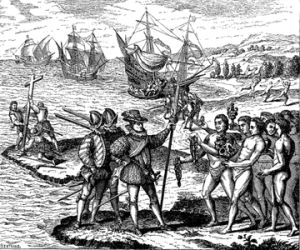
In Part 1 of this blog series, I shared my journey of learning to be a good settler, spurred on by the Woodleys. Convicted of my role as a settler here in Cascadia, I felt led to learn about the Doctrine of Discovery and the possible response of watershed discipleship. As a refresher, the Doctrine of Discovery formed the foundation for European colonization of the Americas, and is still referenced occasionally today in legal disputes over land claims. I found that watershed discipleship offers a theological alternative to the Doctrine of Discovery by encouraging Christians to reclaim their relationship to the watershed they inhabit, not as a mode of conquest, but by reconnection to place and people.
In this post, I want to look at a biblical text that helps ground this complex conversation around the intersecting themes of colonization, land, and faith. We eat three times a day, after all, and food often has subtle symbolism for what kind of society we live in as well as how we relate to land and people. Daniel tells a story that grapples with these themes, merging, in this tale, around a king’s table.
Daniel: the Relationship between Food and Empire
In the first chapter, the author sets the tone for the book, portraying Daniel and his friends as ones who attempt to live faithfully within the Babylonian Empire despite being captive to it. The story introduces these young Israelites as intelligent members of Jerusalem’s elite, taken into service for the king: “young men without physical defect and handsome, versed in every branch of wisdom, endowed with knowledge and insight, and competent to serve in the king’s palace” (Daniel 1:4). This assimilation of members of the elite is an important imperial strategy: putting the social elite at the king’s table essentially puts them under his thumb. The subsequent renaming of Daniel and his friends reveals how the king attempted to reshape these men according to the priorities of Babylon (1:7). Just as later nation-states developed surnames in order to track and tax populations, so the renaming of newly acquired servants is a measure of the degree to which Babylon claimed authority over the lives of political prisoners.
However, like so many indigenous peoples throughout history who find their lands occupied and their people enslaved, the Hebrew captives would not capitulate so easily. Daniel’s refusal of the king’s food constitutes the crux of the story: “But Daniel resolved not to defile himself with the royal rations [emphasis mine] of food and wine” (1:8). Patbag, the word at issue here, is the allotted meal taken from the royal treasury to meet the needs of his courtiers. Most interpreters take this refusal to be a religious one—Jews in antiquity often maintained their ethnic and religious distinction by observing dietary rules. An overlooked area of this issue, however, is that the royal court system depended upon an empire that extracted goods from the margins of the empire to benefit the center. Wresting resources from the conquered periphery to the king’s palace was commonplace:
The procedure of funneling resources from the subject populations to the heartland through seizure and exaction was no less important to the Babylonians as it had been to the Assyrians…. Nebuchadnezzar campaigned almost yearly in the west, in part to ensure order, but also to fill the royal coffers. (David S. Vanderhooft, The Neo-Babylonian Empire and Babylon in the Latter Prophets, p. 62)
The king’s table would certainly be maintained by such imperial campaigns; meat and wine would be sourced as tribute from conquered nations. These particular goods were less perishable, since meat could be transported as livestock, and wine could travel a distance without spoiling. The average urban dweller in Babylon had a diet dependent on grain transported from the surrounding countryside. Babylon’s food footprint, according to one catalogue of grain imports, consisted of an area extending from the Sippa in the north to Sealand in the south, a length of over 190 miles of irrigated land. In contrast, Daniel’s requested meal of vegetables do not travel well, so must be grown nearby. (For more information on these and other aspects of the Babylonian Empire’s relationship with the land, see the chapter “Cities and Urban Landscapes in the Ancient Near East and Egypt with Special Focus on the City of Babylon,” by Pedersen et al., in The Urban Mind: Cultural and Environmental Dynamics, ed. Sinclair et al., 2010.)
The refusal of the king’s table food, therefore, can be read not just as a dietary preference but also as an act of defiance. Daniel’s diet of vegetables and water represents an alternative to the extractive economy of empire in favor of local fare that could not be stolen from distant places. If acceptance of the king’s food symbolized political allegiance, the alternative diet was an implicit rejection of the king. The four friends might have to live in the king’s court, but they would find ways to resist the politics of plunder epitomized by the patbag.
Awareness of Watersheds: First Step in Breaking Down Empire and Building Up Flourishing Spiritual Community
I suggest this correlates to land use and interaction with colonial powers in our own time, and we can use Daniel as an example of how to respond. Like Daniel, we might start by envisioning the end of the imperial food system that incorporates both land and people into a matrix of oppression. Because food connects us to land daily, our food system symbolizes how we will relate to land. The Doctrine of Discovery became a fundamental legal framework that allowed Europeans to take indigenous lands. The question for disciples today is whether we will continue that history by marginalizing indigenous voices and devaluing the colonized landscape on which we all live.
Judy Bluehorse Skelton leads the way in calling indigenous people into “recovery from discovery”; perhaps it is time for settlers similarly to enter into this recovery work. The following are practical ways we can learn to be good settlers:
- Support existing indigenously led organizations. These organizations may want you to volunteer, or may just ask for monetary donations. The most important thing is to ask how you can be supportive. Do this without expectation of being praised for generosity. For people near Portland, Native American Youth and Family is a great place to volunteer or donate. I was grateful this year to attend a session at Eloheh School, led by Edith and Randy Woodley, that focused on indigenous spirituality and relationship with the land; similar sessions will be offered in the future, and represent a way both to support their ministry as well as engage in your own work of learning in the journey of decolonization.
- Learn the history of the land on which you live. To whom did it belong? What were their patterns of life? Where do they live now?
- Practice watershed discipleship. Learn what it means to follow Christ in this moment, with all the ecological devastation that accompanies this time in history. Find others who will also commit to being disciples of your watershed as well—let the land be your rabbi, teaching you to live according to the patterns within it. My faith community, Wilderness Way, practices this with a monthly hike in which we learn more about the native ecology and landscape and notice how being in the forest nourishes our spirituality.
- Practice food justice. Food is what connects us to people and landscapes, and therefore has symbolic and practical importance. Who grows and harvests your food? Support food workers campaigning for better wages. Can you find food sources that are local, farms where you can visit to ensure the land is not being poisoned, and workers not exploited? What is the carbon footprint of your food? Does it come from across the country, or from your region? I connect to both food justice and local ecology by volunteering with Portland Fruit Tree Project, a nonprofit that cares for fruit trees and shares the harvest with people who struggle to access healthy food.
The prophetic actions of Daniel and Judy Bluehorse Skelton spill forth hope that the empire of conquest can be resisted and new life-ways animated in our watersheds. Though this is a daunting task, I can think of two good places to start. One such place is our tables, where the daily act of eating meets ecology, and the other is down by the riverside, where our discipleship to Jesus in baptism joins our commitment to the watershed we call home.

 By Laurel Dykstra. This piece is part of a new anthology- Wrongs to Rights: How Churches can Engage the United Nations Declaration on the Rights of Indigenous Peoples
 By Joyce Hollyday
 By Solveig Nilsen-Goodin
 By Dave Pritchett, Wilderness Way Community, Portland, OR

 Radical Discipleship