Seeds from Jail

36189090_10156615646639180_2288904508601794560_o
Mobile by Deb Hansen

Written by Mark Colville from jail. Serving time for the Kings Bay Plowshares

Jesus said, “The kingdom of God is as if someone would scatter seed on the ground, and would sleep and rise night and day, and the seed would sprout and grow, he does not know how. The earth produces of itself, first the stalk, then the head, then the full grain in the head. But when the grain is ripe, at once he goes in with his sickle, because the harvest has come.”

He also said, “With what can we compare the kingdom of God, or what parable will we use for it? It is like a mustard seed, which, when sown upon the ground, is the smallest of all the seeds on earth; yet when it is sown it grows up and becomes the greatest of all shrubs, and puts forth large branches, so that the birds of the air can make nests in its shade.”

With many such parables he spoke the word to them, as they were able to hear it; he did not speak to them except in parables, but he explained everything in private to his disciples.      – – Mark 4:26-34

There’s a consolation that flows from this parable, “the seed grows of itself,” that I’d not found before.

Day to day life here is dominated by the experience and the effects of scattering. The collective that makes up this cellblock – any cellblock – is just about as far from an intentional community as could be imagined. Everyone here has been torn up by the roots, violently and unwillingly, from his community of choice. We’ve been cast together, literally on top of one another, haphazardly. The only intentionality apparent in how we’ve been assembled by the jailer (the farmer?) is in the separating of friends and co-defendants. It might be argued, or even assumed, that the randomness is specifically intended to prevent the possibility of healthy community living. For the past 45 years, no nation has invested itself in the prison industry with the vengeance of the United States. Not only does the per capita size of our prison population dwarf those of other countries, but we have developed the incarceration project into a finely tuned experiment in anti-community. The prison staff here, typical of thousands nationwide, are highly trained in managing our dysfunction, but completely unequipped to deal with anything substantive within these walls that might resemble unity, mutual empowerment, or even rehabilitation. They are so skilled at anticipating and responding to our violence that the promotion of an agenda that fosters it is a foregone conclusion. And yet, irrepressibly, community happens. The Rastafarian plays chess with the Aryan Brotherhood guy. The violent misogynist and the peace activist read scripture together, praying from the heart. The Mexican awaiting deportation draws an incredible orchid in blue pen on a postcard for the gringo to send home to his wife, and politely refuses anything in return. Food changes hands at meals; one homesick guy gives his place in line at the phone to another; the old man held here for over a year without bail rejoices with the twenty-something who expects to get to a halfway house this week.

We are seeds, scattered. Nothing good is supposed to grow here – that’s against policy. When it happens – and wherever they’ve tossed me, it always happens – they inevitably dig it up and scatter it again. And we sleep and rise, night and day, and through it all the seed would sprout and grow, they know not how.

There’s a sign that keeps appearing at immigrant’s rights marches back in New Haven. I think I saw it first with the families of the disappeared students in Mexico: “They thought they buried us. They didn’t know that we were seeds.”

To learn more about the Kings Bay Plowshares https://www.kingsbayplowshares7.org/

 

Healing Two Daughters

BindingWe continue our celebration of the 30th anniversary of Binding The Strong Man, Ched Myers’ political reading of Mark’s Gospel.  Today’s passage is Mark 5:21-43.

“Then one of the leaders of the synagogue named Jairus came and, when he saw him, fell at his feet and begged him repeatedly, “My little daughter is at the point of death. Come and lay your hands on her, so that she may be made well, and live”…Now there was a woman who had been suffering from hemorrhages for twelve years. She had endured much under many physicians, and had spent all that she had…”–Mark 5:22-23, 25-26

On the one hand, the synagogue ruler, Jairus (one of the rare named characters in Mark’s story), makes an assertive approach to Jesus, as befits male social equals.  This man was both “head” of his family (thus appealing on behalf of his daughter) and “head” of his social group (leader of the synagogue, archisunagogoon).  The man falls down at Jesus’ feet, a proper granting of honor prior to asking a favor. Continue reading “Healing Two Daughters”

The Dysfunction of Denial

BillFrom Bill Wylie-Kellermann’s newest release Dying Well: The Resurrected Life of Jeanie Wylie-Kellermann:
I don’t intend to use it as a frame, but I do want to say something about denial. I understand how healthy a survival mechanism denial can be in certain circumstances, a sane way to cope in the short term. So let me affirm it up front and in passing, but add that as a long-run tactic it is dysfunctional. As already stated, I also believe it is politically endemic to the culture. On societal scale, it hides the body bags, renders the tortured or the prisoners or mistreated workers invisible, obfuscates privilege, distances us technologically from the explosion, misdirects our gaze with media, deadens us to suffering (of others), and outsources the necessary violence of empire. Among other things.

Wild Lectionary: Discerning the Body Learning to Be Aware Before We Act

Proper 8(13)B
Mark 5:21-43

By Ragan Sutterfield

I have a small garden in my front yard, a smattering of plants, haphazardly planted–perennials and annuals, flowers and herbs and vegetables, “weeds” that I’ve welcomed and cultivated for their benefits to the soil and small wild things that make my yard their home. I water infrequently and mulch heavily–a plant must do well here or I take it out for something that won’t be too much trouble to grow.

Continue reading “Wild Lectionary: Discerning the Body Learning to Be Aware Before We Act”

Treat Me Like I’m White

Treat MeFrom the prophetic imagination of Nick Peterson, currently pursuing his PhD in Liturgics and Ethics at Emory University:
Do you find that your race or ethnicity prevents you from getting humane treatment in life? Well, this product is for you. This bracelet will instruct those who you encounter in the real world to treat you like you are white. In an age of colorblindness and implicit bias, nothing can communicate more clearly how you should be treated. When an officer pulls you over – treat me like I’m white. When you are being followed by a clerk in a nice store – treat me like I’m white. When you are in a restaurant and they don’t want to seat you or let you use the restroom – treat me like I’m white. When you go to the bank – treat me like I’m white. Basically, in any formal and mainstream circumstance, there is no better way to be treated. For less than $5, you have a wearable reminder to the world to – Treat You Like You’re White!  Order Here!!

Let Justice Roll Like Rivers: A Court Statement

IMG_5916
photo by Kimiko Karpoff

By Céline Chuang

June 12, 2018

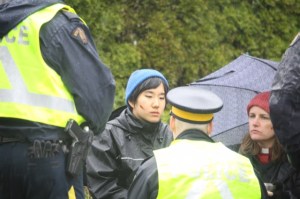
My Lord, I thank you for the opportunity to speak today. I want to acknowledge that this courtroom, this city, and all of us stand on traditional, ancestral and unceded territory, that of the Musqueam, Squamish, and Tsleil-Waututh, stewards of this land since time immemorial. I am here today as I was on the day I was arrested for participating, like others, in nonviolent civil disobedience – standing in solidarity with Indigenous people, here on these territories, and across Turtle Island. I mean no disrespect to the court in my actions. I simply wish to live in a way that honours those whose voices, stories, and wisdom predate the court system on these lands, and whose rights remain unrecognized. I hope that one day we will not only adopt the United Nations Declaration on the Rights of Indigenous People in theory, but put each of its articles into practice as a starting point for true reconciliation. Continue reading “Let Justice Roll Like Rivers: A Court Statement”

Abolition Spell (summer solstice)

015D4709-872B-4C04-8011-54999221350C-300x300.jpegBy adrienne maree brown. Re-shared from her blog.

the other small thing i can offer is an abolition spell, for siwatu, for the babies at the border, for their families, for all political prisoners, for all nonviolent offenders, for all those who have caused harm and are not being helped to find a different way.

all that is light
break bars between teeth
grind bricks down to dust
explode a sunscale life force
in each direction
until the cages shed like dead skin Continue reading “Abolition Spell (summer solstice)”

The Other Side

BindingWe continue our celebration of the 30th anniversary of Binding The Strong Man, Ched Myers’ political reading of Mark’s Gospel. Mark, according to Myers, represents a dissenting socio-political movement.  As the narrative continues, Jesus breaks through the social and economic barriers to the realization of human solidarity.  Today’s passage is Mark 4:35-41.

“On that day, when evening had come, he said to them, ‘Let us go across to the other side.’ And leaving the crowd behind, they took him with them in the boat…”–Mark 4:35-36

…the two sides of the Sea of Galilee symbolize Jewish and gentile territory, and the two major boat journeys represent the crossing from one side to the other.

…Throughout the Gospel, Mark is far more interested in articulating geo-social “space” in terms of narrative symbolics than actual place-names.  Indeed, it is not impossible that Mark may have intentionally dissociated the coordinate “other side” from a literal correspondence with eastern and western shores of the sea;  straining the geographical credulity of the sea narrative would have forced his first readers to focus upon the journeys as symbolic action (which is their purpose) rather than upon details of marine transit around the Sea of Galilee (which is not).  Continue reading “The Other Side”

The Major Philanthropists of Our Society

BarbaraFrom Barbara Ehrenreich’s Nickel and Dimed: On (Not) Getting By in America (2011):

When someone works for less pay than she can live on—when, for example, she goes hungry so that you can eat more cheaply and conveniently—then she has made a great sacrifice for you, she has made you a gift of some part of her abilities, her health, and her life. The “working poor,” as they are approvingly termed, are in fact the major philanthropists of our society. They neglect their own children so that the children of others will be cared for; they live in substandard housing so that other homes will be shiny and perfect; they endure privation so that inflation will be low and stock prices high. To be a member of the working poor is to be an anonymous donor, a nameless benefactor, to everyone else.