A blast from the past from James Boggs (November 1963).
Now I did not come here to comfort you. I came here to disturb you. I did not come here to pacify you. I came here to antagonize you. I did not come here to talk to you about love. I came here to talk to you about conflict. I say this at the outset because the American people have lived for so long under the illusion that America is an exception to the deep crises that wreck other countries – that they are totally unprepared to face the brutish realities of the present crisis and the dangers that threaten them. The American people have lived so long with the myth that the United States is a Christian, capitalist, free democratic nation that we can do no wrong, that the question of what is right and wrong completely evades us.
But the state of Israel was not created for the salvation of the Jews; it was created for the salvation of the Western interests. This is what is becoming clear (I must say that it was always clear to me). The Palestinians have been paying for the British colonial policy of “divide and rule” and for Europe’s guilty Christian conscience for more than thirty years.
In our after times, our task, then, is not to save Trump voters—it isn’t to convince them to give up their views that white people ought to matter more than others. Our task is to build a world where such a view has no place or quarter to breathe. I am aware that this is a radical, some may even say, dangerous claim. It amounts to “throwing away” a large portion of the country, many of whom are willing to defend their positions with violence. But we cannot give in to these people. We know what the result will be, and I cannot watch another generation of black children bear the burden of that choice…
Our task, then, is not to save Trump voters nor is it to demonize them. Our task is to work, with every ounce of passion and every drop of love we have, to make the kingdom new! The first step involves what I called…a “revolution of value.” This involves telling ourselves the truth about what we have done. It entails implementing policies that remedy generations of inequities based on the lie. It requires centering a set of values that holds every human being sacred. All of this will be made possible by grassroots movements that shift the center of gravity of our politics…Our task involves shaking loose the warm “swaddling clothes” that secure us in our prejudices and prevents us from confronting our fears. Our task means speaking truth to power and looking the darkness of our times squarely in the face without the security of legend or myth, and without the comforting idea that black people will save you.
Lorraine Hansberry was the first Black woman to write a play produced on Broadway. After she became famous, she participated in a panel on race relations with black activists and white liberals. It was the mid-60’s and they were attempting to address the growing tension between the two groups.
As the Black freedom struggle moved to the streets, most of the white liberals pulled back their support. On the panel, Hansberry spoke plainly about their ultimate goal in gathering together: “We have to find some way with these dialogues to show and to encourage the white liberal to stop being a liberal and become an American radical.”
Sixty years later, perhaps this task has gotten even more challenging. This is what the Black revolutionary Assata Shakur, writing from exile in Cuba, famously said about the situation.
An excerpt from an unpublished sermon of Rev. Dr. Edgar Rivera Colon at Faith + Work Firist Unitarian Church of Orange, NJ
When we attend to the tears of a grief-stricken activist, we enact the collective mourning work which transfigures into what Robert Sember names “redemptive solidarity.” The wrenching pain of mourning is the affective antechamber to the possibility of joy and collective forward motion. Our tears are the salt of history that leaven more human futures. Thus, what we at first cognize as interruptions to liberating works are the intervening enabling conditions for the materialization of our deepest desires for social and spiritual transformations. Sember alerts us to the alignment of the “poetry of feeling” and “immanent freedom”: they share a homeplace in the soul work that our times require.
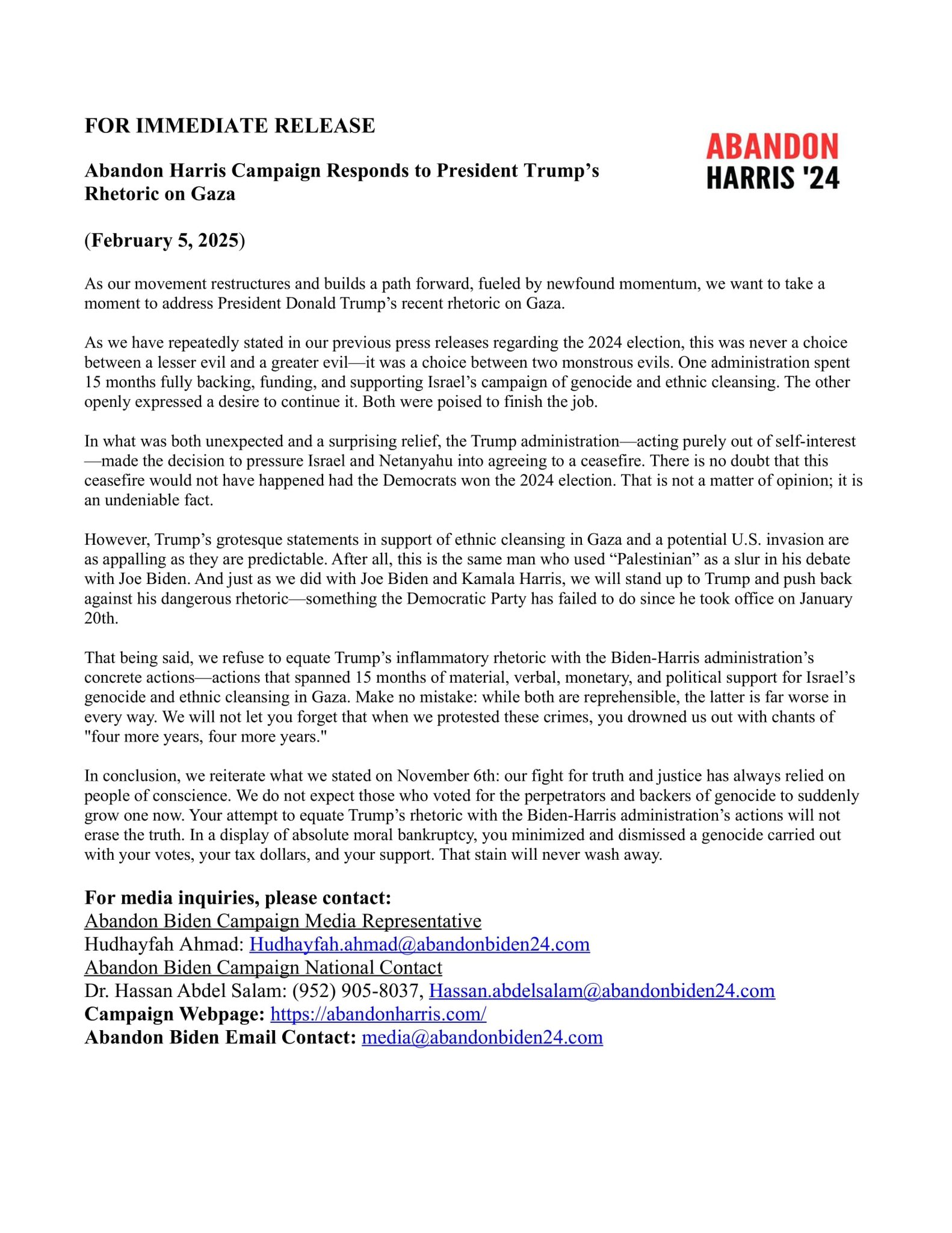
This election cycle suggested that the fight against fascism at home is separate from the fight against genocide abroad. But we know it is the same struggle. There is no way to fight for real, radical, multi-racial democracy in the U.S. without working toward Palestinian liberation. And there was no way to defeat MAGA in this election by fully writing off this movement and the needs of working people. It’s never been clearer that the survival of all of our communities is bound up together. Fighting for freedom for Palestinians is inseparable from the work of liberation everywhere, including for our immigrant, Black and brown, Arab, Muslim, Jewish, trans and queer communities here.
An excerpt from a Biko Mandela Gray tweet yesterday. Gray is an associate professor and director of undergraduate studies at Syracuse University and the author of Black Like Matter (2022).
This is a moment to reflect. It is also a moment to unlearn American theology—by which I mean, it is a moment to absolve ourselves of the idea that presidents are salvific figures. They aren’t. To think this way is to embrace white supremacy.
Anarchy is the move now. And yes, that might include a certain kind of direct action. But more than this, anarchy is a disposition of collective refusal. It is a praxis of collective engagement that is indifferent to institutions and institutionality.
Here’s some more Octavia Butler to meditate on. This one comes to us from author Monica Byrne, who wrote that every time she criticizes the Democratic Party, and someone asks “So what’s the answer?”, she posts this.
By Maria Popova, re-posted from themarginalian.com
In 1845, as the forgotten visionary Margaret Fuller was laying the foundation of modern feminism, advocating for black voting rights, and insisting that “while any one is base, none can be entirely free and noble,” she contemplated what makes a great leader and called for “no thin Idealist, no coarse Realist,” for a person “of universal sympathies, but self-possessed,” one for whom “this world is no mere spectacle or fleeting shadow, but a great, solemn game, to be played with good heed, for its stakes are of eternal value.”
But how does a nation, a society, a world concerned with more than the shadowy spectacles of the present identify and elect such leaders to shape the long future?
A century and a half after Fuller, Octavia Butler (June 22, 1947–February 24, 2006) — another rare visionary — offered a glimmer of guidance in her sibylline two-part series set in the 2020s: Parable of the Sower (public library) and Parable of the Talents (public library) — a set of cautionary allegories, cautionary and future-protective in their keen prescription for course-correctives, about the struggle of a twenty-first-century society, Earthseed, to survive the ecological collapse, political corruption, corporate greed, and socioeconomic inequality it has inherited from the previous generations and their heedless choices.
Like Ursula K. Le Guin, Butler straddled the timeless and the prophetic, saturating her fiction with astute philosophical and psychological insight into human nature and the superorganism of society. Also like Le Guin, Butler soared into poetry to frame and punctuate her prose. Each chapter begins with an original verse abstracting its thematic direction. She opens the eleventh chapter of the second Earthseed book with this verse:
Choose your leaders with wisdom and forethought. To be led by a coward is to be controlled by all that the coward fears. To be led by a fool is to be led by the opportunists who control the fool. To be led by a thief is to offer up your most precious treasures to be stolen. To be led by a liar is to ask to be told lies. To be led by a tyrant is to sell yourself and those you love into slavery.
And yet our discernment in choosing wisely, Butler intimates in a chilling short verse from the first book, can so often be muddled by our panic, by our paralyzing fright and pugilist flight:
Drowning people Sometimes die Fighting their rescuers.