A Day that Directly Confronts the Sorrows and Death We Must Forever Negotiate

KingFrom the preface to Michael Eric Dyson’s April 4, 1968: Martin Luther King, Jr.’s Death and How It Changed America (2008):

When Martin Luther King, Jr., was murdered, I was a nine-year-old school boy. I had no idea who he was, had never heard his name or seen him in action. Just as technology had allowed him to speak at his own funeral, it offered me my first glimpse of King’s oratorical magic. Like so many folk born after he died, I first met King on television. I was sitting on the living room floor of my inner city Detroit home. “Martin Luther King, Jr., has just been shot in Memphis, Tennessee,” the newsman announced, interrupting whatever program we were watching. My father sat behind me in his favorite chair. He was barely able to utter “humph.” It was one of those compressed sighs that held back far more pain than it let loose. It came from deep inside his body, an involuntary reflex like somebody had punched him in the gut… Continue reading “A Day that Directly Confronts the Sorrows and Death We Must Forever Negotiate”
Remembering King’s Assassination 50 Years Ago

4500
Photo credit: The Guardian

By Bill Wylie-Kellermann

I remember precisely where I was when I got the news of Martin Luther King’s assassination. It was my freshman year in college, a midwestern liberal arts school, and I’d just walked into the lounge of my dormitory when a bulletin broke into regular TV programing. The lone other student, whose face and name I mercifully do not recall, was seated high on the back of an overstuffed black leather chair. He muttered, “Somebody finally got that n****r.” I remember running the length of hall to the pay phone booth and calling my folks in Detroit, weeping into the receiver. In those tears, something shifted in me vocationally that day which bears on who I am. Continue reading “Remembering King’s Assassination 50 Years Ago”

Crossing the Desert

reedBy Dee Dee Risher

The aboriginal people of the Kalahari desert break and bury ostrich shells in the sand. The extreme temperatures cause condensation inside the eggshells. As the nomads move over the desert, they survive by drawing drops of moisture from these shells with reeds.

You must prepare well,
Rise in the knowing dark,
Go down to the river,
And listen to the reeds.
A single one will call you.
Listen. Continue reading “Crossing the Desert”

If We Aren’t Willing to Tell the Truth

LorraineFrom Jyarland Daniels, the executive director of Harriet Speaks:

April 4th will be upon us soon, and we will read articles like this for days. I want to ask (read: beg) you to remember language matters.

This article says, “50 Years After Dr. King’s Death…” “Death” is also used throughout the article. If we stop and think about the word “death” for a moment we see history is being sanitized and re-written before our very eyes.

You see, “Death” is the word we use when someone does of old age, or perhaps after a battle with an illness, or even an accident. But Dr. King was MURDERED. And not only that, but we now know that this government was complicit in his murder. 

Language matters. Words matter. If we aren’t willing to tell the truth and use the right language for how King died, then we aren’t ready to talk about what his life meant.

Holy Week Actions!

Seattle2Whidbey Island (WA) based spiritual director and activist Marcia Dunigan reports that earlier in the week, she threw in with about 60 others (including small children) witnessing at a Table Turning event (right) in Seattle in front of the ICE administration building in the rain and cold. This is from the Table Turning website:

Tragically, institutional Christianity in the U.S. has become aligned with nationalism and capitalism. So the aims of Table Turning are:

  • Reclaiming the subversive tradition of Jesus in the public sphere
  • Centering marginalized voices to tell their own story and define their own identity, while interrupting a culture that allows only the powerful to be heard
  • Increasing participation in faith-based social justice activism
  • Repentance and realignment of our own lives away from oppression and toward liberation

Continue reading “Holy Week Actions!”

Wild Lectionary: Wonder and the True Easter Lily

skunk_cabbage.jpgEaster, Year B
Acts 10:34-43
Isaiah 25:6-9
Psalm 118:1-2, 14-24
John 20:1-18
Mark 16:1-8

By Jessica Miller

Across the northeast of North America at this season, a wonder is happening. The flowers of Symplocarpus foetidus have begun emerging and blooming from swamps and wet places. These true Easter-lilies—members of the same family of the Calla ‘lily’—are more commonly known as skunk-cabbage. Varieties of the plant also grow in Japan, where the red robe-like blossoms resembling a monk’s hood have gained it the name Zazen-sou, or Zen meditation plant.

Continue reading “Wild Lectionary: Wonder and the True Easter Lily”

Ratzlaff Review: Justice & Only Justice

VernAnother short and sweet book review-summary from legendary pastor Vern Ratzlaffposting up on the Canadian prairies, pouring his heart and mind into anti-imperial theology and soul-tending. 

Justice and Only Justice. Naim Ateek, Orbis, 1989.

Ateek is (Anglican) canon of St George’s Cathedral in Jerusalem and pastors its Arabaic speaking congregation. The claim for security for the one people, the Israeli Jews, has been purchased at the expense of the just claims to the land of another people, the Palestinians. In Ateek’s words, the Israeli Jews seek peace with security, and the Palestinians seek peace with justice. Continue reading “Ratzlaff Review: Justice & Only Justice”

Ecological Stations of the Cross

IMG_1214
Tanker in the Burrard Inlet near the proposed end of the Kinder Morgan Transmountain pipeline

This liturgical resource was assembled by members of Salal + Cedar (www.salalandcedar.com) and Earthkeepers (www.theearthkeepers.org) two Christian environmental groups on Coast Salish Territory, lower mainland British Columbia who host an Ecological Stations of the Cross each year during Holy Week. Stations of the Cross are a Good Friday tradition of prayer and contemplation on images depicting the events from the time that Jesus is sentenced to death to his burial. We walk outdoors at a site slated for the expansion of a tar-sands bearing pipeline and draw connections between Jesus’ suffering and the suffering and betrayal of creation. The traditional passion narrative from John (18:1-19:42) moves from the betrayal and arrest in the garden to Jesus’ burial. Our stations include action, poetry, song and contemplation when we read from John we use the word Judeans (a more accurate and less anti-semetic translation) instead of “the Jews.”  Themes include: repentance, culpability, betrayal, complicity, empire, suffering, compassion, power/powerlessness, death, lament, longing despair, hope and hopelessness, outrage.

Coast Salish Territory
Water Station (overlook)

Come all you who are thirsty, come to the waters. Isaiah 55:1

And Jesus, knowing that all was now finished said, “I thirst.” John 19:28

Here where Fraser River, the Sto:lo, flows into the Salish Sea, where parts of our region are temperate rainforest, our reservoirs are full and we consign gallons of clean drinking water to the sewers with every flush –we can forget, or even ignore, those who thirst. Continue reading “Ecological Stations of the Cross”

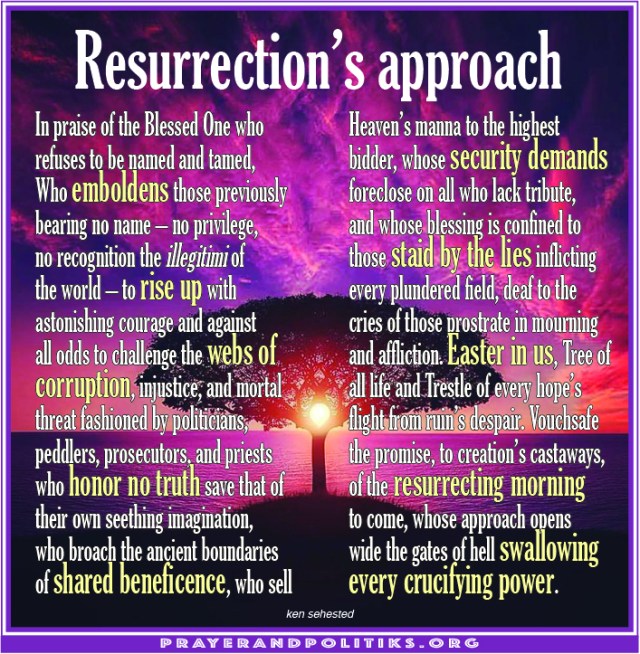
Resurrection’s Approach AND Commentary on the March For Our Lives

A Prayer and Commentary from Ken Sehested

Resurrection's approach.jpeg

Whisper words of wisdom, let it be:
Commentary on the March For Our Lives rally in Washington, DC
Saturday 24 March 2018

I am not ashamed to admit it. They made me do it. Cry. More than once. “They” being the uncommonly common students who led the March For Our Lives rally—three-quarters of a million strong—in Washington, DC. The day may well be accounted as among the most significant in our nation’s history. Continue reading “Resurrection’s Approach AND Commentary on the March For Our Lives”

Seraphim Serpents, Bronze Gifts, and Saving Sights

CrossBy Jim Perkinson, a sermon on John 3: 14-21 and Numbers 21:4-9 (March 11, 2018, St. Peter’s Episcopal, Detroit, MI)

The sermon begins today with this year’s early advent of the parade for St. Patrick. The sea of green we already witnessing this morning provides interesting backdrop for the lectionary readings. In mainstream Christian invocation, Patrick is remembered for clearing the snakes from Ireland and often depicted as such, with crozier in hand and coiled serpents at his feet. Patrick mastered the slithering ones. But for our purposes here, it is important likewise to lift up Afro-diaspora creativity with the Gaelic saint and his serpents. In colonized Haiti, the displaced slaves amalgamated their traditional Yoruban-Dahomean-Congolese spiritual practices with the Roman Catholic orthodoxy into which they were forced. For them, the depiction of the snake-mastering Patrick “spoke” of Damballah, the Creator-Serpent-Spirit (or Loa, in their terminology) whose surreptitious presence they saw “mounting” Patrick in possession and using his snake proclivity to express something quite different. Far from banning the Serpent Power, for the creolized community of the French colony, Patrick became the host body for this African indigenous spirit-guide. The Snake mastered Patrick. And something like that intuition will help us open the Hebrew text to its indigenous root this morning. Continue reading “Seraphim Serpents, Bronze Gifts, and Saving Sights”