After gathering the documents I need from my office, I walk across the street to the former rectory of St. Margaret’s Anglican Church in East Vancouver, British Columbia.
It’s already dark at 7pm, and a most welcoming yellow glow greets me as I knock on the door.
As it opens and I enter, a wonderful chorus of “Heeey!” spills forth from the big dining room table, which is spread with a beautiful vegetarian dinner. Continue reading “Welcome to Hineni House”→
From James Cone’s The Cross and The Lynching Tree (2013):
Just as Jesus knew he could be executed when he went to Jerusalem, Martin Luther King, Jr., knew that threats against his life could be realized in Memphis. Like Jesus’ disciples who rejected the idea that his mission entailed his suffering and death (Mk 8:31-32), nearly everyone in King’s organization vigorously opposed his journey to Memphis, not only because of the dangers but because of the need to focus on the coming Poor People’s Campaign in Washington. But King, like Jesus, felt he had no choice: he had to go to Memphis and aid the garbage workers in their struggle for dignity, better wages, and a safer work place. He had to go because his faith demanded it.
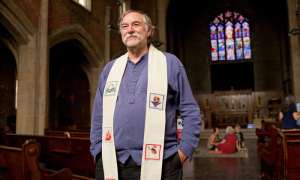
Rev. Weldon Nisly, arrested a few years ago at a nonviolent protest on Good Friday in Seattle, WA
By Weldon Nisly, originally posted in Hospitality (April 2017), the newsletter of Atlanta’s Open Door Community
Militarism is “a symptom of a far deeper malady within the American spirit” revealing “America is the greatest purveyor of violence in the world.” With this prophetic proclamation a half century ago, Martin Luther King, Jr., named the sin-sickness of America’s warring violence. Dr. King was preaching to America from the Riverside Church pulpit in New York on April 4, 1967.
On that consequential night fifty years ago, Dr. King declared, “A time comes when silence is betrayal,” and boldly revealed the interconnected violence of America’s “giant triplets of racism, materialism, and militarism.” His sermon forever connected civil rights, poverty, and war arising from a malady deep within the American soul and psyche. Continue reading “The Malady of Militarism”→
After George W. Bush was elected in 2000, Alice Walker said in an interview: “I know that Martin Luther King would have felt very saddened because he gave his life for a very much larger vision.” During the Obama years, Walker was asked in an interview with an Israeli publication what Dr. King would have thought of Obama’s America and what should be done to fulfill his vision. This was her response:
Martin Luther King was a leader, a person of conviction. He would find it difficult to comprehend, as I do, why Obama is incapable of standing up to Israel and why, whenever he tries, he soon collapses again. I believe Obama started out in the presidency as a good and decent person. With much ambition, but that is not a crime. However, killing people in distant lands by drone attack is, in my opinion, a crime. Condoning Israel’s crimes makes him an enabler of criminal behavior and complicit in the misery Israel causes to poor and frightened people. This is almost unbearable to face, because I, like so many others, love Barack. But we have lost him to the US government machine that is only running true to course in its treacherous machinations around the globe. Continue reading “Treacherous Machinations Around the Globe”→
Seven Catholic plowshares activists were detained early Thursday morning at the Kings Bay Navel Base St. Mary’s Georgia.
They entered on Wednesday nightApril 4. Calling themselves Kings Bay Plowshares, they went to make real the prophet Isaiah’s command: “beat swords into plowshares”. Continue reading “Plowshares on King’s Anniversary”→
From the preface to Michael Eric Dyson’s April 4, 1968: Martin Luther King, Jr.’s Death and How It Changed America (2008):
When Martin Luther King, Jr., was murdered, I was a nine-year-old school boy. I had no idea who he was, had never heard his name or seen him in action. Just as technology had allowed him to speak at his own funeral, it offered me my first glimpse of King’s oratorical magic. Like so many folk born after he died, I first met King on television. I was sitting on the living room floor of my inner city Detroit home. “Martin Luther King, Jr., has just been shot in Memphis, Tennessee,” the newsman announced, interrupting whatever program we were watching. My father sat behind me in his favorite chair. He was barely able to utter “humph.” It was one of those compressed sighs that held back far more pain than it let loose. It came from deep inside his body, an involuntary reflex like somebody had punched him in the gut… Continue reading “A Day that Directly Confronts the Sorrows and Death We Must Forever Negotiate”→
I remember precisely where I was when I got the news of Martin Luther King’s assassination. It was my freshman year in college, a midwestern liberal arts school, and I’d just walked into the lounge of my dormitory when a bulletin broke into regular TV programing. The lone other student, whose face and name I mercifully do not recall, was seated high on the back of an overstuffed black leather chair. He muttered, “Somebody finally got that n****r.” I remember running the length of hall to the pay phone booth and calling my folks in Detroit, weeping into the receiver. In those tears, something shifted in me vocationally that day which bears on who I am. Continue reading “Remembering King’s Assassination 50 Years Ago”→
The aboriginal people of the Kalahari desert break and bury ostrich shells in the sand. The extreme temperatures cause condensation inside the eggshells. As the nomads move over the desert, they survive by drawing drops of moisture from these shells with reeds.
You must prepare well,
Rise in the knowing dark,
Go down to the river,
And listen to the reeds.
A single one will call you.
Listen. Continue reading “Crossing the Desert”→
From Jyarland Daniels, the executive director of Harriet Speaks:
April 4th will be upon us soon, and we will read articles like this for days. I want to ask (read: beg) you to remember language matters.
This article says, “50 Years After Dr. King’s Death…” “Death” is also used throughout the article. If we stop and think about the word “death” for a moment we see history is being sanitized and re-written before our very eyes.
You see, “Death” is the word we use when someone does of old age, or perhaps after a battle with an illness, or even an accident. But Dr. King was MURDERED. And not only that, but we now know that this government was complicit in his murder.
Language matters. Words matter. If we aren’t willing to tell the truth and use the right language for how King died, then we aren’t ready to talk about what his life meant.


 From James Cone’s The Cross and The Lynching Tree (2013):

 After George W. Bush was elected in 2000, Alice Walker said in an interview: “I know that Martin Luther King would have felt very saddened because he gave his life for a very much larger vision.” During the Obama years, Walker was asked in
 From Ellen Grady
 From the preface to Michael Eric Dyson’s April 4, 1968: Martin Luther King, Jr.’s Death and How It Changed America (2008):
 By
 From Jyarland Daniels, the executive director of

