25 Years Later by a Long Shot

RiotsBy Tommy Airey

We have come over a way that with tears have been watered,
We have come, treading our path through the blood of the slaughtered,
Out from the gloomy past,
Till now we stand at last
Where the white gleam of our bright star is cast.

James Weldon Johnson, “Lift Every Voice and Sing”

Last month, we posted up in the pews of an old black Baptist church in Watts for the 50th anniversary of Martin Luther King’s powerful “Beyond Vietnam” speech. We belted out James Weldon Johnson’s “Lift Every Voice and Sing,” the so-called “Black National Anthem,” a song I first heard before the last college basketball game I ever played in (at L.A. Southwest Community College, just a few miles from where we sang in Watts).

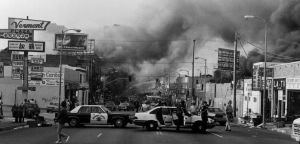
A few days later, we joined up with Bartimaeus Cooperative Ministries to help staff “Commemorating the 25th Anniversary of the L.A. Uprising,” organized by a group called ReconciliAsian, spearheaded by Sue and Hyun Hur, a Korean-American couple who pastor a Mennonite church in Southern California (keep Hyun in your prayers as he heads to North Korea this week). This space provided story-telling from different leaders (black, Latina, Asian and white) bearing witness to those chaotic days in the aftermath of the acquittal of three police officers in the Rodney King beating trial. Continue reading “25 Years Later by a Long Shot” →
Sermon: That’s Just Love Sneakin’ Up On You

images.jpgRev. Rebecca Stelle, Becoming Church
Guest Preacher at New Community Church,
Washington, DC
Sunday April 30, 2017
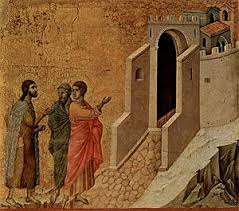
Luke 24: 13-25

When the anticipation of celebration is upended by grief, people are traumatized. Think of November 9 of last year- Do you remember the emotion which has now largely subsided? On November 8, millions of people were poised to celebrate a win, and the next day, millions were outraged, terrified, offended, bewildered and humiliated. Even if you weren’t one of them, can you viscerally recall the intensity of that expectation gone wrong?  Continue reading “Sermon: That’s Just Love Sneakin’ Up On You” →

Morally Coherent & Socially Irresistible

Michael Eric DysonExcerpted from Michael Eric-Dyson’s “Abraham, Isaac and Us,” reposted from OnBeing.org:

The only meaningful interpretation of transcendence we might propose is to strip the term of its philosophical and theological orthodoxy and offer instead a more forceful definition. Truth can be described as transcendent if it illumines the time and place of its emergence as well as other places and periods. Truth’s transcendence is not pegged to its authoritative reflection of an unchanging reality that everyone would agree on if they had access to it. Truth happens when we recognize the expression of a compelling and irrefutable description of reality. Truth is not irrefutable because it appeals to ideals that escape the fingerprints of time and reason. Truth is irrefutable because it is morally coherent and socially irresistible. Continue reading “Morally Coherent & Socially Irresistible” →

Place-Based Resurrection

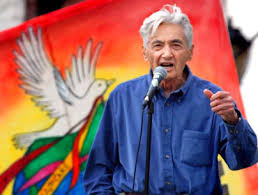
PerkBy Dr. James Perkinson (right), a sermon on Luke 24:13-35
I want to begin with a word of prayer before we jump into the gospel for today, but to facilitate that, first—a story about prayer and some necessary preliminaries. I have a half-Filipino poet friend in Detroit who tells of his first experiences of the Lord’s prayer, while growing up. Whenever he heard “Our Father who art in Heaven,” his five-year-old vernacular ears could not compute “art” as anything other than what happened when you put paint on paper, so his five year-old mind supplied a little slurred “n” in there, and what he actually thought he heard was “Our Father, who aren’t in heaven.” And it rattled him; he couldn’t figure it out; he says he kept thinking, “Well, where is he then?” If not there, then where? But he gradually came to hear it as a positive affirmation: a God who “aren’t” in heaven, because that God’s “place” is really right here, with us. A deep intuition, I would say, for all—what I would call place-based confession. Continue reading “Place-Based Resurrection” →

Learning from Laughter and the Trees: Even Donald Trump

photo(1)By Lydia Wylie-Kellermann

We were sitting in the car and I had somehow managed to have NPR on rather than some song about trains on repeat. I have to start being careful, because Isaac is listening and understanding what he is hearing. I don’t remember the context, but on the radio it says “She loves people.”

“Mommy, it said she loves people.” Continue reading “Learning from Laughter and the Trees: Even Donald Trump” →

Wild Lectionary: Good Shepherd

Catacomb-Art-Shepherd
Earlychurch.com

Good Shepherd Sunday
Acts 2:42-47 • Psalm 23 • 1 Peter 2:19-25 • John 10:1-10
By Noel Moules

A shepherd is a wilderness figure. Distinctive, as they move across the horizon line, while at the same time blending and flowing with and within their surrounding landscape. Always an outsider in terms of mainstream society, yet across the story of human cultures their mystique has left an imprint out of all proportion to their actual power and influence.

Biblically, the concept of the ‘shepherd’ presents a multitude of possible perspectives we might explore, even within the confines of our chosen lectionary passages. However, as a Christian animist I want to focus on a theme of central importance to me, that of ‘relationship’. Continue reading “Wild Lectionary: Good Shepherd” →

Always Vigilant

audreFrom Audre Lorde’s “Learning from the 60’s,” a talk delivered at Malcolm X weekend, Harvard University, February 1982:

Revolution is not a one-time event. It is becoming always vigilant for the smallest opportunity to make a genuine change in established, outgrown responses; for instance, it is learning to address each other’s difference with respect. Continue reading “Always Vigilant” →

Sermon: Sacred Stones

17991880_1356210924426880_4541864573151262921_n.jpgKaterina Friesen, Rooted and Grounded Conference,Chapel Message, April 21, 2017
At one time, the confluence of two powerful rivers churned with such energy that they created smooth, spherical stones. The Lakota people named one of these rivers the “Stone-Make-For-Themselves River,” (‘Íŋyaŋwakağapi Wakpá) because of the round stones the river formed, which they call Iŋyaŋ Wakháŋagapi Othí. Sacred Stones. These stones are used in prayer and ceremony, and are seen as enspirited, part of all our relations, like the river, plants and animals. Continue reading “Sermon: Sacred Stones” →

A Knowledge Gap

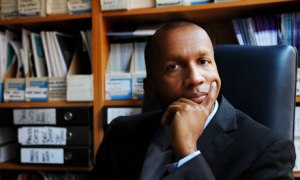
StevensonFrom Christina Gregg in an article entitled “Bryan Stevenson: America’s failure to deal with history of slavery and Jim Crow has manifested” reposted from AOL.com:

As a white nationalist says President Trump incited him to shove a black female protester at a campaign rally last March, a new museum in Montgomery, Alabama aims to advance truth and reconciliation while addressing the often unspoken reality of racial horror in America.

Burning black people alive, hanging them, mutilating their bodies — the graphic history of U.S. racial violence is a shameful and difficult thing to confront, says Equal Justice Initiative founder and executive director Bryan Stevenson, adding racially-driven hatred present today is “a manifestation of our failure to deal effectively” with that past. Continue reading “A Knowledge Gap” →