
When I dare to be powerful, to use my strength in the service of my vision, then it becomes less and less important whether I am afraid.
Audre Lorde
Discipleship as Defection from the Mammon System: Jesus’ Parable about a “Manager of Injustice”
 By Ched Myers, on Luke 16:1-13
Note: This post is part of a series of weekly comments on the Lukan gospel readings from the Revised Common Lectionary during Year C, 2016. This week Ched offers a longer study because of his conviction that this is a crucial text for middle class Christians. A more detailed version of the reflections below can be found here; a webinar exploring these themes can be found here. [Right: “The Wicked Servant,” Ian Pollock, 1972.]
Summary: This Sunday’s gospel can be read as a poignant fable for all who realize that they have been disenfranchised by the dominant economic system, and who would try to “monkeywrench” whatever status they have in it to provide a modicum of Jubilee justice for themselves and others. This parable illustrates the contemporary strategy of navigating what Wendell Berry calls the “Two Economies” by using capital to build social relations, rather than sacrificing social relations to build capital. Continue reading “Discipleship as Defection from the Mammon System: Jesus’ Parable about a “Manager of Injustice””
A Shift Towards Sustainable Community
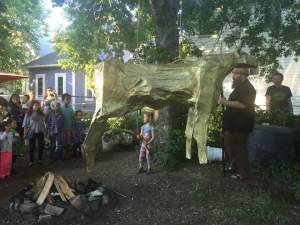 An update from Mark Van Steenwyk, the co-founder of the Minneapolis Mennonite Worker:
I’ve gotten a few comments and messages expressing the assumption that The Mennonite Worker is closing, or has closed. That isn’t true (in one way), but it is true (in another way). Let me explain.
We launched the Mennonite Worker (originally called Missio Dei) in 2004. We started as an urban church with a strong commitment to living out the way of Jesus in a particular area of Minneapolis (mostly around the Cedar Riverside neighborhood). Within the first couple of years, we began a strong radical shift towards becoming an intentional community that lived more deeply into the sorts of radical practices Jesus calls us to embrace: hospitality, peacemaking, prayer, and simplicity. Continue reading “A Shift Towards Sustainable Community”
Why I stand – or rather choose to sit – with Colin Kaepernick

By Patrick O’Neill- co-founder of the Fr. Charles Mulholland Catholic Worker House, an intentional, pacifist community that provides hospitality to people in crisis. Reposted from News Observer.
San Francisco 49ers quarterback Colin Kaepernick is teaching us all an important civics lesson: Freedom is not free. The term, usually reserved to support war, can also be applied to the price Kaepernick is paying for his decision not to stand and sing the national anthem at NFL games as a protest of police killings of African-Americans. Continue reading “Why I stand – or rather choose to sit – with Colin Kaepernick”
Empire Baptized
 During our current lectionary cycle, we’ve been downright spoiled with the scholarship that Ched Myers, Wes Howard-Brook (right) and Sue Ferguson Johnson bring every Thursday with their weekly comments on the Gospel passage. When Wes is not busy teaching at Seattle University, serving at the local soup kitchen, leading the weekly Bible Study in his home, participating in liturgical direct action, hiking up Tiger Mountain or making Sue a latte, he spends his free time researching church history for his next publication. Last week, his Empire Baptized: How The Church Embraced What Jesus Rejected (Orbis) was released for public consumption. We sat down for a long-distance dialogue about what to expect next.
RD.net: What were the circumstances in your own life that led to writing Empire Baptized?
WHB: Two major realities led to this book. First, in doing Come Out, My People!, the contrast between the New Testament’s clear message of embodied resistance to empire and historical Christianity’s embrace of empire jumped out at me. Second, in teaching undergrads who are often deeply and rightly suspicious of “Christianity” as well as older and often lifelong church people, I regularly experienced the shock people express when they discover that, for instance, Jesus not only wasn’t concerned with “how does my soul go to heaven,” but wouldn’t even have understood the question!
I had inherited the Yoderian narrative [Mennonite theologian John Howard Yoder] of “it was great for three centuries, but then along came Constantine,” but several things led me to question that story. For instance, that Constantine embraced “Christianity” did not explain such things as many churches’ obsessive focus on right “doctrine,” sexual ethics, and lack of regard for social injustice. I wanted to find out, at least for myself, what “really happened.”
It Simply Becomes “Force”
 From Ta-Nehisi Coates (see full article from The Atlantic here):
To understand the lack of police legitimacy in black communities, consider the contempt in which most white Americans hold O.J. Simpson. Consider their feelings toward the judge and jury in the case. And then consider that this is approximately how black people have felt every few months for generations. It’s not just that the belief that Officer Timothy Loehmann got away with murdering a 12-year-old Tamir Rice, it is the reality that police officers have been getting away with murdering black people since the advent of American policing. The injustice compounds, congeals until there is an almost tangible sense of dread and grievance that compels a community to understand the police as objects of fear, not respect. Continue reading “It Simply Becomes “Force””
Voice
Our hearts are full; this an historic day for the Standing Rock Sioux Tribe and for tribes across the nation. Native peoples have suffered generations of broken promises and today the federal government said that national reform is needed to better ensure that tribes have a voice on infrastructure projects like this pipeline.
- Dave Archambault II, chairman of the Standing Rock Sioux Tribe
Solidarity with Standing Rock
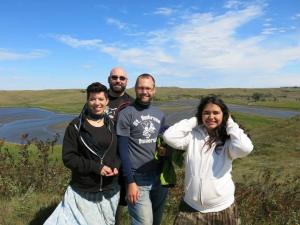 By Nathan Holst
Spirit come alive
Let us follow the current
Trace the sacred sighs
In the call of the earth
With seven generations
Standing before us now
May the Spirit come alive
These words from a song I wrote years ago were ringing in my ears this last weekend as I came with folks from the All Nations Indigenous Center in Duluth to join thousands of indigenous people at the incredible gathering at the Standing Rock Reservation to protect the water (and burial sites) from the Dakota Access Pipeline, slated to run just North of the reservation. There truly was an incredible Spirit coming alive in that space where elders, children, families were all tracing the call of the earth to protect the water for future generations.
Sinners & Lost Sheep
 By Wes Howard-Brook and Sue Ferguson Johnson
This Sunday’s passage from Luke (15.1-10) seems straightforward: like a man seeking a lost sheep and a woman a lost coin, Jesus seeks and finds people who are “lost.” But like so much of the Bible in general and Luke in particular, a close reading reveals there is more than what meets the eye at first glance.
Our first task is to show how Luke subtly but clearly suggests that the Pharisees’ resistance to Jesus’ message is the primary topic of our passage. Next, we’ll look at the passage itself, and how the first two parts of the parable (sheep/coin) are parallel to the two sons in the final section (15.11-32). Finally, we’ll consider how this speaks to our call to discipleship today. Continue reading “Sinners & Lost Sheep”

