An excerpt from Arundhati Roy’s speech at the closing rally of the World Social Forum in 2003.The Indian author will now be prosecuted for remarks she made about Kashmir back in 2010. Fascism is escalating everywhere.
Our strategy should be not only to confront empire, but to lay siege to it. To deprive it of oxygen. To shame it. To mock it. With our art, our music, our literature, our stubbornness, our joy, our brilliance, our sheer relentlessness – and our ability to tell our own stories. Stories that are different from the ones we’re being brainwashed to believe.
The corporate revolution will collapse if we refuse to buy what they are selling – their ideas, their version of history, their wars, their weapons, their notion of inevitability.
Remember this: We be many and they be few. They need us more than we need them.
Another world is not only possible, she is on her way. On a quiet day, I can hear her breathing.
An update from Chava Redonnet, the pastor of Oscar Romero Inclusive Catholic Church which meets in the dining room of the Rochester Catholic Worker (June 16, 2024).
Dear friends,
When my daughters were growing up, at suppertime around the table I would ask them each to share something that made them happy that day, and something that made them sad. (They hated it). (But I learned a lot I otherwise might not have!)
So here’s my own “happy thing” and “sad thing” from the past few days. First the happy thing.
I love it when we have a bunch of people at community supper and Mass. Last night our board met out at the house before supper (some on zoom and some in person), and Librada and Maria hung out with us for a while afterwards. Maria brought some great potato salad. For me personally, things are so much better with Nina and Betty doing the cooking. So grateful. And Bill brought ice cream. At Mass, it was hot enough to need a fan, but the stand-up fan proved to be an irresistible draw for two-year-old Lucas, who wanted to lick it. I told the story about the raccoon and the cookies from way back at the beginning… this Sunday is the 13th anniversary of the first Migrant Mass in 2011. It was just a good and happy evening, and I am full of gratitude.
Thursday evenings, June 27 – July 25 (no class July 4)
7:00 – 8:30 p.m. EST
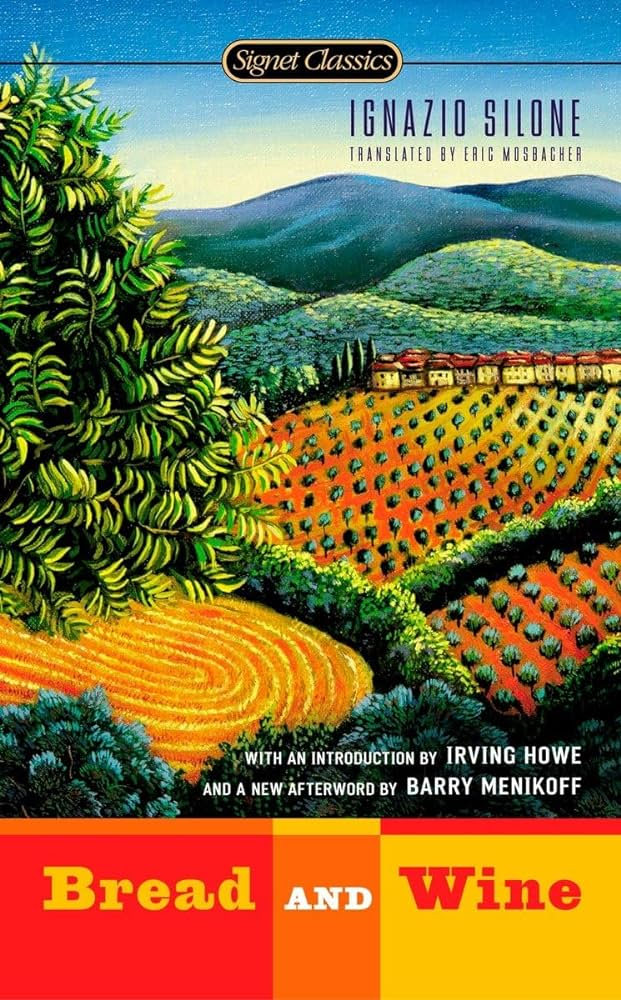
“In wrestling with the problem of how to present the teachings of nonviolence in an age of mass violence, it seems to me that the writings of Ignazio Silone are of immense importance.” – Dorothy Day
Catholic Worker founder Dorothy Day often cited the novel Bread and Wine by Ignazio Silone as one of the most influential works of fiction in her life. A deeply humane and compassionate novel, it was written in 1936 while Silone was in exile from his native Italy for his resistance work against the fascist government of Benito Mussolini. He recounts the story of an idealistic revolutionary who tries to organize Italian peasants against a repressive regime.
Rev. James Lawson died yesterday. He was 95. Here are some compelling things about his life that we can meditate on and emulate today (curated from a few biographies and obituaries).
Lawson became a “conscientious objector” during the Korean War. In April 1951, he was found guilty of violating the draft laws of the United States, and sentenced to three years in a federal prison. Upon his release from prison, Lawson returned to Baldwin-Wallace and earned his bachelor’s degree.
In 1956, Lawson entered Oberlin College’s Graduate School of Theology. In 1957, one of Lawson’s professors introduced him to the Reverend Dr. Martin Luther King, Jr., who urged him to move south and aid in the Civil Rights Movement.
“Don’t wait! Come now! We don’t have anyone like you down there,” MLK pleaded, according to author David Halberstam’s history of the civil rights movement, The Children. Rev. Lawson was outwardly “mild and gentle,” wrote Halberstam, “but he was a true radical Christian who feared neither prison nor death.”
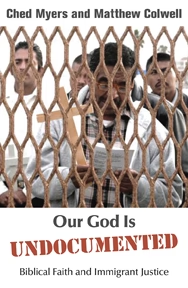
If we are going to talk about how undocumented immigrants impact our society, we ought to first address how our national policies have disrupted their lives. Above all, solidarity with the immigrant poor should seek to know them not as statistics, but as human beings who endure extraordinary hardship and trauma in their struggle just to survive–especially since the structural causes of their impoverishment lie on our side of the border.
An excerpt from James Baldwin’s letter to Angela Davis (November 1970).
The will of the people, in America, has always been at the mercy of an ignorance not merely phenomenal, but sacred, and sacredly cultivated: the better to be used by a carnivorous economy which democratically slaughters and victimizes whites and Blacks alike. But most white Americans do not dare admit this (though they suspect it) and this fact contains mortal danger for the Blacks and tragedy for the nation.
Or, to put it another way, as long as white Americans take refuge in their whiteness—for so long as they are unable to walk out of this most monstrous of traps—they will allow millions of people to be slaughtered in their name, and will be manipulated into and surrender themselves to what they will think of—and justify—as a racial war. They will never, so long as their whiteness puts so sinister a distance between themselves and their own experience and the experience of others, feel themselves sufficiently human, sufficiently worthwhile, to become responsible for themselves, their leaders, their country, their children, or their fate. They will perish (as we once put it in our black church) in their sins —that is, in their delusions. And this is happening, needless to say, already, all around us.
Only a handful of the millions of people in this vast place are aware that the fate intended for you, Sister Angela, and for George Jackson, and for the numberless prisoners in our concentration camps—for that is what they are—is a fate which is about to engulf them, too, White lives, for the forces which rule in this country, are no more sacred than Black ones, as many and many a student is discovering, as the white American corpses in Vietnam prove. If the American people are unable to contend with their elected leaders for the redemption of their own honor and the loves of their own children, we the Blacks, the most rejected of the Western children, can expect very little help at their hands; which, after all, is nothing new. What the Americans do not realize is that a war between brothers, in the same cities, on the same soil is not a racial war but a civil war. But the American delusion is not only that their brothers all are white but that the whites are all their brothers.
So be it. We cannot awaken this sleeper, and God knows we have tried. We must do what we can do, and fortify and save each other—we are not drowning in an apathetic self-contempt, we do feel ourselves sufficiently worthwhile to contend even with the inexorable forces in order to change our fate and the fate of our children and the condition of the world! We know that a man is not a thing and is not to be placed at the mercy of things. We know that air and water belong to all mankind and not merely to industrialists. We know that a baby does not come into the world merely to be the instrument of someone else’s profit. We know that a democracy does not mean the coercion of all into a deadly—and, finally, wicked— mediocrity but the liberty for all to aspire to the best that is in him, or that has ever been.
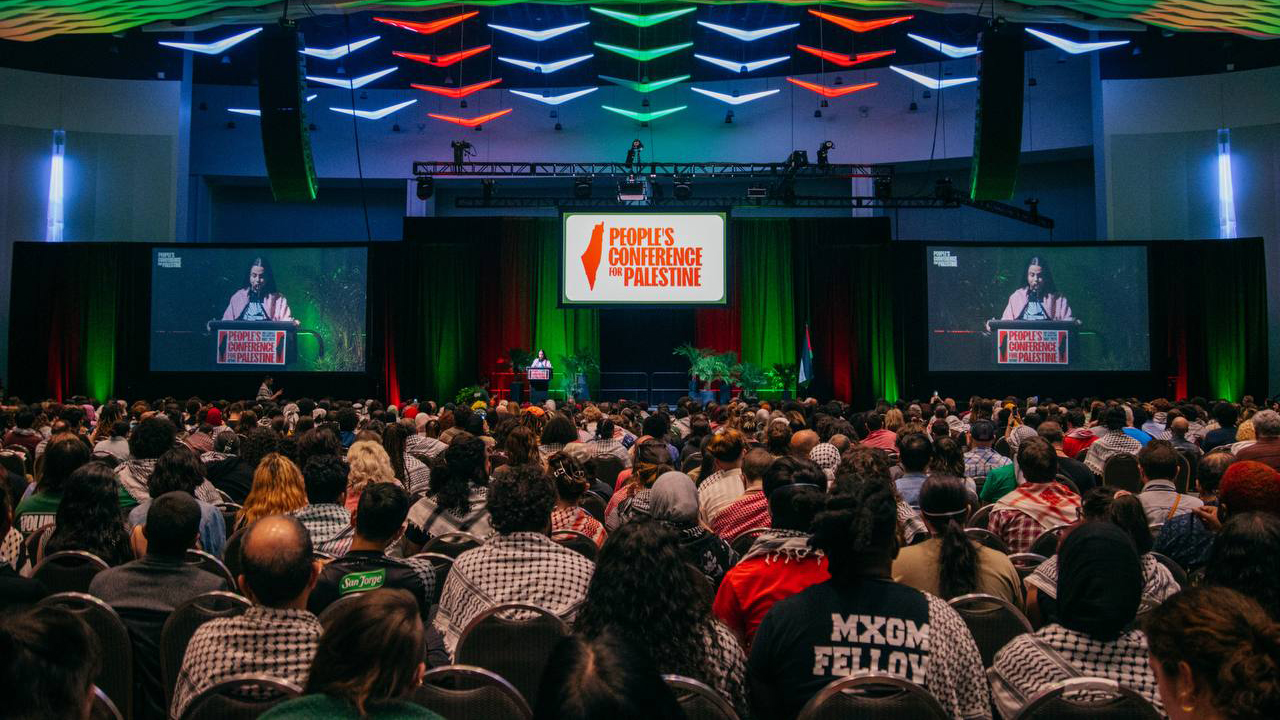
Closing Statement for the People’s Conference for Palestine (May 24-26, 2024 in Detroit, MI). Watch all livestreams here.
A few hours ago, in Rafah, the Zionist occupation bombed a camp of displaced Palestinians sheltering in a so-called humanitarian zone. We call it a camp, but in reality it is a space densely packed with over 1.4 million forcibly displaced people who are seeking refuge in makeshift tents. The Zionist entity has made the entirety of the Gaza Strip unliveable. It has made safe havens into zones of destruction. The Zionist occupation has reached new levels of barbarity and this is because the western criminal forces have given the Zionist entity the material, military, and ideological support necessary for them to continue waging this war with complete impunity. This is not a humanitarian crisis. This is a genocidal war against a colonized people to stifle and break our spirit. This is a war against humanity itself.
But brothers and sisters; do not let the occupation’s rage and blind destruction distract you from the absolute truth. The truth is that there are no bombs strong enough, no fires hot enough, no prison brutal enough to destroy the spirit of the Palestinian people. We are not a people that can ever be destroyed. The occupation does not know that for the Palestinian people, the dead becomes the martyr. The prisoner becomes the teacher. The besieged becomes the free. And the refugee becomes the key that will surely return to its rightful home. Victory is not an abstract concept or an unknown future. Victory is on the horizon. Victory is what we are here to organize for.
Our message to the Occupiers, to the forces of death and destruction: You have murdered and maimed with total impunity; you think your bombs and technologies of war will break the spirit and will of the Palestinian people; you think that your repression of our movement will stop us. But every martyr and every prisoner only strengthens our resolve and conviction: as families are destroyed and men are imprisoned, as our people in Gaza continue to be displaced into refugee tents, continue to face famine, and endure this brutal genocide, the least we can do—the very least that we can do—is to refuse capitulation and demobilization. No amount of intimidation or repression will deter the masses who have been awakened and exposed to the racist and genocidal nature of Zionism. We will be here, in the streets, on our campuses, in our classrooms, in our workplaces, every day until Zionism is defeated and until the total liberation and return of our people.
All of you here today, have been written into the history of the Palestinian struggle. We convened in Detroit, at the People’s Conference for Palestine, with over 3,500 people from across North America, and tens of thousands of people online. We have made our message clear: that we, the movement for Palestine in North America, and across the world, are here to fight until victory.The convening organizations assembled this conference amidst both genocide and revolution—because it is our duty to grow this movement, as one arm out of many in the ongoing national liberation struggle for Falasteen. Over the course of the last three days, we have taken lessons from our history and present in order to apply them to the future. We have heard from movement leaders their experiences of victory, challenges, and defeats. We have built connections and relationships that will drive our movement forward. We honored our martyrs and prisoners, and the families that continue to carry their legacy. They attempted to stop us; denying visas for speakers and harassing participants at the airports, and yet we were undeterred. Over the course of the last three days, we have consolidated around the immense contributions of the student movement and labor sector; explored the advancements in the cultural front; deepened our knowledge of how imperialism and imprisonment operate in Palestine; strategized around how to cut ties with Zionism in our workplaces; and aligned on campaign targets.
At this conference, we fundraised over $200,000 to rebuild Gaza and to support our people in Gaza, who have paid and continue to pay the ultimate sacrifice for liberation – and we know this is only a drop in the ocean of what we can and should do.
Friends, and comrades, brothers and sisters, we are up against an enemy that is highly organized. And so, we must be more organized. This is our commitment—the commitment to organization—that we leave here with.
We know that it is the resistance on the ground that will determine the course of the battle for Palestine, and that the battle will be long, and the conditions impossible to predict. However, it is certain that we are one step closer to liberation, and that liberation is not only possible, it is visible, tangible, and demanded by the masses of the world. But in order to march closer to liberation we in the far diaspora must be ready and we must prepare.
And so, before we conclude, we would like to highlight the ways all of you can continue to organize for Palestine. We have decided, as a steering committee, to build out infrastructure to better coordinate and respond to this moment. I want to leave you here with two important announcement.First, June 8th will mark 8 months of US-Israeli genocide of the Palestinian people, and marks the 54th anniversary of the occupation of Gaza. A month ago, Biden said that the invasion of Rafah was a red line. But now, the invasion of Rafah has continued for weeks, has expanded to the entire Gaza Strip, and Biden’s red line is nowhere to be seen. Instead of following through and stopping military aid to Israel, Biden has authorized billions more in weapons shipments to be used to kill and massacre Palestinians.
Biden can’t draw the line, but we can. On June 8th, we will come together from across the country and surround the White House. Wearing red, and raising our demands high, we will show the world that we are the red line. We demand an immediate ceasefire, an immediate end to the siege on Gaza, the freedom for all Palestinian prisoners, and an end to the occupation of Palestine.Finally, today, the Palestinian Youth Movement is launching a campaign to advance the demand for an arms embargo which will target the shipping and logistics company Maersk. This is the logistics company that has been responsible for transporting the most weapons and weapons components to Israel since the beginning of the genocide. This is the company that shipped 90% of the weapons that the US used in Iraq and Afghanistan. This is the company that is responsible for shipping thousands of weapons that are being used to massacre our people in Gaza. We will not only go after one weapons company — we will go after ALL of them. For the past 8 months, people have been picketing and protesting individual weapons companies but now is the time for organized targeted campaigns. By going after Maersk, we are disrupting the literal flow and transportation of weapons of mass destruction. We will be hitting empire where it hurts most. So join our campaign, follow the Palestinian Youth movement to embark on an international campaign because we know that the power of the people can and will bring empire to its knees. And with this, we end with a quote by the late martyr and revolutionary, Ghassan Kanafani, “Imperialism has laid its body over the world, the head in Eastern Asia, the heart in the Middle East, its arteries reaching Africa and Latin America. Wherever you strike it, you damage it, and you serve the World Revolution.” No matter what, WE will be at the forefront, continuing to expose their crimes and complicity in orchestrating the genocide by generating a political, economic, and moral crisis for imperialism that they cannot ignore. Long live international solidarity, long live the Palestinian struggle!






 Radical Discipleship