National Traumas

A message from Jonathan Kuttab, the executive director of Friends of Sabeel North America (FOSNA), a Christian voice for Palestine

PTSD and Trauma are not only personal and individual in character but often afflict whole nations and peoples. Frequently historical in nature, trauma can be passed down intergenerationally. 

One of the greatest examples of such trauma afflicting our region is that of the Holocaust, compounding the historical experience of centuries of persecution, hatred, and discrimination against Jewish people. This is a trauma that made it easy for many to succumb to the doctrines of Zionism, offering Jewish empowerment via Jewish supremacy in a Jewish-dominated state as the only cure for their ongoing suffering. It has made many easy prey for fascist doctrines, of belief in the value of violence and military overkill as the only path to survival. It has also made it difficult for many to take seriously any path towards peace and reconciliation that is not firmly rooted in their military power and supremacy. And while many cynically exploit the traumas of the Holocaust for political ends, there exists a genuine phenomenon of authentic fear that cries out for healing and needs to be addressed.

That rabbit hole of domination and “deterrence” will likely doom Israeli Jews to eternal strife and enmity with their neighbors, leading to ever increased militarization since in their traumatized state no amount of military power will ever be sufficient, and any attempt by Palestinians to resist that domination is only likely to reinforce the trauma. Similarly, all peace efforts will be viewed with deep suspicion and reticence, particularly if they require concessions that seem to reduce Israeli military domination or appear to make Israel weaker or more vulnerable to the risk of future attacks.

Continue reading “National Traumas”

The Courageous Students

A message of solidarity with Gaza encampments on college campuses, from the National Council of Elders, a coalition of veteran Civil Rights and Peace Activists.

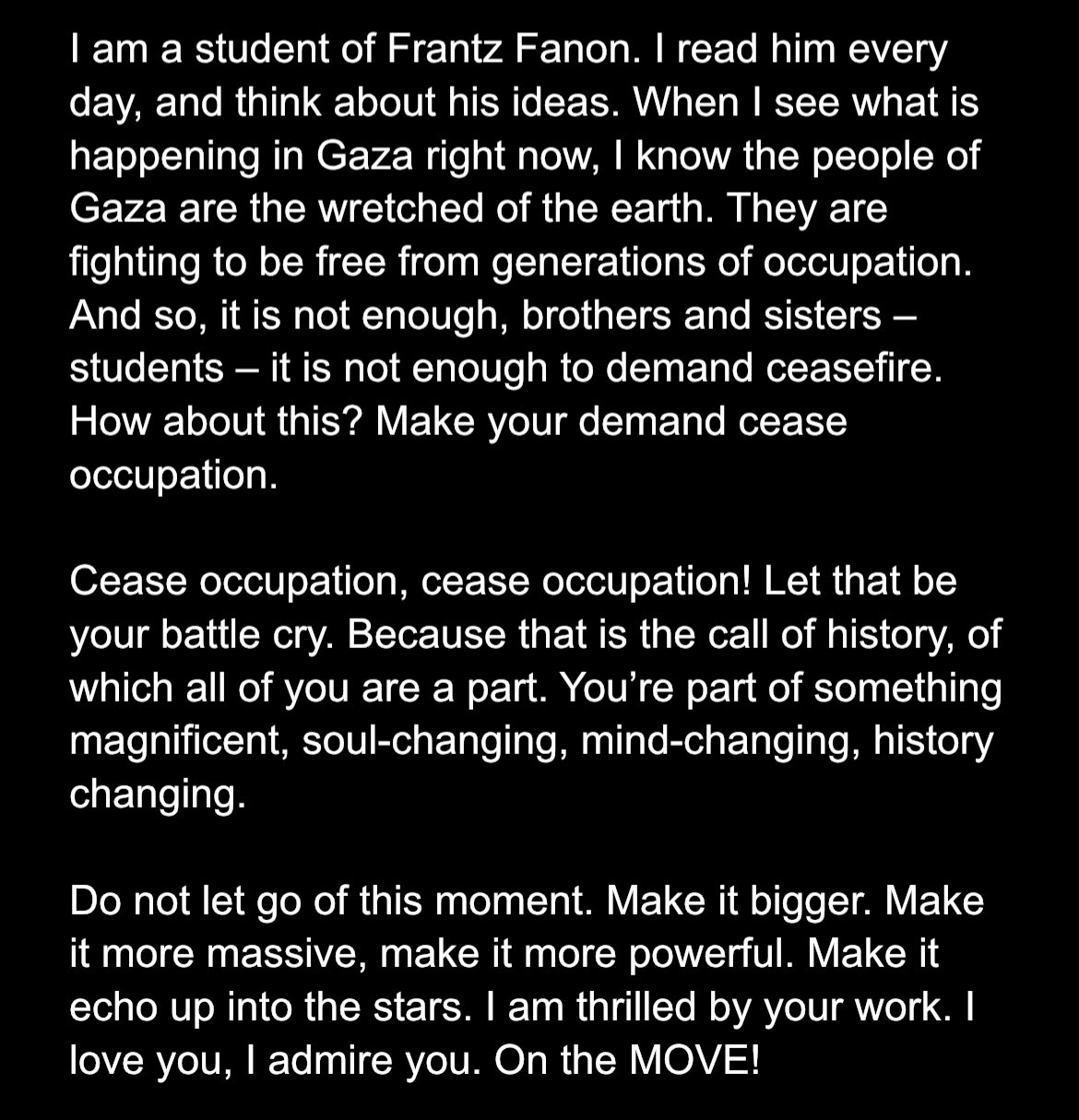
The National Council of Elders calls upon all people to embrace the courageous students demanding a ceasefire in Gaza, an end to the occupation of Palestine by the Israeli government, and the divestment of university funds that support weapons and War.

As veterans of the great liberation movements of the twentieth century, we understand that young people demanding justice and peace are critical to creating more compassionate, responsible societies. Their visions and values of the future are being practiced in encampments on campuses as they construct
communities to care for each other, to learn together, and to develop concrete processes for change.

The consciousness and sensibilities of today’s students has been shaped by actions stretching over the last decade. With Occupy Wall Street, climate justice actions, Me Too, and the Movement for Black lives, students have been demonstrating courage and tenacity in the face of ever escalating repression. Many are stepping forward for the first time and recognizing their power to create change.

Continue reading “The Courageous Students”

Beyond Religious Nationalism

By Rev. Graylan Scott Hagler

There are numerous organizations holding conferences and meeting, circulating petitions, making statements, and collecting prominent names to condemn Christian Nationalism. Coalitions and religious entities have been coalescing to resist what is being portrayed as an almost new and alarming phenomenon that is gripping the US’s cultural, political, and theological landscape with sharpened and ravenous claws. Though I fundamentally agree with those concerns I have some reservations about the timing and sense of urgency.

One of my questions is how closely are the concerns of these groups designed to coincide with the upcoming presidential elections? Is the timing of the objections, and the sense of urgency surrounding Christian Nationalism more allied with the Democratic Party instead of with the theological and ideological ethics and implications of Christian Nationalist in and of itself.

Continue reading “Beyond Religious Nationalism”

Utter Disregard

A Twitter thread from Willow Naomi Curry, a fellow with Boston Review Magazine who is figuring out her role in fighting fascism, labor exploitation, and environmental degradation while caring for herself and others. Follow her on Twitter at @willathewisp.

Watching everything that’s happening as a Gen Z-Millennial cusp (born in ‘96), I see what’s happening to youth on college campuses as, on top of everything else, the logical end point of decades of neglect of and vitriol towards children and young adults. 🧵🪡 

I was a preteen when the Aurora, Colorado movie theater shooting happened, and a 16-year-old high school student when the Sandy Hook Elementary School massacre happened. As I tried to adapt to a new normal of routine active shooter drills, and waiting for the day I might be next, 

I watched over and over again as Congress refused to do anything to stop children from being massacred at schools, putting gun lobby money over our lives. 

Later, as a college student, the backlash to trigger warnings and the infamous Coddling of the American Mind essay trivialized our legitimate protests of white nationalists being allowed platforms. 

Continue reading “Utter Disregard”

History Belongs to the Intercessors

What does it really mean to pray in this season of resisting settler-colonial violence? This is how Walter Wink articulated it in Engaging the Powers.

When we pray, we are not sending a letter to a celestial White House where it is sorted among piles of others. We are engaged in an act of co-creation, in which one little sector of the universe rises up and becomes translucent, incandescent, a vibratory center of power that radiates the power of the universe. History belongs to the intercessors, who believe the future into being. If this is so, then intercession, far from being an escape from action, is a means of focusing for action and of creating action. By means of our intercessions we veritably cast fire upon the earth and trumpet the future into being.

Shalom

Happy Passover. A shout out to all our Jewish friends and comrades who, over the past two hundred days, have modeled for us the true meaning of peace. This shalom has nothing to do with staying civil or steering clear of conflict in an aggressively unjust world. This shalom demands the health and harmony of the whole community. It is committed to collective liberation. The assurance that all God’s children will be protected and provided for — no matter what we look like, where we were born, who we love, or how we worship.

In the spirit of biblical shalom, we offer this story about a journalist asking Rabbi Abraham Joshua Heschel why he was attending a protest against the war in Vietnam. Heschel answered, “I am here because I cannot pray.” The journalist was annoyed and asked him what he meant. Heschel replied:

Whenever I open the prayerbook, I see before me images of children burning from napalm. Indeed, we forfeit the right to pray, if we are silent about the cruelties committed in our name by our government. In a free society, some are guilty, but all are responsible. How dare we come before God with our prayers when we commit atrocities against the one image we have of the divine: human beings?

Scandalous Money

Another compelling offering from the Faith and Money Network. Thank you to Bartimaeus Cooperative Ministries for passing this along.

Do you ever wonder about how early church thinkers viewed wealth and poverty? Have the messages on stewardship that you’ve heard from the pulpit sounded contradictory to Scripture — or have you not heard many messages from church leadership on money at all?

If you’re curious to learn more on your journey of connecting your financial decisions with your faith, we invite you to join us for a live webinar: Scandalous Money with Miguel Escobar.

Escobar is an author and director of strategy and operations at Episcopal Divinity School. His book, The Unjust Steward: Wealth, Poverty, and the Church Today, explores Christianity’s complicated and conflicted relationship with money. He will join us for a live Zoom webinar on Wednesday, April 24, from 7:00-8:30 pm Eastern.

Continue reading “Scandalous Money”