Giving Up The Trump Card

LilyFrom our interview with Dr. Lily Mendoza, the author (with her sister Leny) of Back From the Crocodile’s Belly (2013):

For me, the challenge of decolonization and re-indigenization demands a giving up of all forms of supremacy, including that of Christian supremacy—the claim to having the one right formula, the ultimate trump card, the final word. I know of many Christians who struggle with the notion that the Christian story is only one story among many. But I am all too familiar with the damaging effects of the more typical insistence that the Christian story is the only true one—no matter the attempts to wrap it in benevolent and compassionate missionary work. Can Christians engage with others on equal ground without pulling out the trump card in the end? Can they give up the trump card altogether?
Bees and the Great Economy

beesBy Dave Pritchet. Second post in a series on bees from the Wilderness Way, Portland, OR

For millenia, people around the world have noticed the economy of bees.  The Roman writers Virgil and Varro lauded bees for their thrifty behavior, and the Greek philosopher of economics Xenophon used them as an example of economic well-being.

For over 100 million years, bees have been evolving with plants, providing the service of pollination in return for nectar.  As the agents of genetic exchange for a host of plants, bees are at the heart of what Wendell Berry called the Great Economy.  Berry notes that if the biblical Kingdom of God includes all and that humans by default, whether they are aware or not, live within it, a modern rendering of the phrase would allude to the economy of nature. Thus, the “Great Economy” becomes shorthand for that which humans both live within and live by. Continue reading “Bees and the Great Economy”

Arrested Development

DSC00819 2By Tommy Airey

The hope of a secure and livable world lies with disciplined nonconformists who are dedicated to justice, peace and brotherhood.
Martin Luther King, Jr.

On a Wednesday morning last Spring, just a week shy of his 66th birthday, despite aching knees from decades pounding the basketball court, Bill powered up the three flights of stairs to my office in the old Episcopalian Church overlooking downtown Detroit. I knew something was stirring since he usually whips out his flip phone and sends me a text message if he needs anything while working in his makeshift cubicle downstairs—that, and his eye-of-the-tiger stare down he gave me when he arrived breathless. Obviously, it was game day.
Continue reading “Arrested Development”

Learning from Laughter: Wedding Veils and Wrestling

familyBy Lydia Wylie-Kellermann.

Isaac pulls a green sheet off the floor puts it over his head and says “You getting married.” (He still refers to himself as “you”). He brings Patrick, the life-size stuffed dog out of his room and stands him up to pretend they are getting married. I don’t know where he got the idea, but all I can do is smile and say “You look beautiful.”
Continue reading “Learning from Laughter: Wedding Veils and Wrestling”

We Must Find Our Feet Again

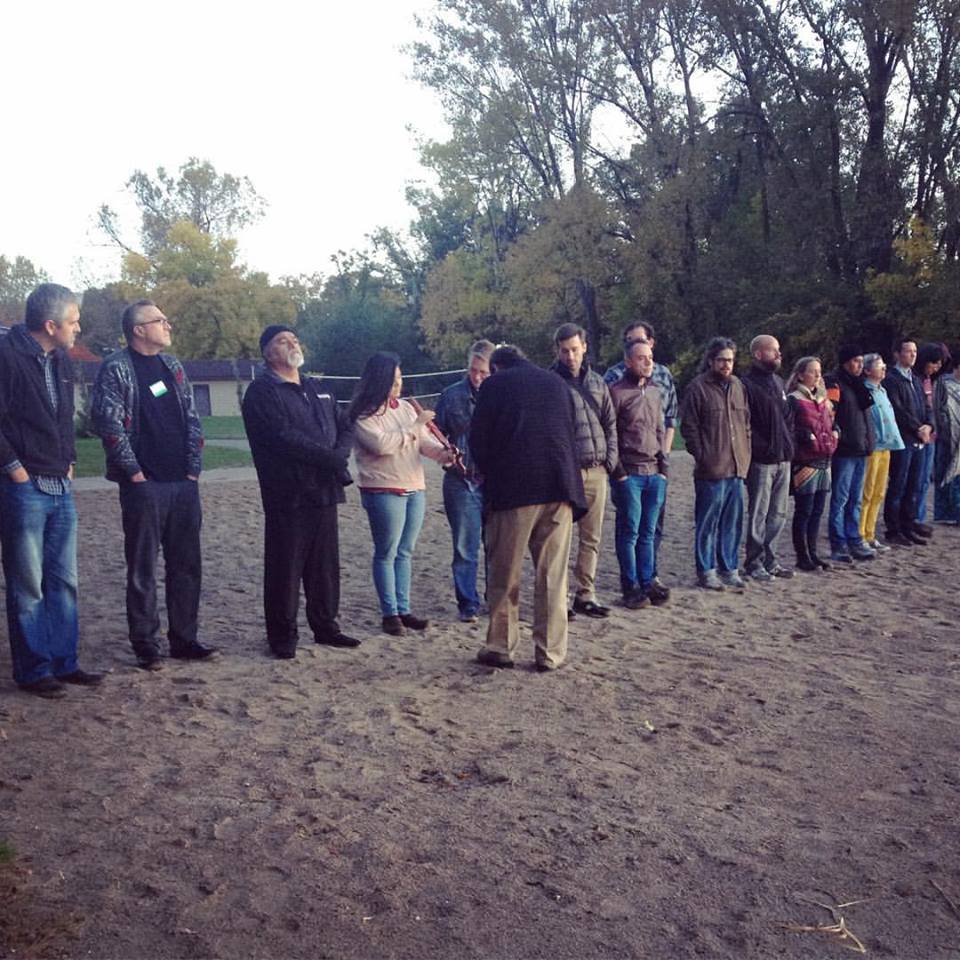
Sunrise Pipe CeremonyBy Ric Hudgens, after the morning session at Identity, Theology, and Place: Reinhabiting the Mississippi Watershed inspired by Ched Myers, Elaine Enns, Tevyn East, and Jay Beck (photo by Sarah Amalia Holst, sunrise pipe ceremony)

Artifice will not save us.
Neither a technological
escape hatch to Mars
nor a booby hatch with
Jesus in the clouds.
A world of our own creation
collapses all around us
crushing the stranger who
seeks no other home. The
World under our world holds
forth but longs for our tears.
We must find our feet again.
The grief with no name
suffocates the real.
Hear no truth. Speak no
truth. See no truth.
We must find our feet again;
not paved roads nor
graveled paths, but
dirt, soil, humus, the mud
from which we came.
Take off your shoes.
We stand, if we will stand
at all, on holy ground.

A Web of Interconnected Lives

farm workersFrom Daniel Rothenberg in With These Hands: The Hidden World of Migrant Farmworkers Today:

When we reach into a bin to choose an apple, orange or plum, our hands stretch out in much the same way as a farmworker’s hands—harvesting our nation’s fruits and vegetables, piece by piece. While the produce may have been mechanically sorted and packed, supercooled, chemically treated, waxed, and shipped hundreds, if not thousands, of miles, often the last hand to touch the fruits and vegetables we buy was that of a migrant farmworker. Through the simple act of purchasing an orange or a head of lettuce, we are connected with a hidden world of laborers, a web of interconnected lives, with hands on both ends.

Witnessing

12009754_1646585842290454_7763670513119376666_nBy Cait De Mott Grady. Cait De Mott Grady grew up in the Ithaca Catholic Worker Community in Ithaca, NY and has been working as an organizer on political and environmental campaigns since graduating from college in 2012. Cait moved to Detroit this past June and is inspired and humbled by all the people who work to make the Beloved Community a reality.

Do not be daunted by the enormity of the world’s grief.
Do justly, now.
Love mercy, now.
Walk humbly, now.
You are not obligated to complete the work,
but neither are you free to abandon it.
– The Talmud

I woke up early this morning to darkness and I lay there listening to night sounds – a chorus of crickets and cicadas, punctuated by the occasional engine roar or dog bark. I lay there listening and thinking of my dear friend who is facing a terminal Leukemia diagnosis. I thought about how grateful I am for his life and our friendship and how I desperately want to know that he will be by my side in the coming years, questioning, organizing, marching, imagining, and loving. Continue reading “Witnessing”