A Twitter thread from Willow Naomi Curry, a fellow with Boston Review Magazinewho is figuring out her role in fighting fascism, labor exploitation, and environmental degradation while caring for herself and others.Follow her on Twitter at @willathewisp.
Watching everything that’s happening as a Gen Z-Millennial cusp (born in ‘96), I see what’s happening to youth on college campuses as, on top of everything else, the logical end point of decades of neglect of and vitriol towards children and young adults. 🧵🪡
I was a preteen when the Aurora, Colorado movie theater shooting happened, and a 16-year-old high school student when the Sandy Hook Elementary School massacre happened. As I tried to adapt to a new normal of routine active shooter drills, and waiting for the day I might be next,
I watched over and over again as Congress refused to do anything to stop children from being massacred at schools, putting gun lobby money over our lives.
Later, as a college student, the backlash to trigger warnings and the infamous Coddling of the American Mind essay trivialized our legitimate protests of white nationalists being allowed platforms.
What does it really mean to pray in this season of resisting settler-colonial violence? This is how Walter Wink articulated it in Engaging the Powers.
When we pray, we are not sending a letter to a celestial White House where it is sorted among piles of others. We are engaged in an act of co-creation, in which one little sector of the universe rises up and becomes translucent, incandescent, a vibratory center of power that radiates the power of the universe. History belongs to the intercessors, who believe the future into being. If this is so, then intercession, far from being an escape from action, is a means of focusing for action and of creating action. By means of our intercessions we veritably cast fire upon the earth and trumpet the future into being.
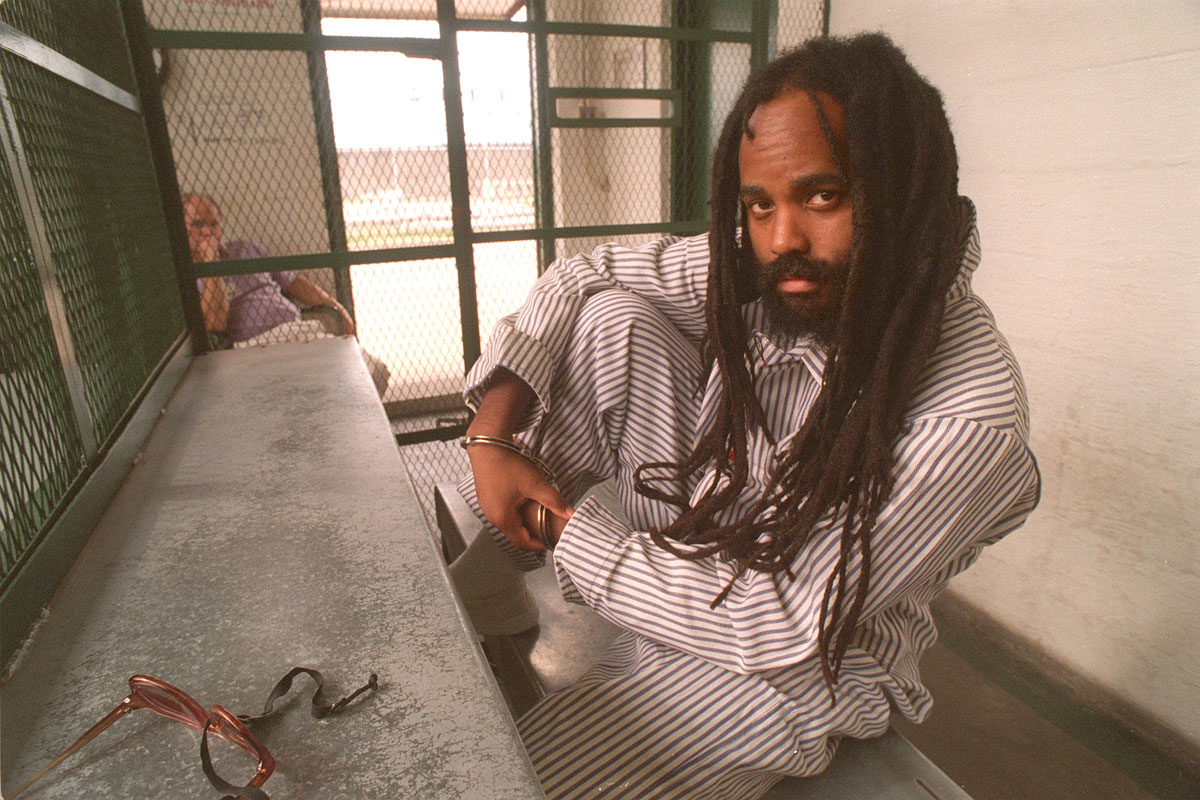
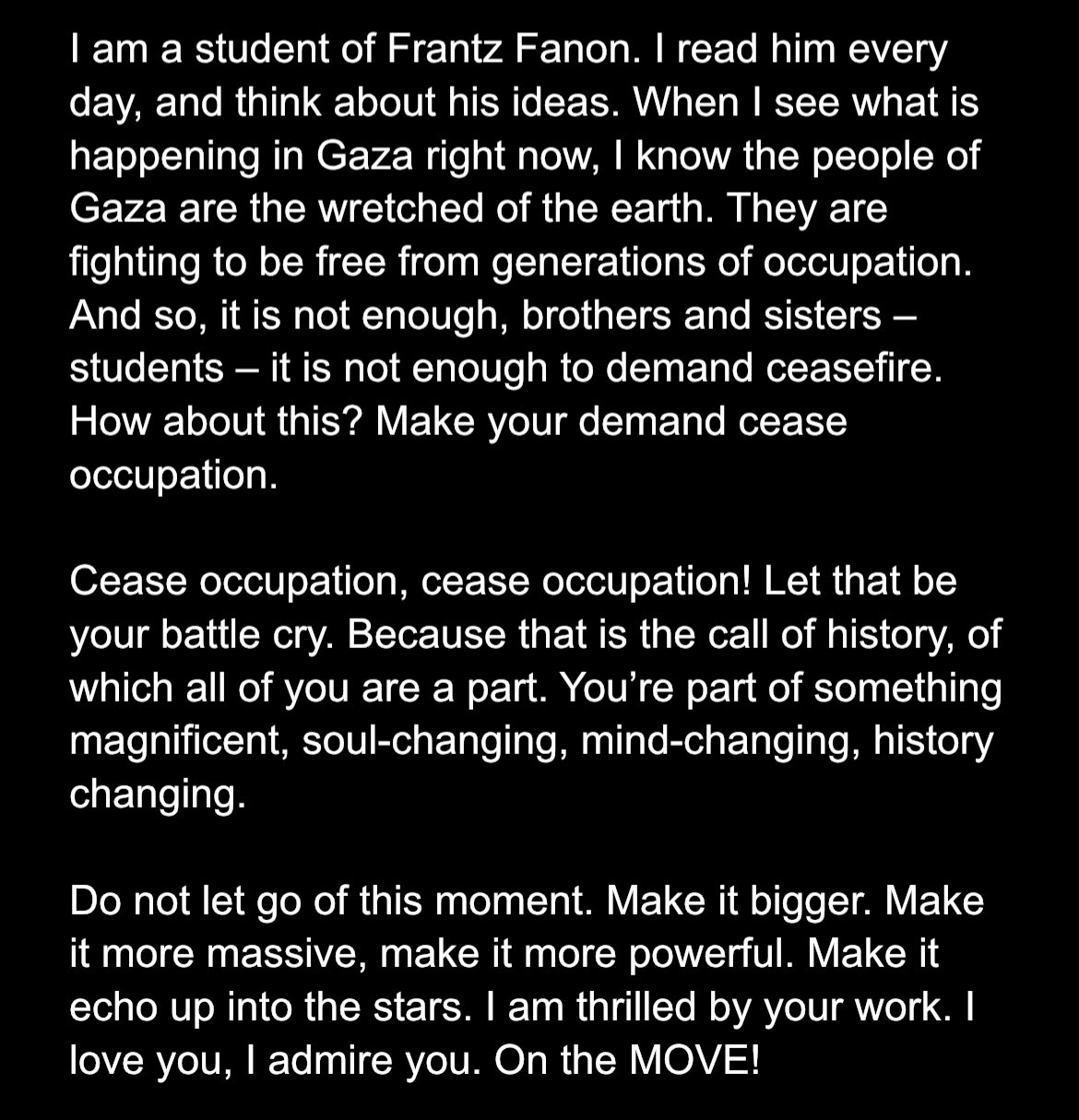
Sophie Hurwitz transcribed the first ~3 minutes of Mumia Abu-Jamal’s call from prison with the students of the CUNY Gaza solidarity encampment. The imprisoned journalist and former Black Panther has been jailed for over 42 of his 70 years.
Happy Passover. A shout out to all our Jewish friends and comrades who, over the past two hundred days, have modeled for us the true meaning of peace. This shalom has nothing to do with staying civil or steering clear of conflict in an aggressively unjust world. This shalom demands the health and harmony of the whole community. It is committed to collective liberation. The assurance that all God’s children will be protected and provided for — no matter what we look like, where we were born, who we love, or how we worship.
In the spirit of biblical shalom, we offer this story about a journalist asking Rabbi Abraham Joshua Heschel why he was attending a protest against the war in Vietnam. Heschel answered, “I am here because I cannot pray.” The journalist was annoyed and asked him what he meant. Heschel replied:
Whenever I open the prayerbook, I see before me images of children burning from napalm. Indeed, we forfeit the right to pray, if we are silent about the cruelties committed in our name by our government. In a free society, some are guilty, but all are responsible. How dare we come before God with our prayers when we commit atrocities against the one image we have of the divine: human beings?
Do you ever wonder about how early church thinkers viewed wealth and poverty? Have the messages on stewardship that you’ve heard from the pulpit sounded contradictory to Scripture — or have you not heard many messages from church leadership on money at all?
If you’re curious to learn more on your journey of connecting your financial decisions with your faith, we invite you to join us for a live webinar: Scandalous Money with Miguel Escobar.
Escobar is an author and director of strategy and operations at Episcopal Divinity School. His book, The Unjust Steward: Wealth, Poverty, and the Church Today, explores Christianity’s complicated and conflicted relationship with money. He will join us for a live Zoom webinar on Wednesday, April 24, from 7:00-8:30 pm Eastern.
By Tawfiq Zayyad, the mayor of Nazareth until his sudden death in 1994
In Lidda, in Ramla, in the Galilee, we shall remain like a wall upon your chest, and in your throat like a shard of glass, a cactus thorn, and in your eyes a sandstorm.
“The idea of sumud has become a multifaceted cultural concept among Palestinians: it means steadfastness, a derivative of “arranging” or “saving up”, even “adorning”. It implies composure braided with rootedness, a posture that might bend but will not break.” – Hala Alyan
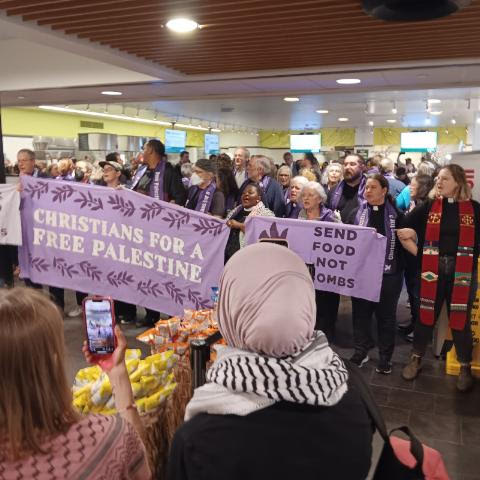
This week, on the anniversary of the execution of Dietrich Bonhoeffer, I watched my spouse get arrested. Lindsay joined dozens of other members of Christians for a Free Palestine publicly calling out the role of the American government and American churches in supporting the apartheid state of Israel’s decades-long occupation and blockade of Gaza, now spiraling into a genocide. After a short worship service of confession, communion and commission under a Magnolia tree a stone’s throw from the Capitol in DC, these parents, professors, engineers, social workers, retired seniors, seminary students and ordained ministers bee-lined for the cafeteria in the basement of the US Senate building. They planned to get “lunch” together.
The cafeteria was crowded and noisy. The Jesus people were ready to turn over tables. But they walked in casually, blended right in, played cool, waiting for their cue. Then, a few of the faithful started singing.
Palestine will be free. Palestine will be free We will not avert our eyes. Palestine will be free.
Over and over again. They rose from their seats and walked to the front of the line and locked arms behind banners that read Send Food Not Bombs and Christians for a Free Palestine and Woe to you who Slay the Hungry and Break Bread not Bodies. They stood in front of the cashiers to block customers from paying. They locked arms, connecting the dots and telling the truth together with loud, coordinated chants. It was more than a symbolic action. If American leaders won’t let Gaza eat, then they don’t deserve to eat lunch. A minor inconvenience compared to forced starvation.
***
In that moment, I was reminded of something I once heard from Lindsay, who not only has a criminal record, but is also a licensed marriage and family therapist. These two credentials are connected. The year after Minneapolis police murdered George Floyd, she told me that whenever we repress or guard or just go along to get along with something that is counterfeit, then the counterfeit will inevitably come out sideways. If we stay silent in the face of injustice, exploitation and oppression built on disinformation, myths and lies, then it will do something serious to the deepest parts of who we are. Because the soul is a web that connects everyone to everything else.
Living otherwise means living according to the Great Economy.
Wendell Berry’s notion of the Great Economy contrasts with what he terms the Little Economy. The Little Economy is the industrial, globalized economic system that prioritizes profit and exploitation of resources over sustainability and community well-being. Berry’s discussion of the Great Economy is a central theme in his critique of contemporary society and his vision for a more sustainable and harmonious way of living.
The Little Economy has had detrimental effects on our environment, local community, and the human spirit. The Great Economy reveals the interconnectedness of economy, ecology, and culture. In some places, Berry literally equates the Great Economy with what Jesus called the kingdom of God. (See the essay “Two Economies” in The Art of the Commonplace: Agrarian Essays, 2003).






 Radical Discipleship