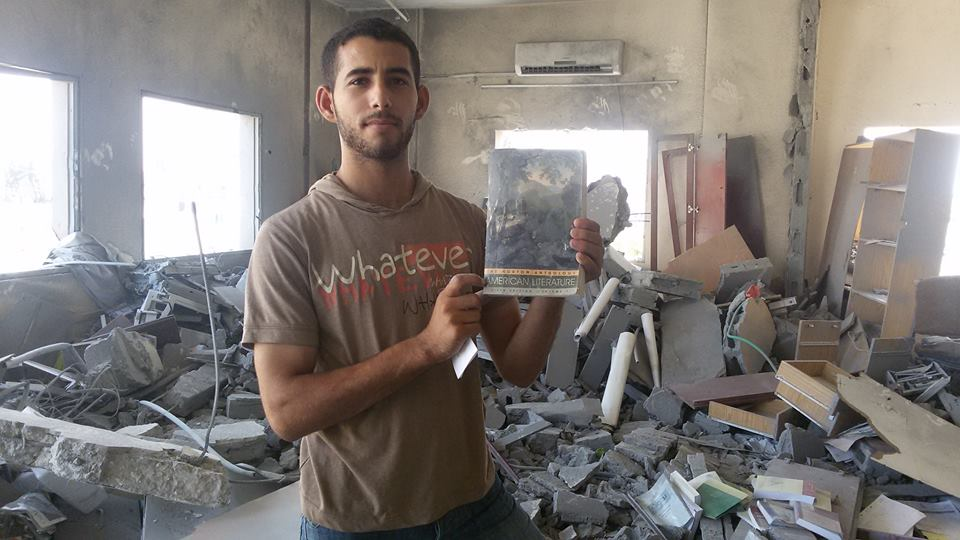
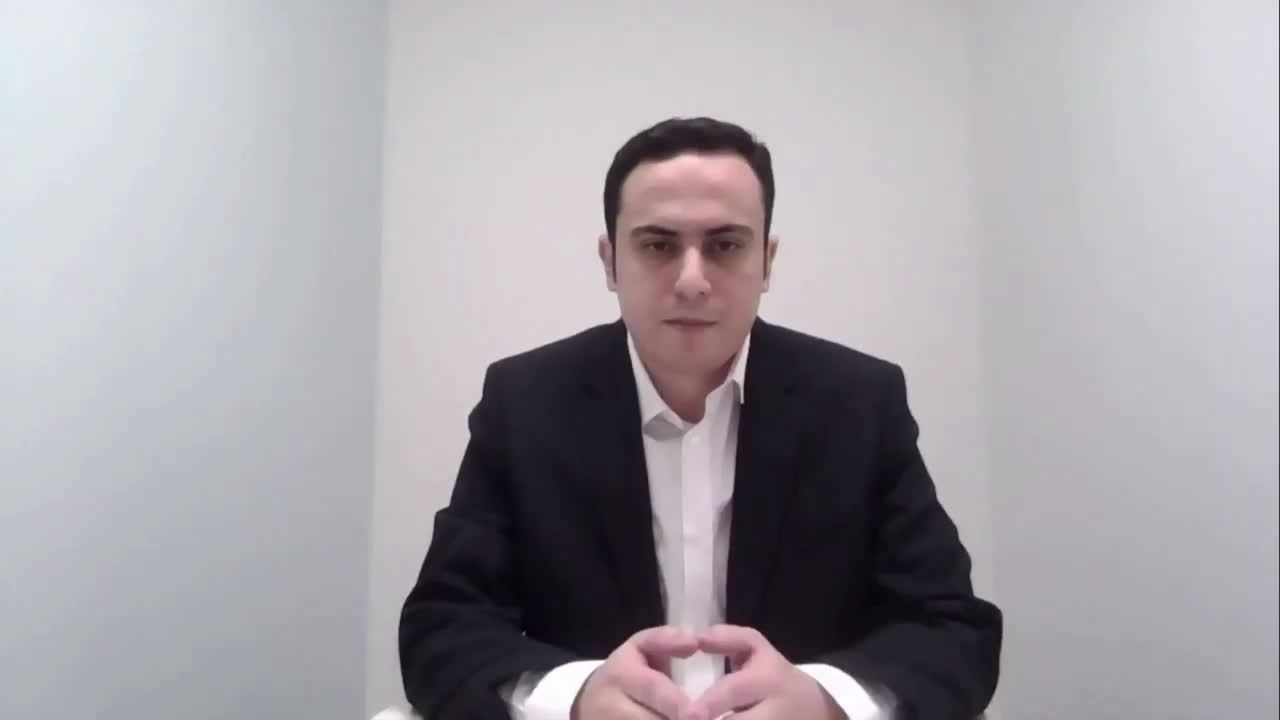
From Ahmed Alnaouq (above), a Palestinian journalist based in London and the co-founder of We Are Not Numbers. Originally posted to Twitter on November 17, 2023.
I will never ever forget you. I will never forgive your killers. And I will keep your memory alive.
By Zeina Azzam, a Palestinian American poet, writer, editor, and community activist. Thank you to Linda Sarsour for posting on social media.
Write my name on my leg, Mama Use the black permanent marker with the ink that doesn’t bleed if it gets wet, the one that doesn’t melt if it’s exposed to heat
Write my name on my leg, Mama Make the lines thick and clear Add your special flourishes so I can take comfort in seeing my mama’s handwriting when I go to sleep
a little Palestinian boy, walking to school in Gaza encountered an Israeli soldier driving a U.S. – made tank Looking up into the soldier’s eyes, the little boy said, “Mr. American President, when you look at me, would you say he could have been my son, like President Obama said of Trayvon Martin
meanwhile, a little black girl, in a studio apartment in north St. Louis waiting for her father to pour milk into her bowl of captain crunch cereal, turned her gaze toward the tv, where images of fire and smoke rained down on gaza “daddy,” she said, “is god blue?”
An open letter from a coalition of anti-occupation Jewish students at Brown University. Re-posted from The Brown Daily Herald (November 7, 2023)
“Solidarity is the political version of love.” – Jewish feminist activist Melanie Kaye/Kantrowitz
As of today, it has been a month since the Oct. 7 attacks that have dominated global political consciousness and discourse, not to mention our experiences as young Jewish people. Zionist institutions purport to be representative of all Jews, often using us as a rhetorical shield to support the unconscionable actions of the state of Israel. We feel a particular pain as Jews having to continuously justify our stance against genocide. We are here to make ourselves clear: We stand in solidarity with Brown Students for Justice in Palestine and the Palestine Solidarity Caucus in the pursuit of the liberation of Palestinian peoples. We know intimately that Jewish struggles are necessarily bound up in global struggles for freedom. We are a group of Jewish students who have coalesced around our shared vision of justice, anti-occupation, liberation and community. We ask you to listen to us now:
1. What do we mean when we say, “from the river to the sea”?
“From the river to the sea, Palestine will be free” is not a call for the forced removal of Jews from Palestine or, as it is commonly misconstrued, a call to “throw Jews into the sea;” instead, it is a call for the end to the oppression of all Palestinians — in Gaza, the West Bank and within the Green Line. Liberating all of Palestine requires revolutionary change: not an eradication of Jews from the land, but a total dismantlement of the apartheid regime occupying it. The assumption that this phrase is inherently genocidal falsely conflates liberation with the annihilation of each citizen of the oppressive state and ignores its liberatory intent. Within this conflation, we hear a racist assumption that Palestinians are ruthless “animals” and an intentional obscuring of the violent intent of a neo-fascist government — a characterization shared even by writers in Israel’s newspaper of record. It is not only blatantly false but obscene to frame a call for liberation and justice as genocidal while Israel is carrying out genocide in Gaza funded by billions of American tax dollars. If calling for a future in which Palestinians can live in their homeland unshackled implies an existential threat to the Zionist ideology, it is that ideology that must be called into question — not the call for liberation.
By Hiba Abu Nada. Re-posted from Protean Magazine. This poem was written on October 10th and is among the last pieces she composed before being martyred by an Israeli airstrike on October 20th. Huda Fakhreddine translated it from the original Arabic.
1. I grant you refuge in invocation and prayer. I bless the neighborhood and the minaret to guard them from the rocket
from the moment it is a general’s command until it becomes a raid.
“They should go, as should the physical homes in which they raised the snakes. Otherwise, more little snakes will be raised there.” —Ayelet Shaked
Think of all the calla lilies. Think of all the words that rhyme with calla. Isn’t it a miracle that they come back? The flowers. The dead. I watch a woman bury her child. How? I lost a fetus and couldn’t eat breakfast for a week. I watch a woman and the watching is a crime, so I return my eyes. The sea foams like a dog. What’s five thousand miles between friends? If you listen close enough, you can hear the earth crack like a neck. Be lucky. Try to make it to the morning. Try to find your heart in the newsprint. Please. I’d rather be alive than holy. I don’t have time to write about the soul. There are bodies to count. The news anchor says oopsie. The Prime Minister says thanks. There’s a man wearing his wedding tuxedo to sleep in case I meet God and there’s a brick of light before each bombing. I dream I am a snake after all. I dream I do Jerusalem all over again. This time, I don’t shake my hair down when the soldier tells me to. I don’t thank them for my passport. Later my grandfather said they couldn’t have kept it. You know that, don’t you? I don’t know what they couldn’t do. I only know that enormous light. Only that roar of nothing, as certain and incorrect as a sermon.
Hala Alyan is the author of the novel Salt Houses, winner of the Dayton Literary Peace Prize and the Arab American Book Award, and a finalist for the Chautauqua Prize. Her latest novel, The Arsonists’ City, was a finalist for the 2022 Aspen Words Literary Prize. She is also the author of four award-winning collections of poetry, most recently The Twenty-Ninth Year. Her work has been published by The New Yorker, The Academy of American Poets, Lit Hub, The New York Times Book Review, and Guernica. She lives in Brooklyn, where she works as a clinical psychologist and professor at New York University.
By Rev. Graylan Scott Hagler, re-posted from Mondoweiss, a source of news and opinion on Palestine, Israel and the US
The Bishop William Barber, II, of the Poor People’s Campaign wrote an Op-Ed that appeared in The Guardian on October 13, 2023, entitled, “We must say an emphatic ‘no’ to Hamas a thousand times“. I feel compelled to respond to that Op-Ed. I am hesitant to challenge a friend and a colleague, but on this issue, I must.
I understand Rev. Barber’s need to thread the needle, but in a time like this, we need truth-telling and not outrage when it is politically expedient to do so. As Bishop Barber decries and mourns the killings and atrocities carried out by Hamas, he makes the same error that he has made in the past, by diminishing — and at times ignoring the horrendous history of settler colonialism endured by Palestinians. I am not suggesting equivocation, where a massacre by Hamas in Israel is justified by the long history of Palestinian dispossession and oppression. But I am advocating for the consistent and equal acknowledgment of the long pain and suffering of the Palestinian people. Rev. Barber has not done that historically or even in the structure of his Op-Ed, where he mentions Palestinian suffering in a secondary position to the recent attacks upon Israel.
Rev. Barber seems to want to excuse 75 years of oppression and harm perpetuated by the Israeli regime and aided by a general silence from the world. Through the years, Israelis, Palestinians, Muslims, Christians, and Jews have worked to draw attention to the gross violence and injustices of Israeli occupation. Yet, it seemed that the world was not interested in war crimes, or the genocidal pogroms carried out against the Palestinians. In most cases, the death of a Palestinian child, or the eviction of a Palestinian family did not even amount to a footnote in the concerns of the U.S. government or many religious leaders, including Rev. Barber. Click here to read the rest on Mondoweiss.
I am re-reading Rev. Dr. Martin Luther King’s “Letter from a Birmingham jail.” MLK wrote the letter 60 years ago to white Christian and Jewish leaders. He lamented their lukewarm acceptance of the racist system. He lamented that they were more interested in order than justice – and that they were content with a kind of peace that forced the oppressed to accept their plight. MLK explained that the nonviolent actions that got him arrested were not creating tension, but simply bringing to the surface the tension that was already there for too long.
This letter is coming to life in those resisting the occupation of Palestinian land and the genocide of Palestinian people. MLK wrote that the movement for Black freedom was turning the monologue into a dialogue. The old Zionist monologue that mutes and cancels anyone with an opposing perspective is fading fast. People of faith and conscience are demanding a real dialogue about this situation. They are breaking the rules of what can be talked about in their families, faith communities, campuses, corporate media outlets and the Democratic Party.
Originally posted here. Click on and sign the petition.
“Learn to do right; seek justice; defend the oppressed” (Isa 1:17).
We, at the undersigned Palestinian Christian institutions and grassroots movements, grieve and lament the renewed cycle of violence in our land. As we were about to publish this open letter, some of us lost dear friends and family members in the atrocious Israeli bombardment of innocent civilians on October 19, 2023, Christians included, who were taking refuge in the historical Greek Orthodox Church of Saint Porphyrius in Gaza. Words fail to express our shock and horror with regard to the on-going war in our land. We deeply mourn the death and suffering of all people because it is our firm conviction that all humans are made in God’s image. We are also profoundly troubled when the name of God is invoked to promote violence and religious national ideologies.
Further, we watch with horror the way many western Christians are offering unwavering support to Israel’s war against the people of Palestine. While we recognize the numerous voices that have spoken and continue to speak for the cause of truth and justice in our land, we write to challenge western theologians and church leaders who have voiced uncritical support for Israel and to call them to repent and change. Sadly, the actions and double standards of some Christian leaders have gravely hurt their Christian witness and have severely distorted their moral judgment with regards to the situation in our land.