Something to think about from Dr. Nicole LePera, the author of How To Do The Work
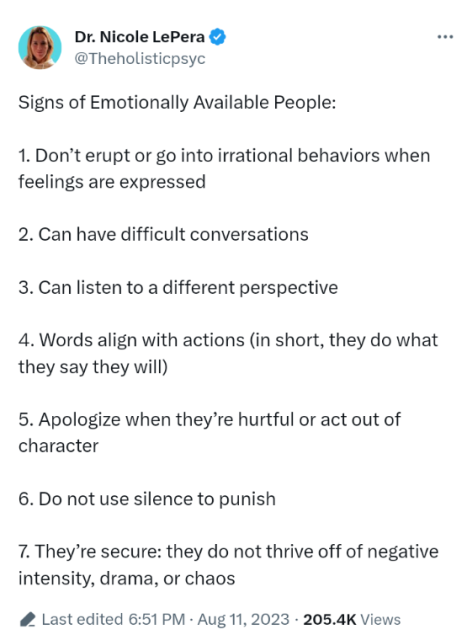

Something to think about from Dr. Nicole LePera, the author of How To Do The Work

A new offering from the Alternative Seminary.
A FIVE-WEEK ONLINE COURSE
September 13 – October 11, 2023
Wednesday evenings, 7:00 – 9:00 pm
We have come through a global virus, but our world is still in desperate need of healing.
Severe poverty and deepening divides of income, war and violence, racism and other forms of hatred and systemic discrimination, a ravaged creation: All of these cry out for healing – but what is the healing we need? As we emerge from the global pandemic, how does this moment of deep societal vulnerability force us to ask deeper questions about who we are and what kind of world we need? And how do we engage in self-healing practices?
For five weeks, we will explore together several Gospel accounts of Jesus’ healings, reflecting on how these stories speak to our society and world. We will reflect on ways we are all in need of healing and how we can be empowered to be faithful disciples and healers in this time of manifold crises.
Continue reading “Gospel Healing in a World of Suffering”
A message from our comrades at Kirkridge Retreat and Study Center.
Do you know about Kirkridge Retreat and Study Center?
With a long, storied activist history (Dan and Phillip Berrigan had a favorite room and frequently led retreats and organized actions there) and an 80-year history of supporting LGBTQI Christians, it’s the kind of place radical disciples should know about. And there are a number of retreats coming up that you might be interested in attending:
Laurel Dykstra on Wilderness Prophets and the Climate Crisis
September 29-October 1
Come explore how the wilderness prophets are relevant to spiritual care and action in a time of climate crisis and discern your own prophetic call for this time. We’ll read scripture, engage scripture and spend time in contemplation in the more-than-human world
Continue reading “This Fall at Kirkridge”
By Caitlin Johnstone, an author writing about the end of all illusions, re-posted from substack
One of the great challenges faced by westerners who oppose the political status quo today is the way the narrative managers of both mainstream factions continuously divert all political energy away from issues which threaten the interests of the powerful like economic injustice, war, militarism, authoritarianism, corruption, capitalism and ecocide and toward issues which don’t threaten the powerful at all like abortion, racism, sexism, homophobia and transphobia.
This method of social control serves the powerful in some very obvious ways, and is being used very effectively. As long as it remains effective, it will continue to be used. The worse things get the more urgent the need to fight the class war will become, anf the more urgent the need to fight the class war becomes the more vitriolic and intense the artificial culture war will become in order to prevent political changes which inconvenience the powerful. This is 100 percent guaranteed. And what’s tricky is that all the vitriolic intensity will create the illusion that the culture war has gotten more important, when in reality the class war has.
Continue reading “Disrupt the Culture Wars”
By Johari Jabir
Honoring the nine martyred priests of Mexico
When I was just a boy in the king’s court, I overheard the king say to the merchants of death: “Kill the priests first. They are the village vanguard.” The fact that our king would betray his own came of no surprise to us, little boys in his harem whose small bodies he touched night after night. Yet, it was the priests who made sure our infinity remained untouchable.
Every evening ‘round midnight, in slow solemn procession, shamans, sages, and priests circled the edges of the village sprinkling water crystals, wafting sweet incense, tossing kisses at the moon, and touching the tree leaves with their fingers, turning them into green lanterns. Out of all the sacred specialists, it was the priests who translated our collective moans and counted, one-by-one, the tears in god’s face.
Continue reading “Priests – The Village Vanguard”
This is an excerpt of an interview Orion Magazine does with Dave Pritchett, the author of Mossback: Ecology, Emancipation, and Foraging for Hope in Painful Places. Here, Pritchett responds to a question about the meaning of his title and his key inspirations to reclaim the word.
Well I love the word. I first heard the term used, I think, in high school when I lived in Arkansas by fishers to describe big old fish or turtles that had algae growing on their backs. In research for the book, I came across the term describing Confederates who evaded the draft by hiding out. The word was really evocative and multilayered, and when I dug further into its use and etymology, I found that it seemed to be a derogatory term sort of like the more modern “redneck,” and there is some suggestion that it came from the Carolina swamps and used in that same disparaging way to describe poor folks who were so slow moving that they had moss growing on their backs. I was really taken when I found a report during the Reconstruction period after the Civil War recounting a gun fight between the Ku Klux Klan and a group called the “Mossy-backs.” So for me, the word conjures a complex meaning with allusions of ecological connection, but also perhaps an unwillingness to fight wealthy people’s wars or to tolerate explicitly white supremacist institutions. That’s the sort of backwardness I can get behind. I found “mossback,” with its multivalent meaning really helpful, since I’ve been looking for metaphors that contribute to the somewhat odd admixture of ecological well being with racial and economic analysis that the word connotes. Of course, I’m doing some fanciful reading, as it’s highly unlikely that the Mossy-backs had a robust racial analysis, or that Confederate deserters were thinking much beyond themselves and their families. But I want to reclaim the word and use it insofar as it moves us toward the kind of environmental and racial solidarity that I believe our times require.
Read the entire interview here. It’s really really good.
David Pritchett is author of Mossback: Ecology, Emancipation, and Foraging for Hope in Painful Places. He works in emergency medicine, and he holds a diploma in mountain medicine and is certified in track and sign.
By Dwight L. Wilson
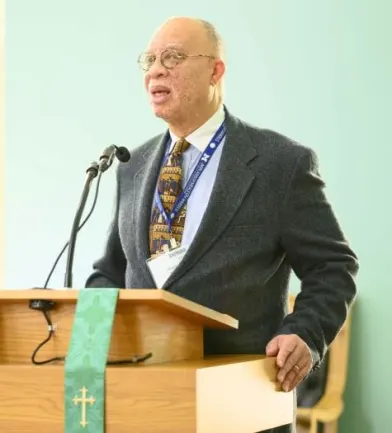
I am the official historian for my maternal grandfather’s side of the family. Last week I was in Charleston, South Carolina where I was asked to give the major address to the Mack/ Kinney/ Rogers Family Reunion (Mom was born a Mack) This week, although not the official historian, I was asked to give the keynote to my maternal grandmother’s family at the Haynes Family Reunion (her mom was born a Haynes). It was held in Dayton, Ohio. Both gatherings trace their families from an enslaved couple who came to adulthood in Northeastern Georgia. I’ve counted those on the first tree. We number over 5000. There are more surnames on the second tree but I haven’t counted people. My guess is they number even more. Each time I read this psalm.
PSALM 40023
Through You we have known bright elation
where glorious victory lights the way.
Our smiles mirror Jesus on the Mount
smiling at those who dared to believe.
Lest we forget where we arrived
after the Middle Passage to a Hell
calling itself, “The land of the free”
remind us of ancestral pain.
Dear One, You delivered us into hope
that our descendants will walk on water
until they arrive at Your great mountain
and united, continue the climb.
Dwight L. Wilson is a Quaker who has held many jobs: educator, administrator, religious leader. In each role, he worked to advance equality, opportunity and understanding. He continues this work in his carefully researched historical fiction series Esi Was My Mother, which follows the lives of an enslaved black family from 18th century Africa to the American Civil War. He strives to portray triumphant examples of black stories that will make history come alive for readers. He is also author of two short story collections, The Kidnapped and The Resistors as well as a memoir centered on caring for children, Whispering to Babies and two psalms books: Modern Psalms In Search of Peace and Justice and Modern Psalms of Solace and Resistance.

By Ric Hudgens, a pastor and author rooted in Northern Illinois
*Note: Three years ago as the covid pandemic was just picking up speed we observed the funeral of John Lewis. I wrote this essay that week. The lessons abide.
The funeral of John Lewis at Ebenezer Baptist Church last week was like an event from another world. Lewis was literally on the frontlines of some of the most remarkable years in our nation’s history. He not only lived a long life (“longevity has its place” said Dr. King, who was killed at 39), but remained engaged, relevant, and prophetic to the end. Case in point perhaps, the editorial Lewis wrote for publication on the day of his funeral (“Together We Can Redeem the Soul of America,” New York Times, July 30, 2020).
Everyone gathered in that historic church where King, Jr, and King, Sr were once ministers (and Rev. Raphael Warnock so ably serves today). I watched the entire service remotely, yet savoring the familiar contours of Black Baptist funerals. Despite the pandemic, everyone was masked, and microphones were switched after each speaker. It was a funeral, much like many others I’ve attended—unique perhaps only by the guests’ notoriety and the length of the service.
Continue reading “Enobling, Prophetic Faith”
By Johari Jabir.
Elegy for Sinead
(1966 – 2023)
every child has a dream,
like a hummingbird born to sing
everything god made is free,
everything like you and me
trouble don’t last always – Sinead.
hope to see you in the land of perfect day.
where every day is howdy howdy
never goodbye, and the mist is rolled away.
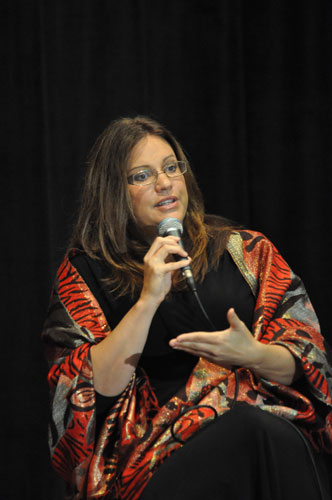
A brilliant Twitter thread from Alisa Lynn Valdes, M.S., an author, journalist and film producer from New Mexico
This quote, from the @nytimes review of the OPPENHEIMER film: “He served as director of a clandestine weapons lab built in a near-desolate stretch of Los Alamos, in New Mexico”…
It was inhabited by Hispanos. They were given less than 24 hr to leave. Their farms bulldozed.
Many of those families had been on the same land for centuries. The Oppenheimer’s crew literally shot all their livestock through the head and bulldozed them. People fled on foot with nowhere to go. Land rich, money poor. Their land seized by the government.
All of the Hispano NM men who were displaced by the labs later were hired to work with beryllium by Oppenheimer. The white men got protective gear. The Hispano men did not.
Continue reading “A Remarkable Whistleblower” Radical Discipleship