Spring Sauntered North

On Juneteenth, we open up Toni Morrison’s Beloved. This passage comes right after Indigenous people, who refused to move to the reservation, cut off the shackles of Paul D, a man who escapes slavery and stays with them in the Southern woods.

“Paul D finally woke up and, admitting his ignorance, asked how he might get North. Free North. Magical North. Welcoming, benevolent North. The Cherokee smiled and looked around. The flood rains of a month ago had turned everything to steam and blossoms. 

‘That way,’ he said, pointing. ‘Follow the tree flowers,’ he said, ‘Only the tree flowers. As they go, you go. You will be where you want to be when they are gone.’ 

So he raced from dogwood to blossoming peach. When they thinned out he headed for the cherry blossoms, then magnolia, chinaberry, pecan, walnut and prickly pear. At last he reached a field of apple trees whose flowers were just becoming tiny knots of fruit. Spring sauntered north, but he had to run like hell to keep it as his traveling companion.”

True Prophets

An excerpt from a 1993 interview with Walter Brueggemann entitled “Why Prophets Won’t Leave Well Enough Alone.” Thank you Rev. John Maine (Kitchener, Ontario) for passing it along!

I believe the large truth surrounding us today is that the white, male, Western, colonial hegemony has collapsed by the mercy of God.  The collapse of that hegemony means that we have a chance to reorganize and reconfigure all social relationships.  True prophets are prophets who act in the direction of that collapse and are working at reorganizing social relationships, and false prophets are people who want to keep pretending that they can jack up the white, male hegemony and keep it going.  The pastoral task, then, is to help people face the reality of the collapse and relinquish those old assumptions of privilege, priority, and power

Under a Deadline

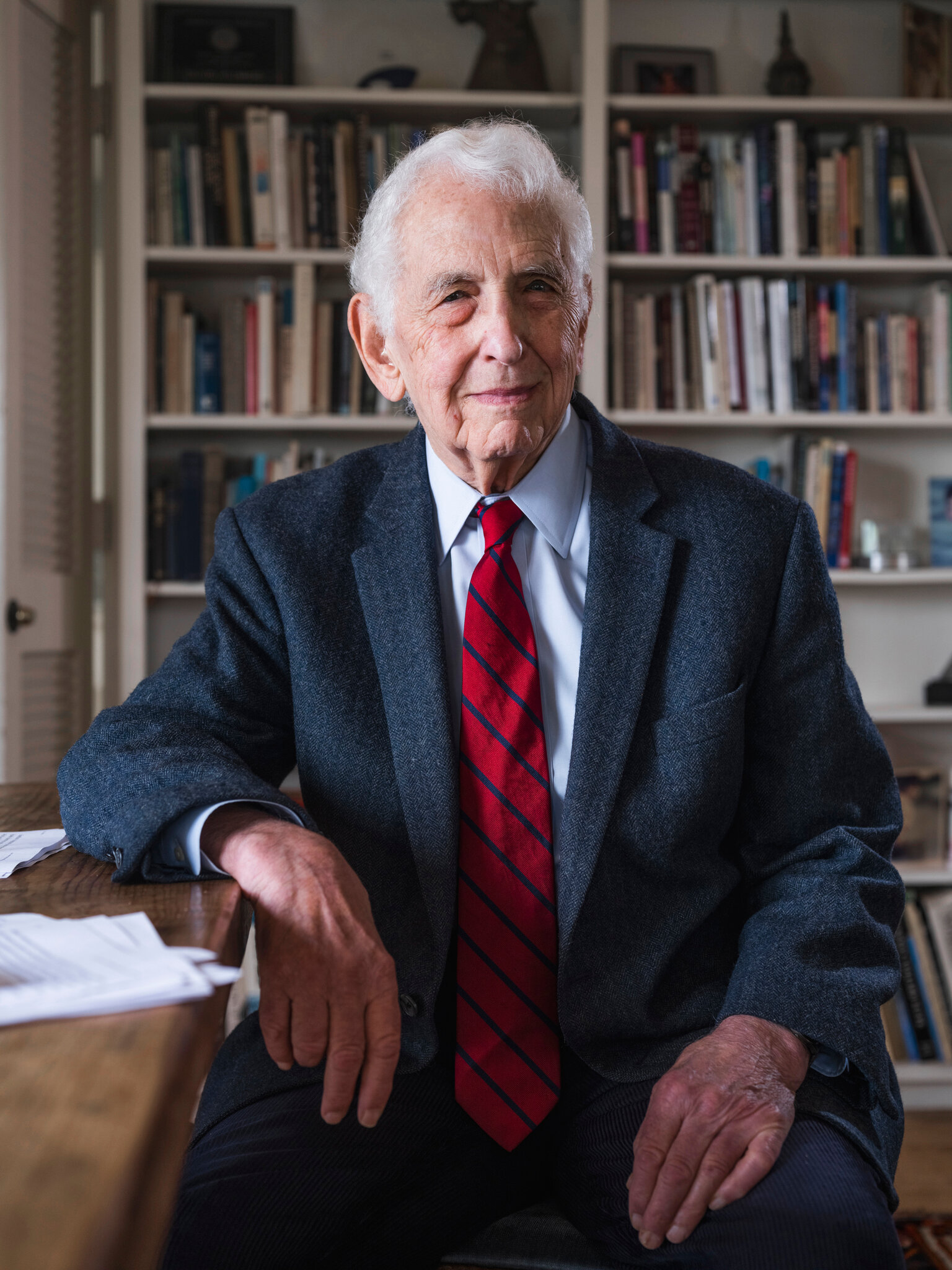
Today, we celebrate the life of Pentagon Papers whistleblower Daniel Ellsberg (1931-2023), who transitioned to the great cloud of witnesses on Friday. This is a letter he wrote to friends and supporters three months ago, reposted from Common Dreams (March 2, 2023).

Dear friends and supporters,

I have difficult news to impart. On February 17, without much warning, I was diagnosed with inoperable pancreatic cancer on the basis of a CT scan and an MRI. (As is usual with pancreatic cancer–which has no early symptoms–it was found while looking for something else, relatively minor). I’m sorry to report to you that my doctors have given me three to six months to live. Of course, they emphasize that everyone’s case is individual; it might be more, or less.

I have chosen not to do chemotherapy (which offers no promise) and I have assurance of great hospice care when needed. Please know: right now, I am not in any physical pain, and in fact, after my hip replacement surgery in late 2021, I feel better physically than I have in years! Moreover, my cardiologist has given me license to abandon my salt-free diet of the last six years. This has improved my quality of life dramatically: the pleasure of eating my former favorite foods! And my energy level is high. Since my diagnosis, I’ve done several interviews and webinars on Ukraine, nuclear weapons, and first amendment issues, and I have two more scheduled this week.

Continue reading “Under a Deadline”

An Expansive, Infinite Array of Expressions

By Kateri Boucher, a homily for a Pride Celebration at St. Peter’s Episcopal Church (Detroit, MI) on June 4, 2023. Click here to watch the video version (homily starts around minute twenty-six).

It is a powerful thing to be celebrating this holiday in this space, with this community. I don’t take it for granted that we can gather here today in this way. It was only in 1976, 46 years ago, that the Episcopal church officially became open and affirming. As we know, there are many other streams of the Christian tradition that have done so even more recently, or still haven’t yet. 

There are many people who believe that the phrase “queer Christian” is an outrage or an oxymoron. And I can feel it coming from both sides… I’ve joked with my friends that coming out as queer was not a very big deal for me, which I’m very grateful for, but coming out as Christian to my queer friends has caused a bit of a stir. People are like, “Oh my gosh… Are you okay? Can we support you?” Just yesterday I was at a brunch with a bunch of young queer folks and I told someone I work for a church. It was kind of uncomfortable. They were kind of like, “Why?” 

Continue reading “An Expansive, Infinite Array of Expressions”

A God Who Confuses

By Tommy Airey

And at this sound the crowd gathered and was confused… – Acts 2:6a

Last weekend, I preached a Pentecost sermon at a church down in Kentucky. The text brought me back to my roots. When I was ten, I transferred to the Christian school where my mom got hired to teach 5th grade. Every single morning, we pledged allegiance to the American flag, to the Christian flag and to the bible. We would pray together. We would read something from the scriptures – and then my teacher, Mr. Cavallaro, who I absolutely loved, would proclaim, “God said it. I believe it. And that settles it.” His triumphalism is all it took to hook me.

I was ten – and I was being scripted into Christian Supremacy. My pastors and teachers propagated a world that was black and white, saved and damned. They taught me that we get to heaven by believing what God said, but also that some people are just better than others. Some people earned their wealth, their power, their sun-splashed perch overlooking the Pacific. Other people made bad decisions. They live in ghettos, reservations, barrios, slums, cells and socialist countries because they swerved from God’s Holy Word. Game Over.  

Continue reading “A God Who Confuses”

Christian Nationalism: An Existential Agreement with God

By Rev. Graylan Scott Hagler

Newt Gingrich broke onto the national political scene with his “Contract with America.” It was the offering of an agreement, that if the public allowed the Gingrich coalition to lead, that coalition would then deliver on a number of points in the contract. Whether you agreed with the framing of this contract or not it conjured the image of the covenant between God and the people in the wilderness established through Moses on Mt. Sinai. There is an “If” and “then” equation to a covenant. One act is related to the other. One thing is related to the next. One thing is required in order to get to the other thing. A covenant is where at least two parties enter into an agreement.

So-called Christian Nationalism addresses the concept of a covenant, or a contract. In this view, America is the promise of God, and blessings will unfold, fulfillment will be realized, and the country will be the “City on the Hill” as long as its people uphold their part of the bargain. If the nation fails in upholding its agreement the blessings will be squandered, the country will be in decay, and the hopes found will become lost. Hence, we hear the assertions that America was founded on Christian values and principles, and its laws should reflect that. Christian norms should be upheld lest the country fall into decadence and decay. All of the assumptions, of course, are built on concepts of a conquering god, patriarchy and white supremacy. The cultural wars are attempts to uphold these sense of values, and keep the country from falling into perceived decay and obsolesce. Therefore, other religions, other peoples, like immigrants of darker hue, defy the dominant idea of “American”. Blended sexual and family structures, bended genders, and expanding expressions of sexuality suggest a crisis and the need to assert and re-assert the perceived so-called Christian American agreement into the covenant or the blessings and the nation will eventually be lost. This is where the tension emerges. 

Continue reading “Christian Nationalism: An Existential Agreement with God”

“As a Mighty Wind”: Or, Which Pentecost?

By Jim Perkinson, a homily for St. Peter’s Episcopal Church, Detroit, MI (May 28, 2023)

So, Pentecost!  We will begin deep in the weeds.  Literally.  “Pente-cost”—in Greek, the 50th day!  But 50th day after what?  After Passover.  But why 50?  Well, 49 + 1.  Huh?  We scratch our heads.  But of course, the early Christians, though working in the language of the Greeks—pentekoste—are translating practice and memory of the Hebrews.  So hard this biblical faithfulness business—plunges us straight into serious cross-cultural labors and mistakes.  Such a big history of mistakes!  More on that later.  But the Hebrews! They didn’t call it Pentecost, but Shavuot, the Feast of Weeks.  7 weeks after Passover, but with the counting starting on the 2nd day of Passover—so 49 + 1. 

Ok—but then, what anchors Passover, when does it begin?  Ah, now we’re getting down to it, yes, getting down, “gettin’ down,” heavy on the down beat!  But what is down?  What direction?  There—pointing to your feet?  Yes, but what is down there?  A tile floor, you say?  And under that?  Wood floor joists?  And under that?  Pipes?  Yes, yes, and a basement and then cement.  And, and . . . But finally, even in the city, we get to it.  Earth.  What all of life stands on and grows in.  The big assumption.  The Big Momma we take for granted again and again! 

Continue reading ““As a Mighty Wind”: Or, Which Pentecost?”

An Act of Defiant Hope

Another subversive bible study from Walter Brueggemann. Re-posted from churchanew.org.

This is an unabashed commendation of a book. The book by Franck Prevot is entitled Wangari Maathai: The Woman Who Planted Millions of Trees (2015). This children’s book, with its winsome art work, tells the story of Wangari Maathai, a Kenyan woman who learned from her mother that “a tree is worth more than its wood.” As she grew up she became aware that her people were deprived of much of their land for agriculture. She saw the devastation of the forests as her country gained independence from Britain. In the face of all the deforestation, her mother taught her:

A tree is a treasure that provides shade, fruit, pure air, and nesting places for birds, and that pulses with the vitality of life. Trees are hideouts for insects and provide inspiration for poets. A tree is a little bit of the future (21).

In response to the destruction of deforestation that she could observe, Maathai organized the Green Belt Movement to encourage villagers to plant many, many trees. She encountered much opposition from business interests and from the authoritarian government of Daniel arap Moi. She was imprisoned by the government for her oppositional stance, but slowly she is able to gain public support for her democratic vision of society. Her great courage led not only to many trees, but to the flourishing of democracy in her home country of Kenya. It is clear that her story is one that our children and grandchildren urgently need to hear, a story of courage in devotion to the wellbeing of the earth and its creaturely population. Click here to read the rest.