From the Twitter account of Dr. Cornel West.


From the Twitter account of Dr. Cornel West.

By Tommy Airey
Last week, in Southern California, we got to spend an entire afternoon at the beach with our nephews. We were on boogie boards for most of it. The next morning, Riley and his brother Mason played a couple games of UNO with their Aunt Linds while I made them pancakes. Riley won both times. When we were driving them back to their dad’s place, Riley pulled out an UNO reverse card from his pocket.
Riley said he carries the card with him because it possesses the power to reverse any of the bad stuff that might happen in real life. He said there’s a YouTube clip that shows a guy getting pulled over by a cop. He flashes his UNO reverse card and the cop lets him go without a ticket or jail time. Riley said the blue UNO reverse cards are the most powerful – then the red, the green and the yellow. In that order. He said that all the other fourth-graders at his school last year respected the power of the UNO reverse card too.
Continue reading “The Reverse Card”
From Judith Butler, who attended Occupy Wall Street in 2011 and was asked to clarify what demands were being made.
People have asked, so what are the demands? What are the demands all of these people are making? Either they say there are no demands and that leaves your critics confused, or they say that the demands for social equality and economic justice are impossible demands. And the impossible demands, they say, are just not practical. If hope is an impossible demand, then we demand the impossible – that the right to shelter, food and employment are impossible demands, then we demand the impossible. If it is impossible to demand that those who profit from the recession redistribute their wealth and cease their greed, then yes, we demand the impossible.

From Rebecca Solnit, re-posted from social media (July 7, 2023)
I collect quotes, starting a new document every year I paste them into as I encounter them. The collections go back several years. Here’s a few from 2023’s album.
“We are all here to serve each other. At some point we have to understand that we do not need to carry a story that is unbearable. We can observe the story, which is mental; feel the story, which is physical; let the story go, which is emotional; then forgive the story, which is spiritual, after which we use the materials of it to build a house of knowledge.” – Joy Harjo
“American racism has many moving parts, and has had enough centuries in which to evolve an impressive camouflage. It can hoard its malice in great stillness for a long time, all the while pretending to look the other way. Like misogyny, it is atmospheric. You don’t see it at first. But understanding comes.” -Teju Cole
“Being queer saved my life. Often we see queerness as deprivation. But when I look at my life, I saw that queerness demanded an alternative innovation from me. I had to make alternative routes, it made me curious, it made me ask this is not enough for me.” – Ocean Vuong
Continue reading “Quotes”by anna markowitz
We went to prove we are not something, which is to say
We were not all there to do the same thing, which is to say
We had our reasons.
Where were you?
Fussing with your collar.
Quaking with a new knowledge—
We are nothing like God, we’ve never met Her.
That apple was just a dizzying tumble
Into our own dark hollow. We’ll only diminish
That which we form in our image and likeness.
Our slightness.
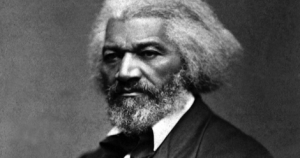 A timely message from Frederick Douglass (1852).
What, to the American slave, is your Fourth of July?
I answer: a day that reveals to him, more than all other days in the year, the gross injustice and cruelty to which he is the constant victim. To him, your celebration is a sham; your boasted liberty, an unholy license; your national greatness, swelling vanity; your sounds of rejoicing are empty and heartless; your denunciation of tyrants, brass-fronted impudence; your shouts of liberty and equality, hollow mockery; your prayers and hymns, your sermons and thanksgivings, with all your religious parade and solemnity, mere bombast, fraud, deception, impiety, and hypocrisy-a thin veil to cover up crimes which would disgrace a nation of savages.

An excerpt from Chris Hedges’ Obama-era Truth Dig article “A Time for ‘Sublime Madness.'”
The theologian James H. Cone captures this in his masterpiece “The Cross and the Lynching Tree.” Cone says that for oppressed blacks the cross was a “paradoxical religious symbol because it inverts the world’s value system with the news that hope comes by way of defeat, that suffering and death do not have the last word, that the last shall be first and the first last.” Cone continues:
That God could “make a way out of no way” in Jesus’ cross was truly absurd to the intellect, yet profoundly real in the souls of black folk. Enslaved blacks who first heard the gospel message seized on the power of the cross. Christ crucified manifested God’s loving and liberating presence in the contradictions of black life — that transcendent presence in the lives of black Christians that empowered them to believe that ultimately, in God’s eschatological future, they would not be defeated by the “troubles of this world,” no matter how great and painful their suffering. Believing this paradox, this absurd claim of faith, was only possible in humility and repentance. There was no place for the proud and the mighty, for people who think that God called them to rule over others. The cross was God’s critique of power — white power — with powerless love, snatching victory out of defeat.
Continue reading “Sublime Madness”
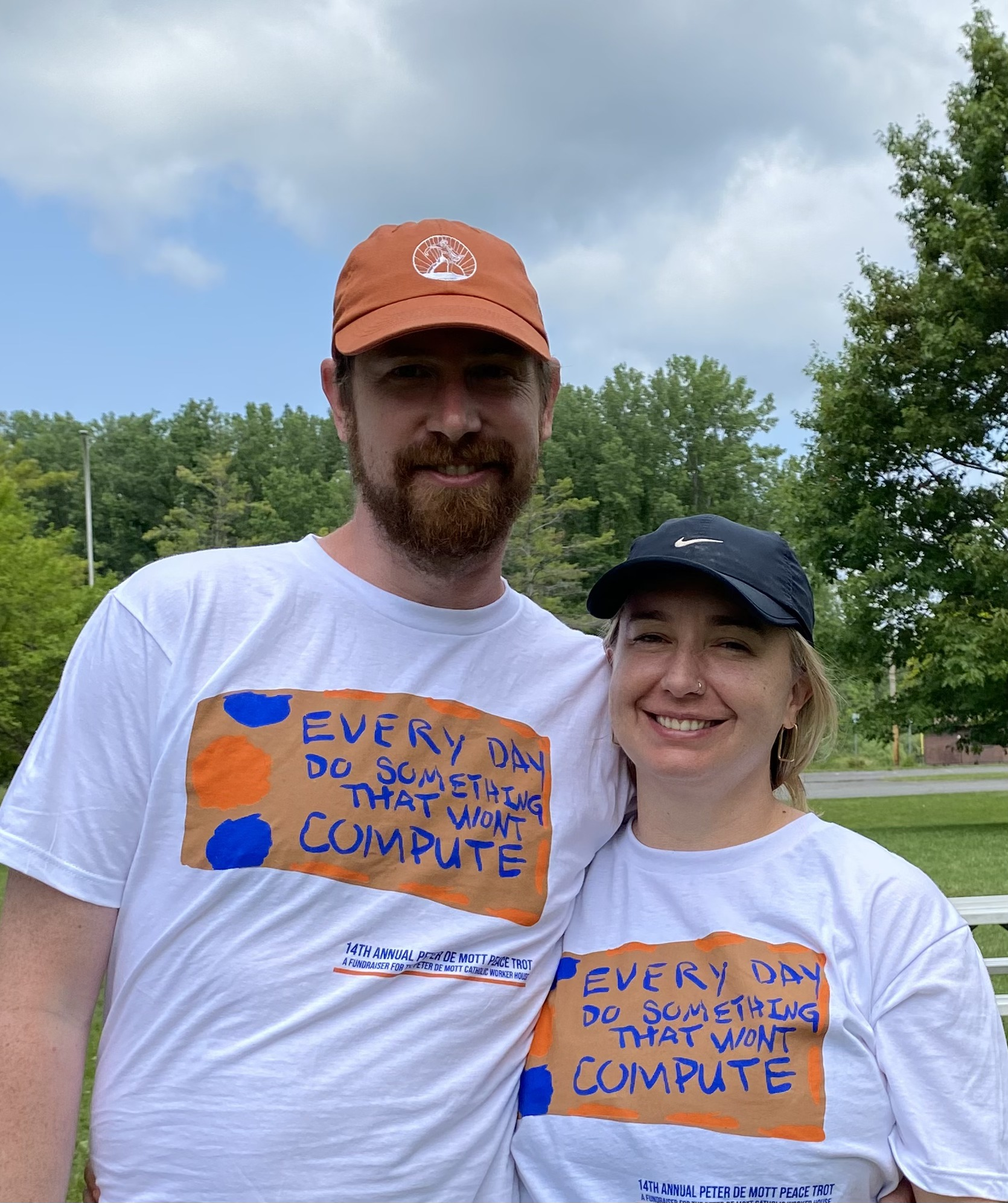
Plenty of radical runners participated in the 14th Annual Pete De Mott Peace Trot last weekend, on Father’s Day, in Ithaca, New York. The race is named after the veteran Catholic peace activist who spent time in federal prison for numerous anti-war protests. This is the pre-race pump up speech from Pete’s daughter Cait De Mott Grady (above, with Mike Williams of Three Lyons Creative).
My mom asked me to say a few words about this year’s Peace Trot t-shirt. The shirt is based on a ceramic tile I made this spring with words from a Wendell Berry poem called Manifesto: The Mad Farmer Liberation Front. The full poem is on the back of this year’s t-shirt, and I encourage you to give it a read.
For those who knew my dad, you likely heard him recite the Mad Farmer poem. This poem was a mantra for my dad, a poem he knew by heart, a poem he looked to as a guide, and a poem whose wisdom became a part of everyday life.
The first stanza of this poem calls out the dominant culture of the United States – a culture that Dr. King powerfully named for us as a culture of rampant materialism, militarism, and racism.
Continue reading “Do Something That Won’t Compute”
An excerpt from a recent Democracy Now interview with Jonathan Eig, the author of the new book King: A Life.
I think it’s really important for us to acknowledge that our heroes have flaws, and if we expect our heroes to be perfect, nobody will ever rise to the occasion. Nobody will even try.
And King was deeply flawed. As you mentioned, he attempted suicide twice as a teenager, jumping from a second-story window of his home when he was upset about, first, an injury suffered by his grandmother and then, later, by her death. And when he won the Nobel Peace Prize, he was hospitalized at the time for what he called anxiety, but for what Coretta described as depression. He was hospitalized numerous times throughout his life because the pressure had just gotten to him so badly.
Continue reading “To Maintain the Existing Power Structure”
On Juneteenth, we open up Toni Morrison’s Beloved. This passage comes right after Indigenous people, who refused to move to the reservation, cut off the shackles of Paul D, a man who escapes slavery and stays with them in the Southern woods.
“Paul D finally woke up and, admitting his ignorance, asked how he might get North. Free North. Magical North. Welcoming, benevolent North. The Cherokee smiled and looked around. The flood rains of a month ago had turned everything to steam and blossoms.
‘That way,’ he said, pointing. ‘Follow the tree flowers,’ he said, ‘Only the tree flowers. As they go, you go. You will be where you want to be when they are gone.’
So he raced from dogwood to blossoming peach. When they thinned out he headed for the cherry blossoms, then magnolia, chinaberry, pecan, walnut and prickly pear. At last he reached a field of apple trees whose flowers were just becoming tiny knots of fruit. Spring sauntered north, but he had to run like hell to keep it as his traveling companion.”
 Radical Discipleship